Dialysate flow rate when pulling through a jug

Click For Summary
SUMMARY

The discussion centers on the physics of fluid dynamics, specifically comparing the fill rates of two tubes with different diameters (0.5 inches and 0.25 inches) under a constant flow rate from a dialysate jug open to atmospheric pressure. The consensus is that the tube with the smaller diameter (0.25 inches) will fill up faster due to its lower volume, despite both tubes being the same length (12 inches). This conclusion aligns with the principles of fluid dynamics, where flow rate remains constant, and the volume of fluid in the tube dictates fill time.

PREREQUISITES
  • Understanding of fluid dynamics principles
  • Knowledge of flow rate and volume calculations
  • Familiarity with siphon mechanics
  • Basic physics concepts related to pressure and capillary action
NEXT STEPS
  • Research the Bernoulli's principle in fluid dynamics
  • Study the effects of tube diameter on flow rate
  • Learn about capillary action and its implications in fluid movement
  • Explore practical applications of siphoning techniques in various fields
USEFUL FOR

This discussion is beneficial for physics students, engineers, and anyone interested in fluid dynamics, particularly in applications involving siphoning and tube flow rates.

LoveScience
Messages
1
Reaction score
0
TL;DR
Looking for an answer and explanation (with formula) to understand the physics concept behind what tube would fill faster which same speed of pump (drawing up not pushing fluid through
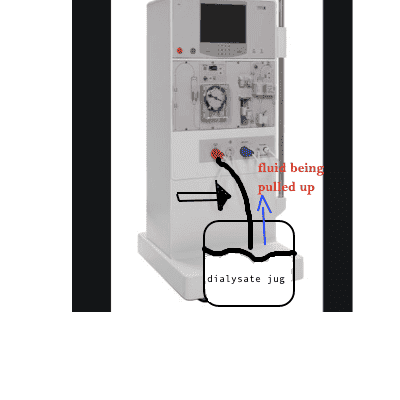
Friendly argument at work (both non physics majors) with what tube would fill up faster with a flow rate (siphon like) that remains the same through two different diameter tubes. The dialysate jug is open to atm pressure. One tube is about .5 inches in diameter and the other is .25. We were agruing which one would fill up faster with dialysate through the tubes that are similar in length. The tube is drawn in black and is only approx 12 inches in length
dialysate.png
 
Biology news on Phys.org
LoveScience said:
Summary: Looking for an answer and explanation (with formula) to understand the physics concept behind what tube would fill faster which same speed of pump (drawing up not pushing fluid through

Friendly argument at work (both non physics majors) with what tube would fill up faster with a flow rate (siphon like) that remains the same through two different diameter tubes. The dialysate jug is open to atm pressure. One tube is about .5 inches in diameter and the other is .25. We were agruing which one would fill up faster with dialysate through the tubes that are similar in length. The tube is drawn in black and is only approx 12 inches in lengthView attachment 247240
None of the medical guys have jumped in yet. I would have thought capillary action would play a part
https://en.wikipedia.org/wiki/Capillary_action
 
  • Like
Likes   Reactions: LoveScience
LoveScience said:
Summary: Looking for an answer and explanation (with formula) to understand the physics concept behind what tube would fill faster which same speed of pump (drawing up not pushing fluid through

what tube would fill up faster with a flow rate (siphon like) that remains the same through two different diameter tubes
If that statement is true, I don't see the argument being about anything .
Might as well argue if it takes longer to fill a gallon jug or a pint.

With the same flow rate in both tubes the ones with less volume fills up its 12 inch length first.
 
  • Like
Likes   Reactions: LoveScience

Similar threads

  • · Replies 9 ·
Replies
9
Views
2K
  • · Replies 10 ·
Replies
10
Views
4K
  • · Replies 4 ·
Replies
4
Views
2K
Replies
13
Views
3K
  • · Replies 21 ·
Replies
21
Views
1K
  • · Replies 9 ·
Replies
9
Views
4K
Replies
0
Views
2K
  • · Replies 4 ·
Replies
4
Views
2K
Replies
4
Views
2K
  • · Replies 48 ·
2
Replies
48
Views
6K