Did I count this current in a circuit correctly?

Click For Summary
SUMMARY

The discussion centers on calculating the current I3 in a circuit with resistors R1 = 10 ohm, R2 = 20 ohm, and R3 = 40 ohm, where the current I1 is determined to be -1/7 A. The participants confirm the calculations and identify a transcription error in the equations used, suggesting that the first term should be 10I1 instead of 20I1. The relationship between the currents is clarified, with I3 being negative due to its dependency on I1, which is also negative. The discussion highlights the importance of understanding circuit analysis techniques, including Thevenin and Norton transformations.

PREREQUISITES
  • Understanding of Ohm's Law
  • Familiarity with Kirchhoff's Laws
  • Basic knowledge of circuit analysis
  • Ability to manipulate algebraic equations
NEXT STEPS
  • Study Thevenin and Norton equivalent circuit transformations
  • Learn advanced circuit analysis techniques
  • Practice solving complex circuit problems without calculators
  • Explore the implications of negative current values in circuit analysis
USEFUL FOR

Electrical engineering students, circuit designers, and anyone involved in circuit analysis and problem-solving in electronics.

Duc Anh Le
Messages
3
Reaction score
0
This i a test question and we are not allowed to use a calculator, so I was wondering whether I did everything correctly, since the I1 = - 1/7. I am supposed to find out I3, but stopped at I1, since the result is a bit tricky.

1. Homework Statement

R1 = 10 ohm, R2 = 20 ohm, R3 = 40 ohm
I3 = ?

Homework Equations


I3 = I2 + I1
V1 = I1 * R1 + I3 * R3
V2 = R2 * I2 + I3 * R3

The Attempt at a Solution


10 = 20I1 + 40 I2 + 40I1
20 = 20I2 + 40I1 + 40I2
-10 = 70I1
I1 = -1/7
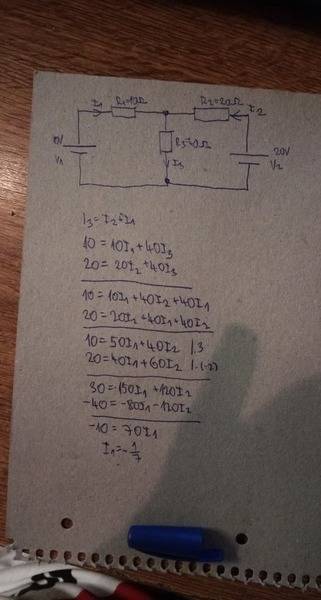
5ly1os8imkw11.jpg
[/B]
 

Attachments

  • 5ly1os8imkw11.jpg
    5ly1os8imkw11.jpg
    24 KB · Views: 302
Physics news on Phys.org
The circuit in the image is very difficult to read the component labels. Please post a closeup or draw and photograph a larger version.
Duc Anh Le said:
3. The Attempt at a Solution
10 = 20I1 + 40 I2 + 40I1
20 = 20I2 + 40I1 + 40I2
-10 = 70I1
I1 = -1/7
From what I can tell, the first term on the RHS should be 10I1 rather than 20I1. This is likely a transcription typo since your value for the current I1 looks good to me.
 
gneill said:
The circuit in the image is very difficult to read the component labels. Please post a closeup or draw and photograph a larger version.

From what I can tell, the first term on the RHS should be 10I1 rather than 20I1. This is likely a transcription typo since your value for the current I1 looks good to me.
6uVlA3E.png

Here's a better picture
 

Attachments

  • 6uVlA3E.png
    6uVlA3E.png
    6 KB · Views: 332
It is indeed much better! Thanks.
 
Duc Anh Le said:
This i a test question and we are not allowed to use a calculator, so I was wondering whether I did everything correctly, since the I1 = - 1/7. I am supposed to find out I3, but stopped at I1, since the result is a bit tricky.
...

I will show that ##I_1## is negative:

$$50 I_1 + 40 I_2 = 10;\ 40 I_1 + 60 I_2 = 20 \\
5 I_1 + 4 I_2 = 1; 2 I_1 + 3 I_2 = 1\\
3 I_1 + I_2 = 0$$
Note that ##I_1## and ##I_2## have different signs and that ##I_3 = -2 I_1##, so ##I_3## and ##I_1## have different signs. And since ##I_2## is clearly positive, we know all the signs and ##I_1## is indeed negative.
 
You are on the right track, good work so far!
Do you know about Thevinin & Norton equivalent circuit transformations yet? I think they make problems like this much easier to do.
 
DaveE said:
You are on the right track, good work so far!
Do you know about Thevinin & Norton equivalent circuit transformations yet? I think they make problems like this much easier to do.
Alright, thanks for the verification. So far we've only been taught ohm's and kirchhoff's laws.
 

Similar threads

Replies
4
Views
1K
  • · Replies 9 ·
Replies
9
Views
4K
Replies
22
Views
4K
Replies
10
Views
3K
  • · Replies 1 ·
Replies
1
Views
1K
  • · Replies 12 ·
Replies
12
Views
2K
  • · Replies 9 ·
Replies
9
Views
2K
  • · Replies 5 ·
Replies
5
Views
4K
Replies
16
Views
2K
  • · Replies 18 ·
Replies
18
Views
3K