Difference between two formulas of resistance

Click For Summary

Homework Help Overview

The discussion revolves around two formulas for resistance: R = ρl/A and V = IR. Participants explore the differences between these formulas and their applications, particularly in the context of calculating current flow when connected to a power source.

Discussion Character

  • Exploratory, Conceptual clarification, Assumption checking

Approaches and Questions Raised

  • Participants discuss the definitions of variables in the formulas and when to use each formula. Questions arise about the implications of using these formulas under different conditions, such as the temperature of a filament in a light bulb.

Discussion Status

The discussion is active, with participants providing insights into the applications of the formulas and questioning assumptions about temperature effects on resistance. Some guidance has been offered regarding the need to consider both formulas for accurate calculations, especially when temperature changes affect resistivity.

Contextual Notes

Participants note that the resistivity values used in calculations are typically measured at room temperature, which may not apply when the filament is heated. This raises questions about the accuracy of using the formulas under varying conditions.

Coco12
Messages
272
Reaction score
0
There are two formulas for resistance
R=pl/A
V=IR

What is the difference between them?
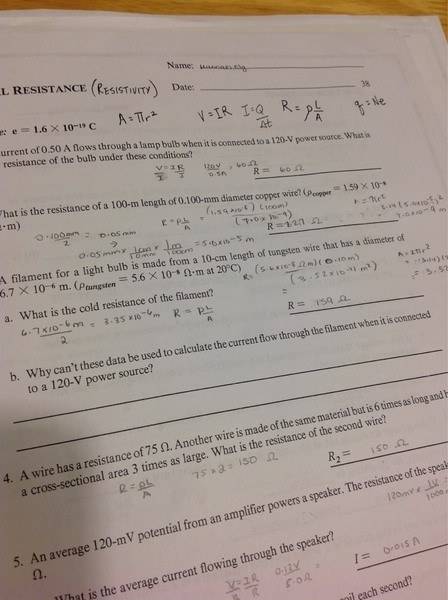
ImageUploadedByPhysics Forums1387319130.100854.jpg


Question b on the sheet. Why can you not use that data to calculate current flow when connected to a power source. I suspect it has something to Do with the difference between these two formulas.
 
Last edited by a moderator:
Physics news on Phys.org
Coco12 said:
There are two formulas for resistance
R=pl/A
V=IR

What is the difference between them?

View attachment 64890

Question b on the sheet. Why can you not use that data to calculate current flow when connected to a power source. I suspect it has something to Do with the difference between these two formulas.

What do the variables in those equations stand for?

When would you use the first equation to calculate resistance?

When would you use the second equation?
 
Last edited:
berkeman said:
What do the variables in those equations stand for?
When would you use the first equation to calculate resistance?
When would you use the second equation?
The first formula is just talking about the resistance of a wire the second is when there's a current flowing?
 
Coco12 said:
The first formula is just talking about the resistance of a wire the second is when there's a current flowing?

You didn't answer my first question. Defining the variables will help you to determine when you use each formula...
 
Ok I understand it now . I know the first equation has is resistivity * length divided by area
The second is volt = current * resistance
Therefore you use the second equation when there is a current
 
Last edited by a moderator:
Coco12 said:
Ok I understand it now . I know the first equation has is resistivity * length divided by area
The second is volt = current * resistance
Therefore you use the second equation when there is a current

Yeah, the 2nd equation is Ohm's Law, and you use it when you know two of the 3 variables. The first equation is for calculating the resistance of some known geometry or volume (like a wire of known thickness, etc.).
 
Last edited:
Coco12 said:
Question b on the sheet. Why can you not use that data to calculate current flow when connected to a power source. I suspect it has something to Do with the difference between these two formulas.

No, it doesn't have to do with the "difference". They can actually be applied for the same problem. You can use one to calculate the resistance of the wire from the parameters of the wire and then use the second to calculate current when some given voltage is applied.

The key here is the mention of "cold filament".
How is the filament of a light bulb when powered at the nominal voltage?
 
Last edited by a moderator:
The first formula relates the physical properties of the material the resistor is made of to it's electrical resistance. It's mainly used when designing a resistor.

The second is Ohms law. It applies to any resistor (that approximates the ideal) regardless of the material it's made of. It's mainly used when designing a circuit containing a resistor.
 
PS: There are other equations involving resistance. Nothing particularly special about those two.
For example

The power dissipated in a resistor is given by..

Power = I2R
where I = current.
 
  • #10
nasu said:
No, it doesn't have to do with the "difference". They can actually be applied for the same problem. You can use one to calculate the resistance of the wire from the parameters of the wire and then use the second to calculate current when some given voltage is applied.

The key here is the mention of "cold filament".
How is the filament of a light bulb when powered at the nominal voltage?

cold filament means...? How does that relate?
 
  • #11
Is the filament of a functioning bulb cold?
What happen with the resistance of a metallic wire when the temperature changes?
Did you learn about temperature dependence of rezistivity?
 
  • #12
Oh yes. When the temperature increases the resistance increases
 
  • #13
So if is a cold filament then you cannot use the other formula?
 
Last edited by a moderator:
  • #14
No, it's nothing about formula. They say that you cannot use these data. No mention about formula.
In order to calculate the current you will need both formulas. You use one of them to calculate the resistance of the filament, by using the dimensions and the resistivity. And then use Ohm's law to calculate the current, given the resistance found in step 1 and the voltage of 120 V.

BUT, these values are measured at room temperature.
When connected to 120 V, the filament heats up to about 2000 K.
At this temperature the rezistivity (as well as the dimensions) will have significantly different values.
So you will need those new values (as well as BOTH formulas) to calculate the current for hot filament.
 
  • #15
Coco12 said:
So if is a cold filament then you cannot use the other formula?

Coco -- please check your PMs about your use of text speak (which I have been correcting)
 
  • #16
Re my post above...

CWatters said:
The first formula relates the physical properties of the material the resistor is made of to it's electrical resistance. It's mainly used when designing a resistor.

The second is Ohms law. It applies to any resistor (that approximates the ideal) regardless of the material it's made of. It's mainly used when designing a circuit containing a resistor.

In the first formula the resistivity of the material is measured at one particular temperature, typically room temperature. What happens when power is applied?
 

Similar threads

  • · Replies 7 ·
Replies
7
Views
2K
  • · Replies 8 ·
Replies
8
Views
2K
  • · Replies 3 ·
Replies
3
Views
2K
Replies
7
Views
1K
Replies
5
Views
2K
  • · Replies 4 ·
Replies
4
Views
2K
  • · Replies 9 ·
Replies
9
Views
2K
Replies
2
Views
1K
  • · Replies 1 ·
Replies
1
Views
841
  • · Replies 2 ·
Replies
2
Views
759