Different Sign Conventions used with Kirchhoff's Law?

Click For Summary
SUMMARY

The discussion centers on the different sign conventions used in Kirchhoff's Law, specifically the standard and flipped conventions. The standard convention states that the voltage across a resistor is negative when the loop direction aligns with the current direction, while the flipped convention states the opposite. Both conventions yield the same solutions in practice, provided consistency is maintained throughout the problem-solving process. The key takeaway is that there is no definitive "right" or "wrong" convention; the critical factor is to adhere to one convention consistently to avoid errors.

PREREQUISITES
  • Understanding of Kirchhoff's Law
  • Familiarity with electrical circuit components (resistors, batteries)
  • Basic algebra for solving circuit equations
  • Knowledge of sign conventions in physics
NEXT STEPS
  • Study the implications of different sign conventions in circuit analysis
  • Learn how to apply Kirchhoff's Law in complex circuits
  • Explore the relationship between Kirchhoff's Law and Faraday's Law of Electromagnetic Induction
  • Review problem-solving techniques for circuit analysis using textbooks such as Giancoli's Physics
USEFUL FOR

Students studying electrical engineering, physics educators, and anyone involved in circuit analysis who needs to understand the implications of sign conventions in Kirchhoff's Law.

bagasme
Messages
79
Reaction score
9
TL;DR
Standard or Flipped One?
Hello,

As far as I know, the standard sign convention for Kirchhoff's law are:
  • For resistor: the potential difference (voltage) is negative if the chosen loop direction is the same as chosen current direction through the resistor, positive otherwise.
  • For battery: the voltage is positive if the chosen loop direction is from negative toward positive terminal, positive otherwise.
But in high school, I'd been taught different, flipped convention:
  • For resistor: the voltage is positive if the chosen loop direction is the same as chosen current direction through the resistor, negative otherwise.
  • For battery: the voltage is negative if the chosen loop direction is from negative toward positive terminal, positive otherwise.
To demonstrate effects of different sign conventions above, I attached sample problem
from this homework forum. The problem image:
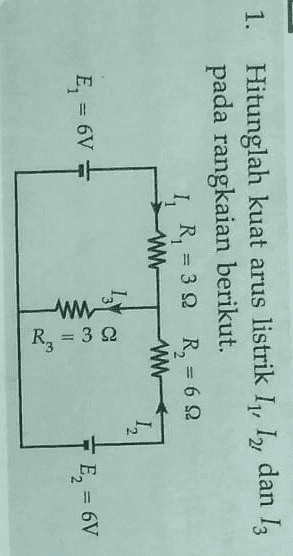
1577530973391.png


By standard sign convention, the equations are:

$$\begin{align}
I_1 + I_2 &= I_3 \nonumber \\
6 - 3I_1 - 3I_3 &=0 \nonumber \\
6 - 6I_2 - 3I_3 &=0 \nonumber
\end{align}$$

Solving the equation, we have ##I_1 = \frac 4 5 A, I_2 = \frac 2 5 A, I_3 = \frac 6 5 A##.

By flipped sign convention, the equations are:
$$\begin{align}
I_1 + I_2 &= I_3 \nonumber \\
-6 + 3I_1 - 3I_3 &= 0 \nonumber \\
-6 + 6I_2 + 3I_3 &= 0 \nonumber
\end{align}$$

Solving the equation, we have same solutions as above with standard convention.

I have questions:
  1. In what cases both sign conventions produce same solutions, and in what cases different solutions are produced?
  2. Which convention is right, the standard or the flipped one?
Regards, Bagas
 
Physics news on Phys.org
bagasme said:
Summary:: Standard or Flipped One?

Which convention is right, the standard or the flipped one?
They are conventions. There is no right or wrong involved. Either works, you just need to be consistent. The only time you will have a problem is if you switch conventions in the middle of a problem.
 
  • Like
Likes   Reactions: vanhees71 and berkeman
Dale said:
They are conventions. There is no right or wrong involved. Either works, you just need to be consistent. The only time you will have a problem is if you switch conventions in the middle of a problem.

Hmm...

Are there cases when those conventions produce different results, assuming that there aren't any calculation errors?

This could happen because in my high school, when doing Kirchhoff's Law problems, most of my answers are invalidated only for using standard convention one instead of the flipped one.
 
bagasme said:
Are there cases when those conventions produce different results, assuming that there aren't any calculation errors?
No
bagasme said:
This could happen because in my high school, when doing Kirchhoff's Law problems, most of my answers are invalidated only for using standard convention one instead of the flipped one.
Then you were consistently making some other mistake also.
 
bagasme said:
This could happen because in my high school, when doing Kirchhoff's Law problems, most of my answers are invalidated only for using standard convention one instead of the flipped one.
If you are having trouble in school, the problem may be that your working is "wrong" because the sign convention is opposite, rather than because your answers are wrong. Just use their convention - getting used to odd sign conventions is an important part of the "school of hard knocks" bit of physics education.

However, I note that the equations you present in your OP appear to have a sign error. Are you sure you aren't just making mistakes?
 
Ibix said:
If you are having trouble in school, the problem may be that your working is "wrong" because the sign convention is opposite, rather than because your answers are wrong. Just use their convention - getting used to odd sign conventions is an important part of the "school of hard knocks" bit of physics education.

However, I note that the equations you present in your OP appear to have a sign error. Are you sure you aren't just making mistakes?

But @Dale said that either conventions works as long as consistent, and always double-check my solution and compare it to other one.

Personally, I'd rather follow conventions on my textbook (I use book by Giancoli) than on book supplied by the high school.

Sorry for the typo/sign error from second equation from "flipped" convention one. What I mean is ##-6 + 3I_1 + 3I_3 = 0 ##.
 
bagasme said:
But @Dale said that either conventions works as long as consistent, and always double-check my solution and compare it to other one.
I agree with Dale. I'm just suggesting that you may be being marked down for not using your school's chosen convention, right answer or not. In that case switching conventions is the easy solution - and a useful skill, since this is very far from the only sign convention issue in physics.

So I'd suggest talking to whoever marks your work and asking for feedback around a question of this type. See if you can find out if you are being marked down because you aren't using their convention (some marking schemes are very restrictive, for good reasons and bad). Then you can decide if you want to flip convention, persuade them to allow different conventions, or if there's some other issue.
 
  • Like
Likes   Reactions: Dale
Kirchhoff's Law is nothing else than the integral form of Farday's Law. If all parts of the circuit are at rest, it reads
$$\int_{\partial A} \mathrm{d} \vec{r} \cdot \vec{E}=-\frac{1}{c} \mathrm{d}_t \int_A \mathrm{d}^2 \vec{f} \cdot \vec{B}=-\frac{1}{c} \mathrm{d}_t \Phi_{\vec{B},A},$$
where one takes ##\partial A## as a closed path usually going along the wires and circuit elements (resistors, capacitances, inductances, batteries,...) and ##A## is an area with the integration path ##\partial A## its boundary. The signs have to be carefully determined according to the right-hand rule, i.e., given a direction of the line integral along ##\partial A## the direction of the surface-normal vectors ##\mathrm{d}^2 \vec{f}## are determined by the right-hand rule (thumb of the right hand along ##\partial A##, fingers along ##\mathrm{d}^2 \vec{f}##. It's of course completely arbitrary in which direction you let ##\partial A## be oriented. Important is only the correct relative orientation of ##\mathrm{d} \vec{r}## along ##\partial A## and ##\mathrm{d}^2 \vec{f}## along ##A##, which is determined by the right-hand rule as described.
 
  • Like
Likes   Reactions: weirdoguy

Similar threads

  • · Replies 1 ·
Replies
1
Views
2K
  • · Replies 20 ·
Replies
20
Views
3K
  • · Replies 3 ·
Replies
3
Views
2K
  • · Replies 7 ·
Replies
7
Views
2K
Replies
7
Views
1K
  • · Replies 1 ·
Replies
1
Views
2K
  • · Replies 9 ·
Replies
9
Views
12K
  • · Replies 6 ·
Replies
6
Views
3K
  • · Replies 9 ·
Replies
9
Views
4K
  • · Replies 5 ·
Replies
5
Views
5K