Difficult integrals (important für Fourier series)

Click For Summary
SUMMARY

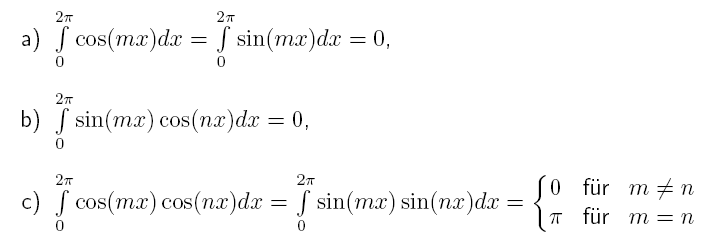
The forum discussion focuses on solving integrals related to Fourier series, specifically the integral of the product of sine and cosine functions. The user initially struggles with the integral \int_{0}^{2\pi}\sin(mx)\cos(nx)dx and attempts partial integration, ultimately realizing that the integral evaluates to zero when both m and n are integers. The discussion highlights the importance of trigonometric identities in simplifying the problem, particularly the angle addition and subtraction identities.

PREREQUISITES
  • Understanding of Fourier series concepts
  • Familiarity with trigonometric identities
  • Knowledge of integral calculus, specifically integration techniques
  • Experience with evaluating definite integrals
NEXT STEPS
  • Study the application of trigonometric identities in integral calculus
  • Learn about the properties of definite integrals involving periodic functions
  • Explore advanced techniques in integration, such as integration by parts
  • Investigate the implications of Fourier series in signal processing
USEFUL FOR

Mathematics students, educators, and anyone involved in signal processing or Fourier analysis will benefit from this discussion, particularly those working with integrals in the context of Fourier series.

keenPenguin
Messages
20
Reaction score
3
Hello,

I couldn't figure out the following problem so far.

Homework Statement


m,n \in \mathbb{N}. Show the following relations:
fourierintegralsmtgi.png


Homework Equations


a) is no problem, but b) and c) seem tricky. I tried partial integration (two times) on b), which gave me a term which contained the original integral. So I sorted the term and got that:

\int_{0}^{2\pi}\sin\left(mx\right)\cos\left(nx\right)dx=\frac{1}{1+\frac{n^{2}}{m^{2}}}\left(\left[-\frac{\cos\left(mx\right)}{m}\cos\left(nx\right)\right]_{0}^{2\pi}+\frac{n}{m}\left[\frac{\sin\left(mx\right)}{m}\sin\left(nx\right)\right]_{0}^{2\pi}\right)

But I can't see why this should be zero.

Any help appreciated!

kP
 
Physics news on Phys.org
Welcome to PF.

I think the trig identities for angle addition and subtraction would be useful here. I mean the ones that involve
sin(a+b), sin(a-b), cos(a+b), and cos(a-b)

EDIT:
I looked more carefully at what you did get. Okay, if m and n are integers, what can you say about cos(mx) and cos(nx) when they are evaluated at 0 vs. when they are evaluated at 2pi?
 
Last edited:
Thank you Redbelly,

you are right, I don't know why I missed that, n and m being integers, b) is quite obviously 0.

Concerning c): Yes, I also thought about those trig identities, but still couldn't figure it out. It's

cos(mx+nx)+sin(mx)sin(nx)=cos(mx)cos(nx), but trying to integrate the LHS, I get into even more trouble.
 
Try

cos(mx+nx) + cos(mx-nx) = ?
 
That's it, thanks a lot. Works fine! :-)

EDIT: BTW, if an admin reads that, please change the thread title from the German "für" to for ;-)
 

Similar threads

Replies
1
Views
1K
  • · Replies 1 ·
Replies
1
Views
2K
  • · Replies 14 ·
Replies
14
Views
2K
  • · Replies 6 ·
Replies
6
Views
2K
  • · Replies 16 ·
Replies
16
Views
2K
  • · Replies 5 ·
Replies
5
Views
2K
  • · Replies 1 ·
Replies
1
Views
2K
  • · Replies 5 ·
Replies
5
Views
2K
  • · Replies 7 ·
Replies
7
Views
2K
  • · Replies 3 ·
Replies
3
Views
2K