Difficult Introductory Electricity Circuit Problem - Capacitors

Join the discussion
Ask a follow-up here, or get your own question answered by working scientists, mathematicians and engineers — people, not an autocomplete.
Real named experts · corrections over time · the nuance an AI answer skips
8 replies · 5K views
Emc2fma
Messages
9
Reaction score
0
Difficult Introductory Electricity Circuit Problem -- Capacitors
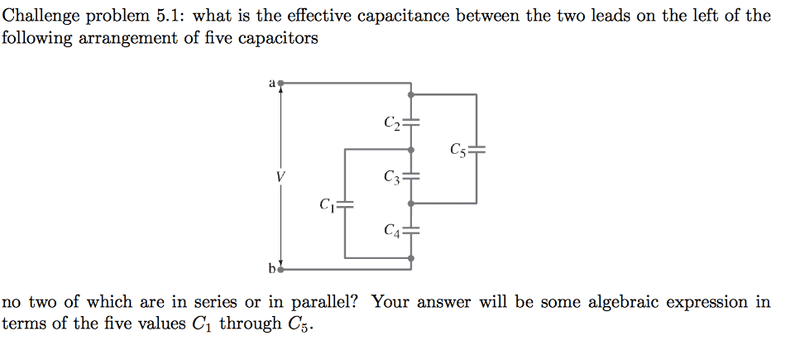
Homework Statement


MAvH81u.png


The Attempt at a Solution


This problem was very difficult, and the most I could do was re-arrange the circuit into a make-shift Wheatstone bridge with all capacitors instead of resistors/voltmeter.

Any ideas?
 
Last edited:
Physics news on Phys.org
What you need is a relevant equation ! Hence the template...

I propose Q = C V There are five of them, plus one for the equivalent over-all C, so you should get enough material to solve for the latter.

That's how we do parallel, series, etc. of two capacitors. This one is a little more involved.
 
I've already attempted doing that - I think the big problem is that since no two of them are in series/parallel with each other, it's very difficult to use the standard method.
 
I scrapped my approach because it wasn't working.

Do you mean I should calculate the charge on the capacitors using Q = VC?
 
Emc2fma said:

Homework Statement


[ IMG]http://i.imgur.com/MAvH81u.png[/PLAIN]

The Attempt at a Solution


This problem was very difficult, and the most I could do was re-arrange the circuit into a make-shift Wheatstone bridge with all capacitors instead of resistors/voltmeter.

Any ideas?
Are the capacitances all different, or do all capacitors have the same capacitance?
 

Attachments

  • MAvH81u.png
    MAvH81u.png
    16.5 KB · Views: 748
They're all different...does that make a difference? I figure the calculation would be the same.
 
Emc2fma said:
They're all different...does that make a difference? I figure the calculation would be the same.
The special case of all being equal allows you to make a drastic simplification right from the start, basing this on symmetry of the circuit. For this reason, the special case cannot qualify as a "challenge problem". :smile:
 
  • Like
Likes   Reactions: 1 person
Emc2fma said:

Homework Statement


MAvH81u.png


The Attempt at a Solution


This problem was very difficult, and the most I could do was re-arrange the circuit into a make-shift Wheatstone bridge with all capacitors instead of resistors/voltmeter.

Any ideas?

I just write the KCL equations for complicated questions like this.