Diffraction Gratings: Calculating Wavelength for CD ROM

  • Thread starter Thread starter Sarah0001
  • Start date Start date
  • Tags Tags
    Diffraction
Click For Summary

Homework Help Overview

The discussion revolves around the diffraction of light from a CD ROM, specifically focusing on the calculation of wavelength changes due to tilting the disc. The original poster presents a scenario involving white light and yellow light of wavelength 590 nm, observed under first-order diffraction conditions. The problem includes determining the spacing between adjacent tracks and how tilting the CD ROM affects the observed wavelength.

Discussion Character

  • Exploratory, Assumption checking, Conceptual clarification

Approaches and Questions Raised

  • Participants discuss the relationship between angles of incidence and reflection in the context of diffraction. There are attempts to understand the path difference and how it relates to the observed wavelength. Questions arise regarding the subtraction of sine values in the worked solutions and the implications of angle conventions.

Discussion Status

The discussion is ongoing, with participants exploring various interpretations of the equations governing diffraction. Some guidance has been offered regarding the conventions for measuring angles, but there is no explicit consensus on the reasoning behind certain steps in the calculations.

Contextual Notes

Participants are grappling with the implications of tilting the CD ROM and how it alters the angles involved in the diffraction process. There are also discussions about the conventions for defining positive and negative angles in relation to the normal incidence of the surface.

Sarah0001
Messages
31
Reaction score
1
1. A white light shines vertically down on a horizontal CD ROM disc.
The disc is viewed by a teacher whose eye is a horizontal distance 0.50 m from the disc and 0.35 m vertically above its horizontal plane, Figure 1.2. A yellow light of wavelength 590 nm is observed due to first order diffraction.
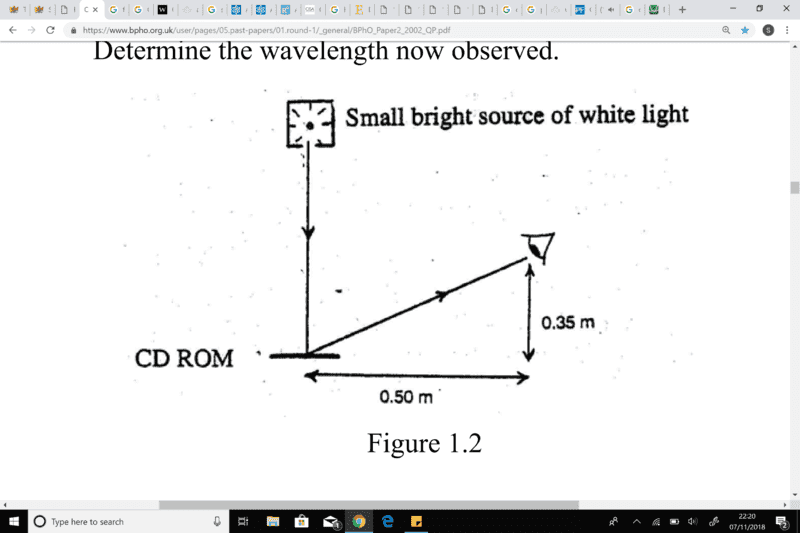
2018-11-07 (1).png
Fig 1.2 Uploaded image
. (i) Deduce the spacing d between adjacent tracks of the CD ROM.
Answer: 720 nm,
angle subtended between incident and reflected ray is 55 degrees

2) relevant equations :
dd714d434379cac3e139d2e3f530834f0d90d64e


This below part is what I require help with.
(ii) The CD ROM is tilted, clockwise through an angle of 5 degrees . Determine the wavelength now observed.


3. My attempt at the solution :

wavelength = 720*10^-9 * sin 60

Worked solution: (uploaded)
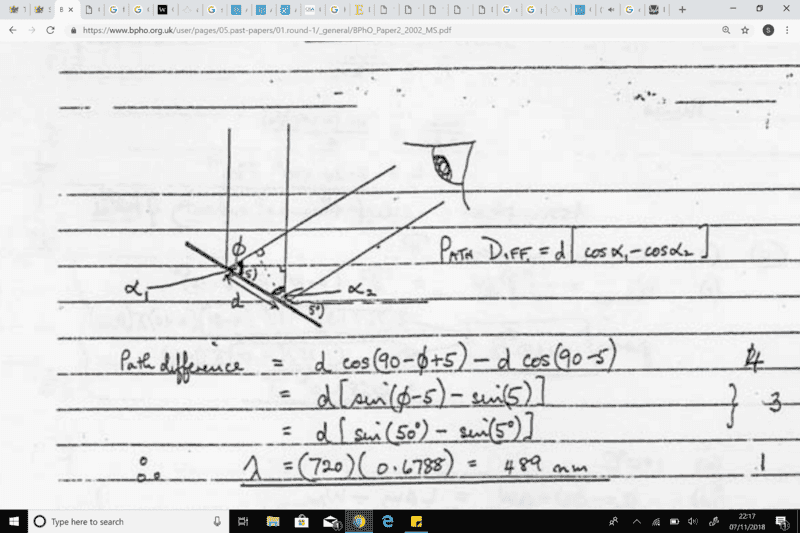
upload_2018-11-7_22-18-26.png

I understand that the angle of incidence ray with mirror is now 95 degrees as opposed to 90,
so 95-55 = 40
so cos theta 1 = wavelength / d , theta 1 is 40, and thus sin theta 2 = wavelength / d , theta two must be 50 degrees by ( 180-90-40).
However I do not understand why 'sin5' is subtracted by sin 50 in the worked solutions, nor do I understand how cos ( 90 - 5) leads to sin (5), or cos(90 -x+5) = sin ( x -5) for that sake
Also fundamentally I cannot understand why the worked solutions initially finds the path difference to equal to (cosine A - Cosine B ) * slit separation (d)
 

Attachments

  • upload_2018-11-7_22-18-26.png
    upload_2018-11-7_22-18-26.png
    76.1 KB · Views: 858
  • 2018-11-07 (1).png
    2018-11-07 (1).png
    25.2 KB · Views: 943
Physics news on Phys.org
Normally, the incident and reflected angles are measured off of a diffraction grating as measured from normal incidence. Then the equation for constructive interference reads ## m \lambda=d(\sin{\theta_i}+\sin{\theta_r}) ##. In this case, ## \theta_r ## will be ## 50^{\circ} ## to the viewing point. The ## \theta_i ## here gets a minus sign, so that ## \theta_i=-5^{\circ} ## because the incident angle is in the other quadrant. ## \\ ## (Alternatively, the equation can be written as ## m \lambda=d(\sin{\theta_i}-\sin{\theta_r}) ##, with a positive sign on ## \theta_i ##, but that gets confusing, because then ## m=-1 ## for this problem). ## \\ ## The equation for constructive interference for the diffraction grating with normal incidence, so that ## \theta_i=0 ## is often written as ## m \lambda=d \sin{\theta} ## where the only angle that gets computed is the angle ## \theta_r ## so it is shortened to ## \theta ##. The equation I presented is the more complete equation for constructive interference, where ## \theta_i ## can be any arbitrary angle. These angles are measured from the normal to the grating.
 
Last edited:
  • Like
Likes   Reactions: Sarah0001
Sarah0001 said:
1. A white light shines vertically down on a horizontal CD ROM disc.
The disc is viewed by a teacher whose eye is a horizontal distance 0.50 m from the disc and 0.35 m vertically above its horizontal plane, Figure 1.2. A yellow light of wavelength 590 nm is observed due to first order diffraction.
View attachment 233616 Fig 1.2 Uploaded image
. (i) Deduce the spacing d between adjacent tracks of the CD ROM.
Answer: 720 nm,
angle subtended between incident and reflected ray is 55 degrees

2) relevant equations :
dd714d434379cac3e139d2e3f530834f0d90d64e


This below part is what I require help with.
(ii) The CD ROM is tilted, clockwise through an angle of 5 degrees . Determine the wavelength now observed.


3. My attempt at the solution :

wavelength = 720*10^-9 * sin 60

Worked solution: (uploaded)
View attachment 233615
I understand that the angle of incidence ray with mirror is now 95 degrees as opposed to 90,
so 95-55 = 40
so cos theta 1 = wavelength / d , theta 1 is 40, and thus sin theta 2 = wavelength / d , theta two must be 50 degrees by ( 180-90-40).
However I do not understand why 'sin5' is subtracted by sin 50 in the worked solutions, nor do I understand how cos ( 90 - 5) leads to sin (5), or cos(90 -x+5) = sin ( x -5) for that sake
Also fundamentally I cannot understand why the worked solutions initially finds the path difference to equal to (cosine A - Cosine B ) * slit separation (d)
It will help to create some labels.
Call the light source point L, the eye E, the points where the rays hit the disc C (left) and D.
The diagram shows a perpendicular dropped from DE to CE. Call this point A. Likewise, a horizontal from point C meets LD at a point I'll call B.
The paths from L to the disc are LC and LD. These differ in length by BD = d cos α2. The paths from the disc to the eye are CE and DE. These differ in length by CA = d cos α1.
 
  • Like
Likes   Reactions: Sarah0001
haruspex said:
It will help to create some labels.
Call the light source point L, the eye E, the points where the rays hit the disc C (left) and D.
The diagram shows a perpendicular dropped from DE to CE. Call this point A. Likewise, a horizontal from point C meets LD at a point I'll call B.
The paths from L to the disc are LC and LD. These differ in length by BD = d cos α2. The paths from the disc to the eye are CE and DE. These differ in length by CA = d cos α1.
A perpendicular dropped from DE to CE??
 
Sarah0001 said:
A perpendicular dropped from DE to CE??
Sorry, I meant from D to CE.
 
  • Like
Likes   Reactions: Sarah0001
Charles Link said:
Normally, the incident and reflected angles are measured off of a diffraction grating as measured from normal incidence. Then the equation for constructive interference reads ## m \lambda=d(\sin{\theta_i}+\sin{\theta_r}) ##. In this case, ## \theta_r ## will be ## 50^{\circ} ## to the viewing point. The ## \theta_i ## here gets a minus sign, so that ## \theta_i=-5^{\circ} ## because the incident angle is in the other quadrant.

What is the convention for determining whether the diffracted angles or incidence angles are negative or positive relative to the normal incidence of the surface?
 
Sarah0001 said:
What is the convention for determining whether the diffracted angles or incidence angles are negative or positive relative to the normal incidence of the surface?
The incident angle ## \theta_i ## can always be chosen as positive. You then compute the path distance difference for the rays. If it scatters back into the same quadrant as the incident angle, the path distance difference will read ##\Delta=d(\sin{\theta_i}+\sin{\theta_r}) ## with ## \theta_r ## as positive. If we want to use this same equation (with "+" sign between the two terms), and the scattering is into the opposite quadrant, (I'm considering reflection type grating here), then ## \theta_r ## will be negative.
 

Similar threads

  • · Replies 3 ·
Replies
3
Views
2K
  • · Replies 3 ·
Replies
3
Views
3K
  • · Replies 5 ·
Replies
5
Views
2K
  • · Replies 3 ·
Replies
3
Views
6K
  • · Replies 4 ·
Replies
4
Views
3K
  • · Replies 3 ·
Replies
3
Views
2K
Replies
1
Views
3K
  • · Replies 6 ·
Replies
6
Views
5K
  • · Replies 4 ·
Replies
4
Views
2K
  • · Replies 1 ·
Replies
1
Views
1K