Digital Communications: Bit Error Rate (BER), C/N, Constellations

Join the discussion
Ask a follow-up here, or get your own question answered by working scientists, mathematicians and engineers — people, not an autocomplete.
Real named experts · corrections over time · the nuance an AI answer skips
4 replies · 2K views
ashah99
Messages
55
Reaction score
2
Homework Statement
Please see a snippet of the problem below.
Relevant Equations
C/N = (Eb/N0) * (data rate/bandwidth)
Problem Statement:
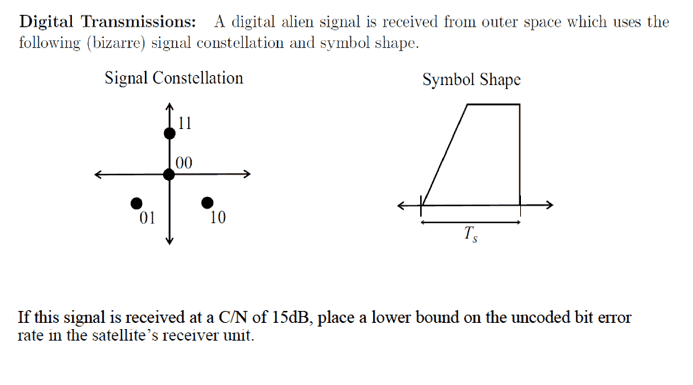
1636383706600.png

I am not quite sure how to approach this problem and would appreciate the help. I how the C/N is closely related to the SNR (Eb/N0), but the question does not give the bandwidth or data rate for me to use the formula above. From the constellation diagram, my guess is this is QPSK modulation scheme, but even that is a guess. Can anyone help?
 
Physics news on Phys.org
ashah99 said:
Homework Statement:: Please see a snippet of the problem below.
Relevant Equations:: C/N = (Eb/N0) * (data rate/bandwidth)

Problem Statement:

View attachment 291953
I am not quite sure how to approach this problem and would appreciate the help. I how the C/N is closely related to the SNR (Eb/N0), but the question does not give the bandwidth or data rate for me to use the formula above. From the constellation diagram, my guess is this is QPSK modulation scheme, but even that is a guess. Can anyone help?
Is there any more information given?
 
tech99 said:
Is there any more information given?
Unfortunately not, which is why I ask for help.

I could show you the entire problem if you would like, but it is irrelevant in my opinion. The other parts were to sketch the in-phase and quadrature phase voltage signals that would be sent to an IQ-modulator and to discuss a drawback in using the given symbol with that pulse shape (sharp transitions makes it spectrally inefficient is my answer).
 
tech99 said:
Is there any more information given?
Any additional thoughts?
 
I think in essence we take the signal amplitude as 1 volt. As we have two quadrature carriers, half the power is in each, so each phase has 0.7 volt peak. Next we measure the distance between the nearest points on the constellation. This looks like 0.35 volt. So the decision threshold, where the detector decides 0 or 1, will be half that = 0.18 volt. Then we find the RMS noise amplitude, which is 1 Volt - 15dB = 0.18. So the detector is seeing a signal at the same amplitude as the RMS noise. In this situation it cannot decode data.
Sorry I am not too expert on these calculations and I might be slightly out in the explanation. There are several web sites talking about C/N and BER for different modulation schemes.