Dingy rib automatic start syphon system

  • Context: Plumbing 
  • Thread starter Thread starter Roger T
  • Start date Start date
  • Tags Tags
    Automatic System
Click For Summary

Discussion Overview

The discussion revolves around the design and functionality of a siphon system for a dinghy rib, specifically focusing on the pressure dynamics involved in raising water through pipes of varying diameters and lengths. Participants explore theoretical and practical aspects of the system, including pressure calculations and the effects of trapped air.

Discussion Character

  • Exploratory
  • Technical explanation
  • Debate/contested
  • Mathematical reasoning

Main Points Raised

  • One participant proposes that trapped air in a 32 mm pipe could create enough pressure to raise water 600 mm in a connected 10 mm pipe.
  • Another participant questions the pressure required to push water up a 10 mm x 600 mm pipe, suggesting that the vertical rise is significant for pressure calculations.
  • A later reply clarifies that the pressure of trapped air cannot exceed the static head of water in the boat, indicating that the water will rise to the same level as in the boat.
  • One participant argues that the analogy of a hydraulic jack is misleading, emphasizing that the pressures involved are due to gravity rather than mechanical advantage.
  • Another participant discusses the relationship between the diameters of the pipes and the pressure generated, suggesting that a smaller outlet pipe could lead to a greater height of water being raised.
  • There is a mention of the weight of water in the pipes and how it relates to the pressure needed for the siphon to function effectively.
  • One participant introduces a separate pneumatic question about air pressure in a submerged pipe, linking it to the original siphon system discussion.
  • Another participant shares empirical data regarding flow rates and pressures for different pipe sizes, contributing to the understanding of the system's dynamics.

Areas of Agreement / Disagreement

Participants express differing views on the mechanics of the siphon system, particularly regarding the effects of pipe diameter and the role of trapped air pressure. There is no consensus on the exact pressure calculations or the effectiveness of the proposed system.

Contextual Notes

Some assumptions about the system's operation and the effects of water levels and air pressure are not fully resolved. The discussion includes various mathematical considerations and empirical observations that may not be universally applicable.

Roger T
Messages
6
Reaction score
0
TL;DR
I'm trying to create a dinghy rib automatic start syphon system, to drain the water out of dingy every time it rains, Kindly do not post any alternative systems that require a power supply other than free power i.e. wind or wave.
The theory is that that the trapped air in pipe A would create enough pressure to raise the water 600 mm in pipe C,
Design and parts: 32 mm x 1 metre pipe (A) running from the stern floor (open end) forward with the front end raised 100 mm, then turned 360 deg and reduced to 10 mm (pipe B) back to the stern floor alongside pipe A,
At the stern end of pipe B fit a T 10 mm connecter with a foot valve and another 10 mm pipe rising vertically for 600 mm (pipe C) over the transom and continuing down for 800 mm with the tide out,

The water level is always slightly higher inside when it rains than sea level, but the difference would be considerable different when the tide goes out.

Question 1:
How much pressure would a 32mm x 1m pipe with one end blanked of (top) submerged in water create?

Question 2:
How much pressure would it take to push water up a 10mm x 600mm pipe?.
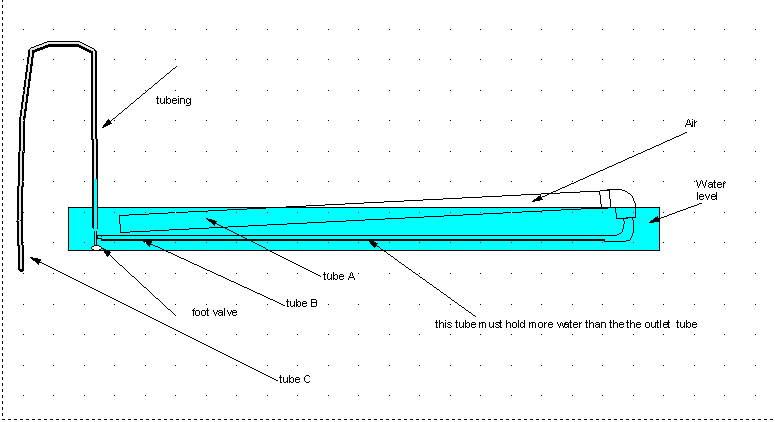
Syphon2.PNG
 
Last edited:
Physics news on Phys.org
Roger T said:
How much pressure would it take to push water up a 10mm x 600mm pipe?.
You said the vertical rise is 60 mm, not 600. That is the significant number. Diameter doesn't matter. (I would have guessed closer to 250 mm vertical rise is needed).

60 mm head gives 0.006 bar pressure.
 
Hi, Sorry about that typo, yes 600mm I have edited that & modified the drawing,
 
Assuming that you start 'dry' - no water in the 'inverted U-shaped' hose:

The pressure of the trapped air cannot exceed the static head of the water in the boat. The water in the 'U-tube' will rise exactly to the level of the water in the boat, and only that high (ignoring a little capillary action). Your system could work (and empty the boat) after the water level in the boat exceeds the elevation of the high point of the 'U tube.' A too-large' siphon hose (or a too-low rainfall rate) could cause the system to act as a simple overflow drain and never allow the 'full hose' condition required for a siphon to occur.
 
Hi Dullard,
Yes all tubes start dry, the water level that I'm showing in the diagram is to show the air that is trapped, it normally ends up three times as high in wet spells, if the system started to syphon obviously it would not get to that height, but the more water the more pressure created, the weight of the water in the U pipe is only .o5kg, this is effectively reversing the principle of the hydraulic car jack, by using 32mm tube down to 10mm, if 1psi with a 1" piston will lift 1 lb I think it will work, would just like to know what pressure the 32mm pipe is likely to produce,
 
The 32 mm pipe will be at a pressure equivalent to the head of the water in the boat - the higher the water, the higher the pressure. It will be exactly enough pressure to raise the water in the outlet tube to an equal height. Your 'hydraulic jack' analogy is just wrong - the pressures here are due to gravity.
 
Hi Dullard,
The 32mm tube would raise the water in the outlet pipe to the same level if it was 32mm, butt it is 10mm, the analogy of the jack was purely to demonstrate by turning it upside down, push fluid large into small, instead of small into large in the case of the jack, and yes we are applying pressure with physical force proving that it is a long stroke with a small piston moving a heavy weight a tenth of the distance, without going into it 50 kg of force was lifting 400 kg,
As an example if the small pipe is 25% area of the large pipe & pushed the the fluid in the large pipe 100mm the fluid in the small pipe would move 400mm and the forces required to lift .05 kg could be as little as 1 to 2 psi.
 
A column of water isn't a piston - it's like a piston that 'gains weight' as you elevate it. The pressure at the bottom of a column of water is independent of the pipe size - it depends only on the height of the water column. You are 'pressurizing' the trapped air with water in the boat. The water in the siphon hose will rise until the pressure at the bottom of that column is the same as the air pressure - the water level in the boat and in the siphon hose will be the same.
 
  • Like
Likes   Reactions: berkeman
Summary:: How much air pressure could a 1 metre long by 50mm ISD pipe blanked at the top end, submerged in 300mm of water at 10 dg angle produce.

Pneumatic question
Air pressure in a submerged pipe.
How much air pressure could a 1 metre long by 50mm ISD pipe blanked at the top end, submerged in 300mm of water at 10 dg angle produce.
 
  • #10
I moved this thread from a technical forum, no template.

@Roger T , This sounds like homework. Please use the homework forum in the future, and follow the directions.

Our rules require that you show us your work before we offer help. How would you approach this problem.
 
  • #11
This is actually an interesting computation.
I assume the pipe is capped on top and immersed into the water vertically.. As the pipe is lowered the water inside the pipe rises from zero to increasing levels as a fraction of the pipe length as the contained air is increasingly compressed with attendant pressure increases. The math is a bit cumbersome but not too bad, and it was fun to put the equations into excel to see what happens at different depths, from zero to 10000m (about the depth of the Marianas Trench).

PS I ignored the 10 degree slant as that is of secondary import.
 
  • #12
This question was asked because it is actually linked to the question in DIY for a dingy rib automatic start syphon system,
Information that I have found so far:
Normal Human can blow 1.3 psi Athlete can blow up to 1.9 psi.
Flow rate of 10mm x 1000m tube at 0.0001 bar is 4 litres an hour, or 96 L per Hr
.The weight of water in a 10mm x 600mm tube is 0.05kg
Flow rate of 8mm x 1000m tube at 0.0001 bar is 1.6 litres an hour, or 36L per Hr
The weight of water in a 8mm x 600mm tube is 0.03kg

I think we can forget 6 & 5mm of 6mm x 1000m tube at 0.0001 bar is .54 litres an hour.
of 5mm x 1000m tube at 0.0001 bar is 0.18 litres an hour.

At 1 ft water pressure is increased by 1/33 of atmospheric pressure
The system works by blowing in it, and it is just as easy to make it as it is to make a test bench with pressure gauges,

I'm trying to ascertain the diameter of the submerged end tube & the water outlet tube to achieve the result.
Syphon2.PNG
 
  • #13
OK, not homework. But I merged it into the original dinghy thread. Please don't start multiple threads on the same basic question.
 

Similar threads

  • · Replies 7 ·
Replies
7
Views
2K
  • · Replies 10 ·
Replies
10
Views
3K
  • · Replies 6 ·
Replies
6
Views
2K
  • · Replies 28 ·
Replies
28
Views
4K
  • · Replies 8 ·
Replies
8
Views
7K
  • · Replies 6 ·
Replies
6
Views
2K
Replies
48
Views
12K
  • · Replies 39 ·
2
Replies
39
Views
16K
  • · Replies 2 ·
Replies
2
Views
2K
Replies
8
Views
6K