Diodes in parallel with resistors and terminal PD

Click For Summary

Homework Help Overview

The problem involves analyzing a circuit with diodes in parallel with resistors and understanding the terminal potential difference (PD) across various components. The original poster explores the effects of reversing diodes and the implications for voltage distribution in the circuit.

Discussion Character

  • Exploratory, Conceptual clarification, Assumption checking

Approaches and Questions Raised

  • The original poster attempts to understand the voltage across diodes and resistors in a parallel configuration, questioning the behavior when one diode is reversed. Participants discuss the implications of diode orientation on voltage distribution and current flow.

Discussion Status

Participants are actively engaging with the original poster's questions, providing feedback on the correctness of assumptions regarding voltage and current in the circuit. There is a recognition of the complexity of diode behavior, and some participants suggest reconsidering the basic principles of voltage in parallel circuits.

Contextual Notes

There is mention of a rough approximation for diode voltage drop and the potential for high currents leading to diode failure. The discussion also touches on the limitations of introductory physics courses regarding diode behavior.

mrcotton
Messages
120
Reaction score
0
1.

diode_zpsbf4b87a5.jpg

Homework Statement

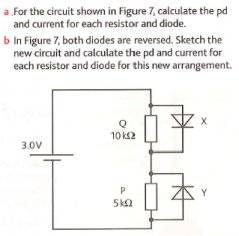
The problem is not answering the questions, as supplied by the book
The book then asks you to reverse both diodes, so you still have one diode in the circuit that let's current pass through it and one that does not.
When you solve for the PD at Q you use the 0.6V of the diode and therefore because parallel the 10kOhm resistor also gets 0.6V so therefore the resistor at P gets 3.0-0.6=2.4V the rest of the 3V terminal PD

My question is what happens if we only reverse 1 diode, so that both are now in the same direction as conventional current flow.

Homework Equations


My understanding that a diode will only take the 0.6V then the current will flow through it.
Also the same PD will be across any branch of a parallel oart of a circuit

The Attempt at a Solution


If both resistors and diodes only get 0.6 volts each than the total circuit voltage is only 1.2V

Is this correct?
Any ideas welcomed
 
Physics news on Phys.org
No, it is not correct. The total voltage must equal the battery voltage. Note that one of the diodes will be conducting, the other will not.
 
Integral said:
No, it is not correct. The total voltage must equal the battery voltage. Note that one of the diodes will be conducting, the other will not.

Thanks for responding Integral
I am happy that in the circuit above the diode at X let's current flow through it at 0.6V and therefore the 10kOhms resistor at Q has this 0.6V across it as well.
Then the other diode at Y does not so the 5kOhm resistor at P has the rest of the PD at 2.4V

If I change the circuit to this one below by turning the diode Y the other way, by the logic above why do they not both now only get 0.6V

diode2_zps90f703c9.jpg

I am as dumb as I look
Thank you
 
The 0.6V rule-of-thumb for diodes is a very rough approximation that holds at modest current levels. It is possible to go higher in voltage, but the resulting currents will be enormous and in practice will burn out the diode.

A more sophisticated model of a diode's voltage-current relation is here:
http://en.wikipedia.org/wiki/Diode#Shockley_diode_equation

That is, current through a diode increases roughly exponentially with voltage. It might increase by a factor of 10 for every 0.05 to 0.1 V increase (if my memory is correct), and over a wide range of operating currents the voltage will be somewhere between 0.5 and 0.8 V.
 
Thanks RedBelly98
So if we just had the two diodes and the 3V cell they would both get 1.5V and a large current would flow that would burn them out?

If we have the two diodes and two resistor in the second case then because there is a resistor in parallel in series with each other we would get voltage drops across the two resisitors with the 10kOhm receiving more of the voltage to push the same current through

cant we just stick to bulbs and resistors!
 
mrcotton said:
Thanks RedBelly98
So if we just had the two diodes and the 3V cell they would both get 1.5V and a large current would flow that would burn them out?
Yes. (Assuming they are identical diodes.)
If we have the two diodes and two resistor in the second case then because there is a resistor in parallel in series with each other we would get voltage drops across the two resisitors with the 10kOhm receiving more of the voltage to push the same current through
The 10Ω resistor would have slightly more voltage than the 5k. I don't think "pushing the same current through" is an adequate description of what is going on though.
cant we just stick to bulbs and resistors!
Most intro physics courses (i.e., high school or college freshman level) do not deal with diodes.
 

Similar threads

  • · Replies 7 ·
Replies
7
Views
2K
  • · Replies 25 ·
Replies
25
Views
5K
  • · Replies 13 ·
Replies
13
Views
3K
  • · Replies 2 ·
Replies
2
Views
2K
Replies
3
Views
1K
  • · Replies 3 ·
Replies
3
Views
2K
Replies
20
Views
2K
  • · Replies 2 ·
Replies
2
Views
2K
  • · Replies 31 ·
2
Replies
31
Views
6K
  • · Replies 26 ·
Replies
26
Views
4K