Dirac delta function approximation

Click For Summary
SUMMARY

The forum discussion centers on the approximation of the Dirac delta function through the limit of a sequence of functions \( g^{\epsilon}(x) \) as \( \epsilon \) approaches zero. Task b was correctly solved using the mean value theorem for integrals, leading to the conclusion that \( \lim_{\epsilon \to 0} \phi(x^*_{\epsilon}) = \phi(0) \). However, task c raised confusion regarding the interchange of limits and integrals, with participants clarifying that the integral's boundaries depend on \( \epsilon \) and cannot be separated from the limit. Ultimately, the integral \( \int_{-\infty}^{\infty} \lim_{\epsilon \to 0} g^{\epsilon}(x) \phi(x) dx \) was debated, with suggestions that it evaluates to zero.

PREREQUISITES
  • Understanding of Riemann integrals and their properties
  • Familiarity with the Dirac delta function and its approximations
  • Knowledge of the mean value theorem for integrals
  • Basic concepts of limits and continuity in calculus
NEXT STEPS
  • Study the properties of the Dirac delta function and its applications in physics and engineering
  • Learn about the interchange of limits and integrals, particularly in the context of Riemann sums
  • Explore the mean value theorem for integrals in greater depth
  • Investigate the implications of Lebesgue integrals compared to Riemann integrals
USEFUL FOR

Mathematicians, physicists, and engineering students who are working with integrals, limits, and the Dirac delta function in their studies or research.

Lambda96
Messages
233
Reaction score
77
Homework Statement
show that the following applies ##\displaystyle{\lim_{\epsilon \to 0}} \int_{- \infty}^{\infty} g^{\epsilon}(x) \phi(x)dx = \phi(0)##
Relevant Equations
none
Hi,

I'm not sure if I have calculated task b correctly, and unfortunately I don't know what to do with task c?
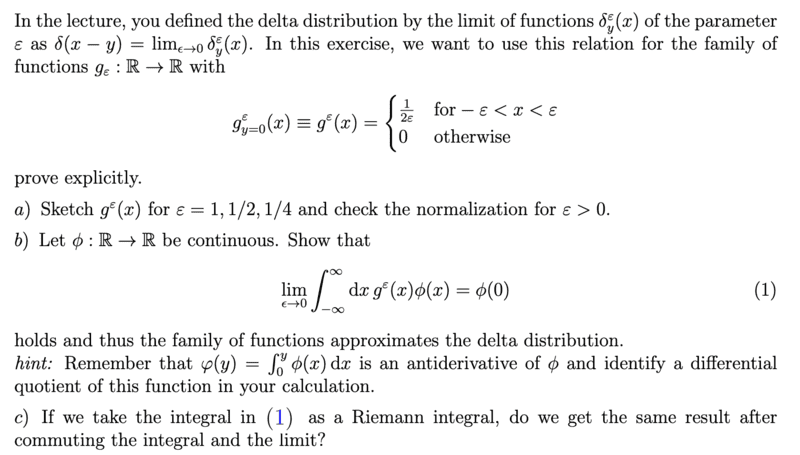
Bildschirmfoto 2024-01-16 um 14.38.30.png


I solved task b as follows

##\displaystyle{\lim_{\epsilon \to 0}} \int_{- \infty}^{\infty} g^{\epsilon}(x) \phi(x)dx=\displaystyle{\lim_{\epsilon \to 0}} \int_{\infty}^{\epsilon} 0 \phi(x)dx + \displaystyle{\lim_{\epsilon \to 0}} \int_{- \epsilon}^{\epsilon} \frac{1}{2 \epsilon} \phi(x)dx +\displaystyle{\lim_{\epsilon \to 0}} \int_{\epsilon}^{\infty} 0 \phi(x)dx=\displaystyle{\lim_{\epsilon \to 0}} \int_{- \epsilon}^{\epsilon} \frac{1}{2 \epsilon} \phi(x)dx = \displaystyle{\lim_{\epsilon \to 0}} \frac{\varphi(\epsilon) - \varphi(- \epsilon)}{2 \epsilon}= \phi(0)##

Does task c mean the following
##\int_{- \epsilon}^{\epsilon} \frac{1}{2 \epsilon} \phi(x) dx=\displaystyle{\lim_{\epsilon \to 0}} \sum\limits_{x= -\epsilon}^{\epsilon} \frac{1}{2 \epsilon} \phi(x)##
 
Physics news on Phys.org
task b) looks correct to me though the equality in the very last step is not so obvious and you have to show the intermediate steps (but I guess maybe in your book there is a sub problem that does that ). Also it is a bit confusing that you are using two different representations of the greek letter phi to denote a continuous function and its antiderivative.

Hold on while I process task c).
 
  • Like
Likes   Reactions: Lambda96
What you wrote in c) doesn't even make sense cause you seem to consider a sum over a continuous variable x, while the sum/series i know are over discrete variables from the set of integers.

What task wants you to is to write the integral as the limit of a Riemann sum and then take the limit for epsilon and then change the order with which you take the limits.

I mean the limit of a Riemann sum is something like $$\lim_{n\to\infty} \sum_{i=1}^{n} f(a+i\frac{b-a}{n})\frac{b-a}{n}$$ and then take the limit of this with epsilon tending to zero , setting first ##a=-\epsilon ,b=\epsilon## (##f(x)=g^e(x)\phi(x)##) and then first compute the limit as epsilon tending to zero and then in what is computed take the limit n tending to infinity. You ll find that you get infinity and not the desired result by doing it that way.
 
  • Like
Likes   Reactions: Lambda96
For b I would not work with the antiderivative explicitly. Instead, I would apply the mean value theorem for integrals
$$
\int_a^b f(x) dx = (b-a) f(c)
$$
for some ##c## such that ##a<c<b##. This means that
$$
\frac 1{2\epsilon} \int_{-\epsilon}^\epsilon \phi(x)dx
= \phi(x^*_\epsilon)
$$
where ##|x^*_\epsilon | < \epsilon## such that ##\lim_{\epsilon \to 0} \phi(x^*_{\epsilon}) = \phi(0)##. It just feels cleaner to me.
 
  • Like
Likes   Reactions: Lambda96
Orodruin said:
It just feels cleaner to me.
The whole idea seems nice and neat except that it is not so clear to me that $$\lim_{\epsilon \to 0} x_{\epsilon}^{*}=0$$.
 
To the OP:
Forget what i said in post #3 about the limit of the Riemann sum ( i ll leave the post there though and not delete it cause it might seem interesting to you)

What c) wants you to do is to compute $$\int_{-\infty}^{\infty}\lim_{\epsilon \to 0}g^{\epsilon}(x)\phi(x)dx$$
 
  • Like
Likes   Reactions: Lambda96
Delta2 said:
The whole idea seems nice and neat except that it is not so clear to me that $$\lim_{\epsilon \to 0} x_{\epsilon}^{*}=0$$.
If you choose ##\epsilon > 0## then for any ##\delta < \epsilon##: ##|x^*_{\delta}-0| < \epsilon## so ##x^*_\epsilon## converges to zero by definition.
 
  • Wow
Likes   Reactions: Delta2
Orodruin said:
If you choose ##\epsilon > 0## then for any ##\delta < \epsilon##: ##|x^*_{\delta}-0| < \epsilon## so ##x^*_\epsilon## converges to zero by definition.
Ye ok what confused me is the way you write it it seems to be a sequence with a continuous variable as index so you know very confusing but it is in fact a real function $$x_{\epsilon}^{*}=h(\epsilon)$$ such that $$|h(\epsilon)|<\epsilon$$ from which it follows that that limit is zero indeed.
 
Thank you Delta2 and Orodruin for your help 👍 👍

I have now tried to calculate the task c

##\int_{-\infty}^{\infty} \displaystyle{\lim_{\epsilon \to 0}} g^{\epsilon}(x)\phi(x)dx=\int_{-\epsilon}^{\epsilon}\displaystyle{\lim_{\epsilon \to 0}} \frac{1}{2 \epsilon}\phi(x)##

But if I now form the limit value, I get ##\displaystyle{\lim_{\epsilon \to 0}} \frac{1}{2 \epsilon}=\infty## or am I misinterpreting the term in the integral?
 
  • #10
Lambda96 said:
Thank you Delta2 and Orodruin for your help 👍 👍

I have now tried to calculate the task c

##\int_{-\infty}^{\infty} \displaystyle{\lim_{\epsilon \to 0}} g^{\epsilon}(x)\phi(x)dx=\int_{-\epsilon}^{\epsilon}\displaystyle{\lim_{\epsilon \to 0}} \frac{1}{2 \epsilon}\phi(x)##

But if I now form the limit value, I get ##\displaystyle{\lim_{\epsilon \to 0}} \frac{1}{2 \epsilon}=\infty## or am I misinterpreting the term in the integral?
You cannot take the integral out of the limit. Its boundaries depend on ##\epsilon##!
 
  • Like
Likes   Reactions: Lambda96 and Delta2
  • #11
Orodruin said:
You cannot take the integral out of the limit. Its boundaries depend on ##\epsilon##!
That's correct but i also kinda did what the OP did at #9 and i thought we get ##+\infty## in this case. But i see now its wrong. So I cant understand what task c is supposed to mean.
 
  • Like
Likes   Reactions: Lambda96
  • #12
Thank you Orodruin and Delta2 for your help 👍👍

Unfortunately, I also don't understand what is meant by commuting the integral and the limit. Isn't the integral (1) a Riemann integral, why does the problem specifically state that it should now be interpreted as one?
 
  • Like
Likes   Reactions: Delta2
  • #13
Lambda96 said:
Thank you Orodruin and Delta2 for your help 👍👍

Unfortunately, I also don't understand what is meant by commuting the integral and the limit. Isn't the integral (1) a Riemann integral, why does the problem specifically state that it should now be interpreted as one?
I had the exact same question to myself . That is a Riemann definite integral anyway it isnt a Lebesque integral. The only thing I see is that the task means to view it as the limit of a Riemann sum (as i describe in post #3) and not as an antiderivative by using the fundamental theorem of calculus.
 
  • #14
Ah hm , I think afterall what i say in post #6 is what the task c wants us to do but we didnt calculate it correctly.

I think that ##\lim_{\epsilon\to 0}g^{\epsilon}(x)=0## think about it and tell me your thoughts. So that integral is 0.
 

Similar threads

Replies
6
Views
2K
  • · Replies 31 ·
2
Replies
31
Views
2K
  • · Replies 9 ·
Replies
9
Views
2K
  • · Replies 3 ·
Replies
3
Views
2K
  • · Replies 6 ·
Replies
6
Views
2K
Replies
2
Views
2K
  • · Replies 10 ·
Replies
10
Views
2K
  • · Replies 3 ·
Replies
3
Views
1K
Replies
4
Views
2K
  • · Replies 14 ·
Replies
14
Views
2K