Math Amateur
Gold Member
MHB
- 3,920
- 48
I am reading the book "Several Real Variables" by Shmuel Kantorovitz ... ...
I am currently focused on Chapter 2: Derivation ... ...
I need help with an element of the proof of Kantorovitz's Proposition on pages 61-62 ...
Kantorovitz's Proposition on pages 61-62 reads as follows:
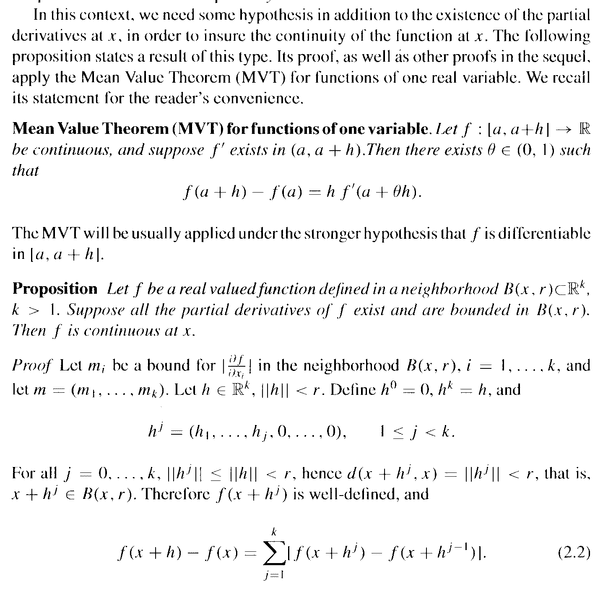
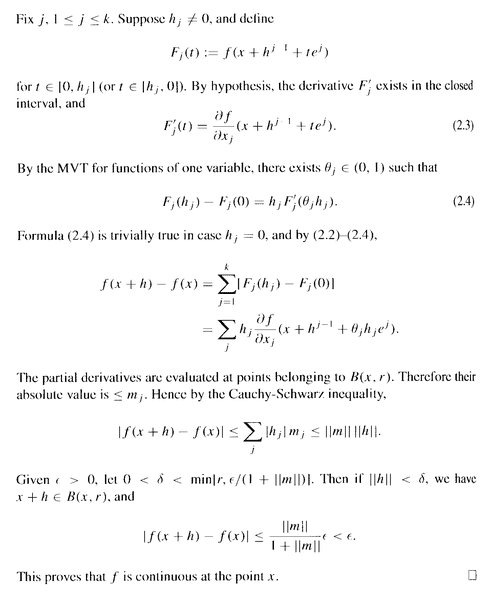 I am trying to understand the above proof in terms of the definitions of directional and partial derivatives (in terms of limits) ... but I am having trouble understanding equation (2.3) above ... specifically I am concerned regarding how (2.3) follows from Kantorovitz's definition of partial derivative ...
I will explain my difficulties in terms of Kantorovitz's definitions as he develops them on page 60 ... as follows:
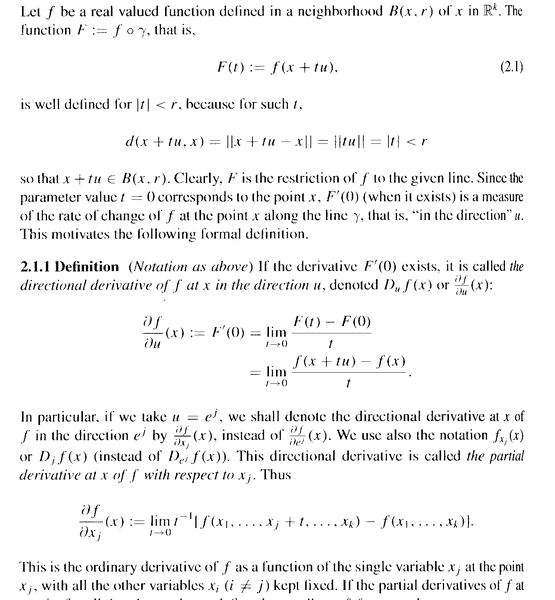 Now ... I am trying to understand how the definition of partial derivative applies to equation (2.3) in the proof of the proposition ... so for equation (2.1) of the definition we put ##u = e^j## (because we are dealing with partial derivatives) ... ... and so (2.1) becomes:##F(t) = f( x + t e^j)##
so then for ##F_j## in the proof (see the expression that is above the expression (2.3)) ... we have
##F_j (t) = f ( x + h^{j-1} + te^j )##and we appear to be dealing (for some reason?) with ##( x + h^{j-1} )## instead of ##x## ...
... which is OK ... just put ##x = x + h^{j-1}## ...... BUT ...In Definition 2.1.1 Kantorovitz defines the partial derivative this way:##\frac { \partial f }{ \partial x_j } := F'(0) = \lim_{ t \rightarrow 0 } \frac{ F(t) - F(0) }{t}####= \lim_{ t \rightarrow 0 } \frac{ f ( x + h^{j-1} + te^j ) - f(x) }{t} ##... ... is the above correct?Now ... my question is as follows: (pertaining largely to equation (2.3) )
What is the definition of ## F_j'(t)## ... and working strictly and rigorously from the definition how do we obtain
##F'_j (t) = \frac { \partial f }{ \partial x_j } f ( x + h^{j-1} + te^j )##
Hope someone can help ...
Peter***NOTE***
I have to say I find it somewhat confusing in trying to work from the definition of partial derivative, that Kantorovitz gives the definition for partial and directional derivative in terms of expressions where ##t## tends to zero ... and then equation (2.3) above is a partial derivative with ##t## as a variable ... as in ##F'_J(t)## ... surely ##t \rightarrow 0## as per the definition ...
I am currently focused on Chapter 2: Derivation ... ...
I need help with an element of the proof of Kantorovitz's Proposition on pages 61-62 ...
Kantorovitz's Proposition on pages 61-62 reads as follows:
I will explain my difficulties in terms of Kantorovitz's definitions as he develops them on page 60 ... as follows:
so then for ##F_j## in the proof (see the expression that is above the expression (2.3)) ... we have
##F_j (t) = f ( x + h^{j-1} + te^j )##and we appear to be dealing (for some reason?) with ##( x + h^{j-1} )## instead of ##x## ...
... which is OK ... just put ##x = x + h^{j-1}## ...... BUT ...In Definition 2.1.1 Kantorovitz defines the partial derivative this way:##\frac { \partial f }{ \partial x_j } := F'(0) = \lim_{ t \rightarrow 0 } \frac{ F(t) - F(0) }{t}####= \lim_{ t \rightarrow 0 } \frac{ f ( x + h^{j-1} + te^j ) - f(x) }{t} ##... ... is the above correct?Now ... my question is as follows: (pertaining largely to equation (2.3) )
What is the definition of ## F_j'(t)## ... and working strictly and rigorously from the definition how do we obtain
##F'_j (t) = \frac { \partial f }{ \partial x_j } f ( x + h^{j-1} + te^j )##
Hope someone can help ...
Peter***NOTE***
I have to say I find it somewhat confusing in trying to work from the definition of partial derivative, that Kantorovitz gives the definition for partial and directional derivative in terms of expressions where ##t## tends to zero ... and then equation (2.3) above is a partial derivative with ##t## as a variable ... as in ##F'_J(t)## ... surely ##t \rightarrow 0## as per the definition ...
Attachments


Last edited: