Discharging a capacitor faster using an external B-field?

  • Thread starter Thread starter PhiowPhi
  • Start date Start date
  • Tags Tags
    B-field Capacitor
Click For Summary

Discussion Overview

The discussion revolves around the concept of discharging a capacitor more rapidly by utilizing an external time-varying magnetic field. Participants explore theoretical implications, practical considerations, and the effects of electromagnetic induction in the context of capacitor discharge rates.

Discussion Character

  • Exploratory
  • Technical explanation
  • Debate/contested
  • Conceptual clarification

Main Points Raised

  • One participant proposes that aligning a time-varying external magnetic field with the magnetic field produced by displacement currents could potentially increase the discharge rate of a capacitor.
  • Another participant suggests that a time-varying magnetic field could induce a voltage in series with the circuit, effectively acting like a dynamo, which could aid in discharging the capacitor faster if the polarity is favorable.
  • A different viewpoint notes that the design of capacitors, such as rolled or multi-plate configurations, may limit the effectiveness of applying an external magnetic field to influence discharge rates.
  • One participant questions whether the discussion is purely theoretical or if there is a practical application, emphasizing the need for clarity on the goals of discharging the capacitor.
  • Another participant highlights the challenges of rapidly discharging a capacitor, particularly in relation to the inductance of the coil required to generate the magnetic field, and raises concerns about the feasibility of achieving extremely high discharge currents.
  • A later reply emphasizes the importance of specific parameters such as charge, capacitance, and the desired discharge speed to provide a meaningful answer to the original question.

Areas of Agreement / Disagreement

Participants express a range of views on the feasibility and implications of using an external magnetic field to influence capacitor discharge rates. There is no consensus on the practicality or effectiveness of the proposed methods, and several questions remain unresolved.

Contextual Notes

Participants note limitations related to the design of capacitors and the practical challenges of achieving rapid discharge rates, particularly concerning the inductance and current requirements. Specific conditions and parameters necessary for a serious exploration of the topic are also mentioned.

PhiowPhi
Messages
203
Reaction score
8
If a capacitor is being discharged and the electric field is varying with time producing the displacement currents, wouldn't it be possible to align a time-varying external magnetic field with the magnetic field produced by the displacement currents to increase the discharge rate? Or the vice-versa slow down the discharge rate?
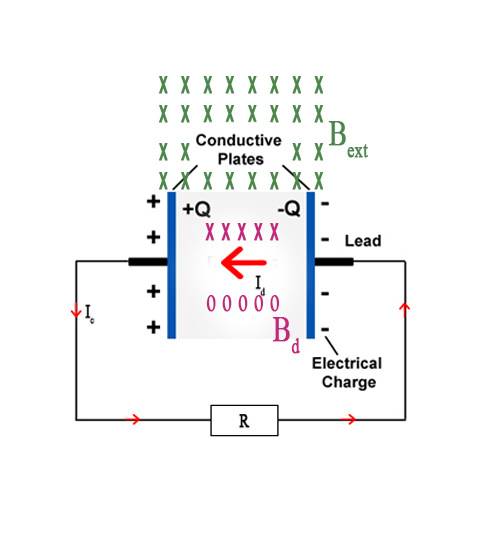
0NmOQNV.jpg

$$B_{Net} = \Delta B_d + \Delta B_{ext} ∴ \uparrow t_d $$
$$B_{Net} = \Delta B_d - \Delta B_{ext} ∴ \downarrow t_d $$

Where,
##t_d##: The discharge time.
##B_{Net}## : The net magnetic field within the separation region.

From Ampere's law it seems plausible:

$$\oint_C {Bd\ell = \mu _0 I_C }$$
 

Attachments

  • 0NmOQNV.jpg
    0NmOQNV.jpg
    15.7 KB · Views: 751
  • Like
Likes   Reactions: Nik_2213
Engineering news on Phys.org
The time varying magnetic field can encompass the space between the capacitor plates or the connecting wires with equal effect. It will induce a voltage in series with the circuit by electromagnetic induction, and is equivalent to placing a dynamo in series with the circuit. If the polarity is such as to aid the flow of current, the capacitor will discharge quicker.
The energy supplied by the dynamo will be expended in additional heating of R.
 
  • Like
Likes   Reactions: anorlunda
#PP: Slightly tangential but, given many capacitors are 'rolled up' for volumetric efficiency, and air-gapped variable capacitors are usually multi-plate, so the effects of an external magnetic field would cancel, you'll have difficulties applying this tweak.
Kudos for the lateral thinking !
 
  • Like
Likes   Reactions: sophiecentaur
Is this a thought experiment or is there a practical aspect to it. Is the aim to discharge the capacitor as fast as possible or is it to pass a high current through the R?
I'm sort of looking for a Switch somewhere in the circuit??
The current through the load R will depend on the voltage across it.
 
The need to discharge a capacitor rapidly is usually encountered when resetting a charge integrator circuit. Unfortunately the current in the inductance of the coil needed to generate the magnetic field takes longer to build than does short circuiting the capacitor, and then you must wonder what will happen when you try to turn off the magnetic field.

To discharge 1 volt, from a 1 farad capacitor, in 1 second, would only need a current of one amp. To discharge it in 1 nanosecond would require an impossible Giga-amp. By employing commutation, a charge integrator of any capacitance, can be used to generate a sawtooth waveform with a one nanosecond transition time.

Why do you need to discharge the capacitor so quickly?
 
I can't help thinking that the OP could be putting the cart before the horse. Any question of this nature just has to have the How Fast, What charge, what Capacitance ? information if a serious answer is expected.
One obvious solution would (could, depending on the actual requirement) be to switch in a massive capacitor in parallel to take most of the charge and then discharge the sink capacitor at your leisure.
 

Similar threads

Replies
3
Views
2K
  • · Replies 7 ·
Replies
7
Views
2K
  • · Replies 6 ·
Replies
6
Views
3K
Replies
1
Views
2K
  • · Replies 3 ·
Replies
3
Views
11K
  • · Replies 1 ·
Replies
1
Views
2K
Replies
12
Views
2K
  • · Replies 2 ·
Replies
2
Views
2K
  • · Replies 6 ·
Replies
6
Views
3K
Replies
2
Views
2K