Distance and acceleration from a v(t) graph

Join the discussion
Registration is free. Start your own thread to ask a follow-up.
34 replies · 4K views · last reply
gladidi
Messages
19
Reaction score
4
Summary:: Please tell me an example

Determine the distance traveled by the object between 0-7 s.

Determine the acceleration of the piece in the range of 0-4 s
Determine the acceleration of the piece in the range of 4-7 s.I've tried, but something I'm doing wrong. Could you clarify?
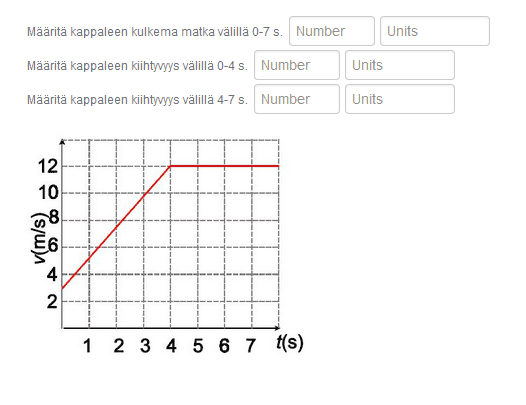
Velocity-time graph of v(m/s) against t(s): velocity rises linearly from about 3 m/s at t=0 to 12 m/s at t=4 s, then stays constant at 12 m/s until t=7 s. Finnish input fields for distance 0-7 s and accelerations 0-4 s and 4-7 s.
 
Physics news on Phys.org
Welcome to PF.

You need to show us your work before we can help you with this. How is the velocity as a function of time related to the position and acceleration as a function of time? How can you use that to help you solve these questions?
 
berkeman said:
Welcome to PF.

You need to show us your work before we can help you with this. How is the velocity as a function of time related to the position and acceleration as a function of time? How can you use that to help you solve these questions?
This is the work.
 
Attachments
  • Finnish worksheet: three answer fields asking for distance travelled in 0-7 s and acceleration in 0-4 s and 4-7 s, above a v(m/s) against t(s) graph of a line rising from about 3 to 12 m/s by t = 4 s, then constant at 12 m/s to t = 7 s.
    Screenshot_20210910_221318.jpg
    33.8 KB · Views: 160
gladidi said:
This is the work.
No, that is the graph you are supposed to use to figure out those 3 questions.

Please answer this:
berkeman said:
How is the velocity as a function of time related to the position and acceleration as a function of time?
 
berkeman said:
No, that is the graph you are supposed to use to figure out those 3 questions.

Please answer this:
I've tried to solve it with a chart, but the answers aren't going right
 
You didn't answer my questions. Until you do that, you will not get very far on problems like this one...
 
  • Like
Likes   Reactions: Chestermiller
How is velocity defined in terms of position and time?

How is acceleration defined in terms of velocity and time?
 
gladidi said:
Summary::
I've tried, but something I'm doing wrong. Could you clarify?
View attachment 288876
What specifically did you try?

gladidi said:
I've tried to solve it with a chart, but the answers aren't going right
What approach with a chart did you try?
What were your answers
and how did you get them, specifically?
 
robphy said:
What specifically did you try?What approach with a chart did you try?
What were your answers
and how did you get them, specifically?
> Determine the acceleration of the piece in the range of 0-4 s

< 12/4
 
gladidi said:
> Determine the acceleration of the piece in the range of 0-4 s

< 12/4
Ok, that's a start.
Why 12/4?
 
  • Like
Likes   Reactions: berkeman
robphy said:
Ok, that's a start.
Why 12/4?
Speed change / time to change
 
robphy said:
Ok, that's a start.
Why 12/4?
Acceleration formula
 
gladidi said:
Speed change / time to change

That sounds like a slope.
What is the speed-change [although velocity-change is more correct], during the time-change?
 
gladidi said:
Speed change / time to change
What is the speed at t=0s?
What is the speed at t=4s?
What is the change in speed?
 
haruspex said:
What is the speed at t=0s?
What is the speed at t=4s?
What is the change in speed?
Speed at t=0s =0?
Speed at t=4s? =12?
 
haruspex said:
What is the speed at t=0s?
What is the speed at t=4s?
What is the change in speed?
How solve this? Determine the acceleration of the piece in the range of 4-7 s.
 
gladidi said:
How solve this? Determine the acceleration of the piece in the range of 4-7 s.
Same process. What was the increase in velocity in that interval?
 
haruspex said:
Same process. What was the increase in velocity in that interval?
4 and 7 have same speed 12?
 
haruspex said:
Yes, so what was the increase in speed?
24?
 
gladidi said:
24?
If you are earning $20 an hour and that changes to $20 an hour, how much is your pay rise?
 
haruspex said:
If you are earning $20 an hour and that changes to $20 an hour, how much is your pay rise?
0...
 
  • Like
Likes   Reactions: Delta2
haruspex said:
Right.
So what is the speed increase from t=4s to t=7s?
Answer is 0..
 
  • Like
Likes   Reactions: Steve4Physics, TSny and Delta2
The last point is to calculate the distance traveled by objects.
it is said that should calculate the surface area