Distance from a point on a circle to an arbitrary axis

Join the discussion
Registration is free. Ask a follow-up in this thread, or start your own.
6 replies · 2K views
Slipjoints
Messages
6
Reaction score
1
Homework Statement
Formulate an equation for the shortest distance from a point to a line
Relevant Equations
Pythagorean Theorem / Thales?
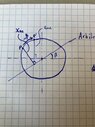
Hi all! In this assignment I have to formulate an equation for the shortest distance from a point on a circle perimeter to an arbitrary axis in a circle with angle theta. I included an image with the sketch. Anyone that can help?
 

Attachments
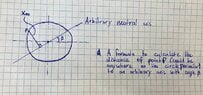
  • IMG_0476.jpg
    IMG_0476.jpg
    58.7 KB · Views: 211
  • Like
Likes   Reactions: Delta2
Physics news on Phys.org
Rotate the whole points around the Origin with angle ##-\beta##
Then you see new y coordinate of thus rotated P is what you want.
 
Thanks for the reply, I get what you mean but can't seem to get the new point P' through rotation. Do you know how to write it down? I added what you meant to my sketch for clarification.
 

Attachments

  • IMG_0483.jpg
    IMG_0483.jpg
    46.5 KB · Views: 221
Find in your sketch, say OP has angle ##\theta## to X axis, OP' has angle ##\theta-\beta## so you get y coordinate of P'.
 
1. You know that the equation of the reference line is ##y=(\tan\beta)x.##
2. You know that a line perpendicular to the reference line has the general form ##y=-\dfrac{1}{\tan\beta}x+b.##
3. You also know the coordinates ##\{x_P,~y_P\}## of the given point P.
4. Use the information in item 3 to find the intercept ##b## in item 2.
5. Find the coordinates of the intersection of the two lines.
 
  • Like
Likes   Reactions: Lnewqban
Slipjoints said:
Homework Statement:: Formulate an equation for the shortest distance from a point to a line
Relevant Equations:: Pythagorean Theorem / Thales?

Hi all! In this assignment I have to formulate an equation for the shortest distance from a point on a circle perimeter to an arbitrary axis in a circle with angle theta. I included an image with the sketch. Anyone that can help?
Hi @Slipjoints.

Let the circle’s centre be ‘O' and let ‘Q’ be the point on the line closest to P.

Have you given us the complete/accurate question? I’m guessing that you are told the circle’s radius is R and are told θ (which you haven’t marked) is the angle, measured anticlockwise, between the +x axis and OP.

Edit: And you want the distance (PQ) as a function of R, θ and β.
____________

Draw triangle OPQ. Note it is right-angled and that OP = R. Can you work out ∠POQ (or ∠QPO)?

If you can, the rest is (very) simple trigonometry.
 
Last edited: