Darkmisc
- 222
- 31
- Homework Statement
- What is the distance from r*(2i -j -2k) = 7 to the point (1, 1, -1)?
- Relevant Equations
- d=|PQ*n|
Hi everyone
I have worked solutions to the question, but I don't fully understand what they are doing and I get a different answer.
I used d=|PQ*n| and chose (0, 0, -7/2) as a point on the plane. I got that point by letting i and j = 0.
Since P = (1, 1, -1), PQ = (-1, -1, -5/2).
The unit vector of the normal works out to be (1/3)(2i -j -2k)
So d = |(-1, -1, -5/2)*(1/3)*(2, -1, -2)| = 4/3.
These are the worked solutions.
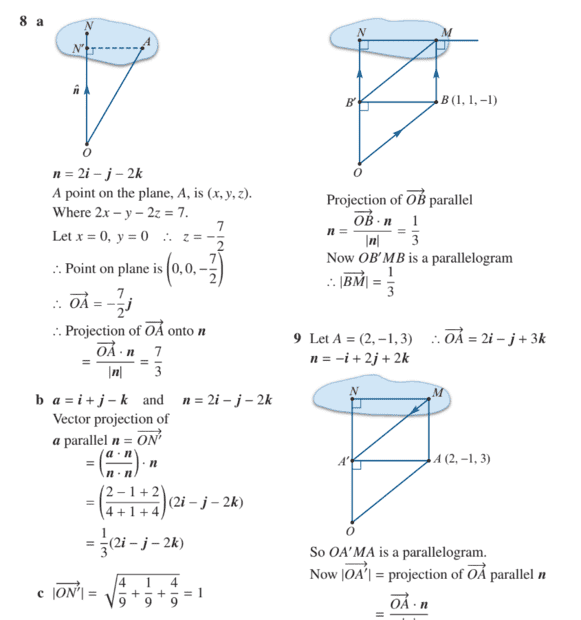
I understand the general logic behind it and can accept that OB' = BM. However, I don't understand how they know M is a point on the plane. Is it not possible for OB'MB to form a parallelogram without M touching the plane?Thanks
I have worked solutions to the question, but I don't fully understand what they are doing and I get a different answer.
I used d=|PQ*n| and chose (0, 0, -7/2) as a point on the plane. I got that point by letting i and j = 0.
Since P = (1, 1, -1), PQ = (-1, -1, -5/2).
The unit vector of the normal works out to be (1/3)(2i -j -2k)
So d = |(-1, -1, -5/2)*(1/3)*(2, -1, -2)| = 4/3.
These are the worked solutions.
I understand the general logic behind it and can accept that OB' = BM. However, I don't understand how they know M is a point on the plane. Is it not possible for OB'MB to form a parallelogram without M touching the plane?Thanks