Distance variation dependency between coil and magnet

Click For Summary
SUMMARY

The discussion centers on the non-linear relationship between the distance of an electromagnet (coil with iron core) and a magnet (Samarium Cobalt). Participants conclude that the force exerted by the magnet does not follow a simple inverse square or inverse cube law due to the complexity introduced by the interaction of two magnetic fields. Numerical calculations are suggested as a method to analyze the force more accurately, especially when considering the substitution of the magnet with un-magnetized iron. Ultimately, the consensus is that the relationship is complex and cannot be easily defined by a simple mathematical function.

PREREQUISITES
  • Understanding of electromagnetism principles
  • Familiarity with magnetic field interactions
  • Knowledge of numerical analysis techniques
  • Basic concepts of magnetic materials, specifically Samarium Cobalt and un-magnetized iron
NEXT STEPS
  • Research numerical methods for calculating magnetic forces
  • Explore advanced electromagnetism textbooks for in-depth theories
  • Investigate the effects of magnetic field distortion in proximity to ferromagnetic materials
  • Learn about the characteristics of Samarium Cobalt magnets and their applications
USEFUL FOR

Physicists, electrical engineers, and students studying electromagnetism who are interested in the complexities of magnetic field interactions and their mathematical modeling.

pasall
Messages
2
Reaction score
0
Hello!

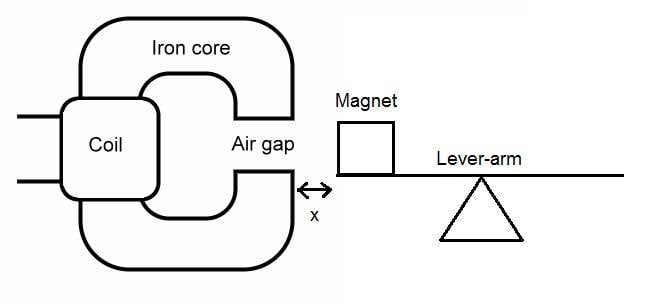
I'm wondering if there's a general dependency/connection/correlation/function for changes in distance between an electromagnet (coil with iron core) and a magnet (Samarium Cobalt). Here's a picture to explain what I mean:
3o1tYH2.jpg


If I move the coil closer to the magnet (smaller x) the force on the magnet increases and vice versa. I've discovered that it's not a linear connection. I've tried searching and the closest answer I've found is a function like f(x)=1/x^3 or f(x)=1/x^2 which I believe is called the inverese square law. However, in this case there are two magnetic fields involved so maybe it's not possible to determine such function for the above case? Any ideas?
 
Engineering news on Phys.org
pasall said:
However, in this case there are two magnetic fields involved so maybe it's not possible to determine such function for the above case?
Can you determine the force if the magnet is substituted by un-magnetized iron?

When you close up the magnet/iron, the magnetic field in the air gap will be distorted, and the location at some unlinear magnetizing characteristic will change.

It will not be a 1/x2 - function, nor a 1/x3.

A computer can calculate it, using numerical calculations.
 
Hesch said:
Can you determine the force if the magnet is substituted by un-magnetized iron?

Not really. I don't have the necessary equipment available and it's not that important either. Basically I wanted to know if there was a simple function/connection or if it was more complicated. I think I've got the answer (that it's very complex) and that will do just fine! Thank you for your answer!
 

Similar threads

Replies
12
Views
3K
Replies
7
Views
5K
  • · Replies 7 ·
Replies
7
Views
3K
  • · Replies 7 ·
Replies
7
Views
3K
  • · Replies 37 ·
2
Replies
37
Views
4K
  • · Replies 1 ·
Replies
1
Views
2K
  • · Replies 16 ·
Replies
16
Views
4K
  • · Replies 4 ·
Replies
4
Views
3K
  • · Replies 43 ·
2
Replies
43
Views
7K