Distributed weight of inclined beam.

Click For Summary

Homework Help Overview

The discussion revolves around the representation of a distributed load on an inclined beam, specifically how to accurately depict this load in a free body diagram. Participants are exploring the nature of the load, its direction, and the implications of the beam's inclination on the load's representation.

Discussion Character

  • Conceptual clarification, Problem interpretation, Assumption checking

Approaches and Questions Raised

  • Participants question whether the distributed load should be represented as rectangular or triangular and discuss the implications of the beam's angle on the load's direction. There are attempts to clarify the nature of the distributed load, with some suggesting it should be vertical while others express confusion about how to depict it accurately.

Discussion Status

There is active engagement with multiple interpretations of how to represent the distributed load. Some participants have provided insights into the nature of the load, while others are seeking visual aids to better understand the free body diagram. Guidance has been offered regarding the uniformity of the load and its representation.

Contextual Notes

Participants are navigating the complexities of drawing free body diagrams under specific conditions, including the weight per unit length of the beam and the effects of inclination. There is mention of a specific weight value and references to external resources for further clarification.
Mohmmad Maaitah
Messages
90
Reaction score
20
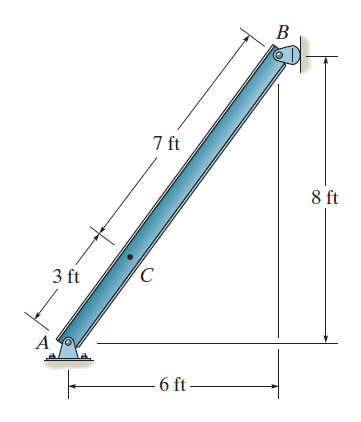
Homework Statement
The beam weighs 280 lb/ft. Determine the internal
normal force, shear force, and moment at point C.
Relevant Equations
Equations of equilibrium
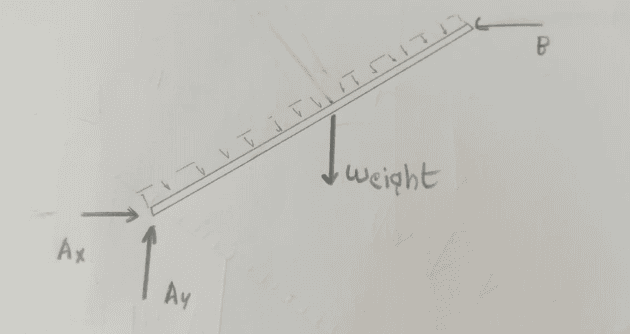
I'm having problem in drawing the distributed load (weight per foot) for the inclined beam as it shows.
should it be rectangular? if so shouldn't the distributed load be vertical down as the resultant weight at the centroid (W)
1702636296255.png
please help me understand how to draw the free body diagram for this one.
1702636361361.png
 
Physics news on Phys.org
If I draw it as Triangle it must be wrong (reason I want to is because I could make the Distributed load vertical then).
 
The distributed weight is $$\frac{dm}{ds}dsg$$ where ds is differential length along the bar; its direction is vertically downward.
 
Chestermiller said:
The distributed weight is $$\frac{dm}{ds}dsg$$ where ds is differential length along the bar; its direction is vertically downward.
I know and I solved the problem, I just want to see a free body diagram including the distributed load acting on the bar like this
(just how to draw the distributed load and I would appreciate a picture)
1702644491006.png
 

Attachments

  • 1702644424783.png
    1702644424783.png
    4.6 KB · Views: 142
  • 1702644452531.png
    1702644452531.png
    6.3 KB · Views: 105
Mohmmad Maaitah said:
I know and I solved the problem, I just want to see a free body diagram including the distributed load acting on the bar like this
(just how to draw the distributed load and I would appreciate a picture)
The distributed load should be in the direction of the resultant weight force. Taking a slice of the beam doesn't change its direction, just the magnitude of the resultant.
 
erobz said:
The distributed load should be in the direction of the resultant weight force. Taking a slice of the beam doesn't change its direction, just the magnitude of the resultant.
Right, but how do I draw the distributed load going vertically down?
like this:
1702646062261.png
 
1702646347846.png


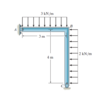
The weight per unit length of the beam is constant ( i.e. a uniformly distributed load), there is no "triangle" shaped distribution here. Those are representative of a changing distributed load over the span.

If you imagine rotating the beam to horizontal the distributed load from its own weight just tends to:
1702647800911.png
 
Last edited:
  • Like
  • Love
Likes   Reactions: Mohmmad Maaitah and Lnewqban
Mohmmad Maaitah said:
°°Homework Statement: The beam weighs 280 lb/ft. Determine the internal
normal force, shear force, and moment at point C.
Relevant Equations: Equations of equilibrium

I'm having problem in drawing the distributed load (weight per foot) for the inclined beam as it shows.
should it be rectangular? if so shouldn't the distributed load be vertical down as the resultant weight at the centroid (W)
help me understand how to draw the free body diagram for this one.
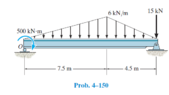
Just imagine the extreme case of 90° Inclination.
The beam becomes a column then.
The total weight will still be the same, only that “less equally distributed”.

Please, see:
https://learnaboutstructures.com/Determinate-Frame-Analysis
 
  • Informative
Likes   Reactions: Mohmmad Maaitah
I think the common misconception with distributed loads is that the arrows represent forces, when they actually represent the force gradient ## \frac{dF}{dx} ##. This is what I think your mix up is, given that you think the shape of the distribution should be triangular. The force increases linearly as we progress along the beam, but the gradient (the distributed load) is uniform.
 
  • Like
Likes   Reactions: Lnewqban and Mohmmad Maaitah
  • #10
Thank you all for the reply it is a big help!!
 
  • Like
Likes   Reactions: berkeman, Lnewqban and erobz
  • #11
For the case of the imaginary column, think of how normal force, shear force, and moment at point C will change.

Tip: No bending, only compression load that is inversely proportional to the height of the cross-section.
 
  • Informative
Likes   Reactions: Mohmmad Maaitah
  • #12
erobz said:
I think the common misconception with distributed loads is that the arrows represent forces, when they actually represent the force gradient ## \frac{dF}{dx} ##. This is what I think your mix up is, given that you think the shape of the distribution should be triangular. The force increases linearly as we progress along the beam, but the gradient (the distributed load) is uniform.
I find it a bit odd to describe it as a force gradient. I suppose it works if you define F to be the total force over the extent 0 to x.

I would rather describe it as force per unit length.
 
  • Like
Likes   Reactions: erobz and Mohmmad Maaitah

Similar threads

Replies
4
Views
1K
  • · Replies 8 ·
Replies
8
Views
18K
  • · Replies 5 ·
Replies
5
Views
2K
  • · Replies 4 ·
Replies
4
Views
2K
Replies
6
Views
2K
  • · Replies 2 ·
Replies
2
Views
2K
  • · Replies 5 ·
Replies
5
Views
4K
Replies
18
Views
3K
  • · Replies 4 ·
Replies
4
Views
2K