Distribution of Position in classical & quantum case

Click For Summary
SUMMARY

The discussion clarifies the distinction between classical and quantum distributions of position as outlined in Griffith's "The Harmonic Oscillator." In the classical case, the distribution of positions over time for a single oscillator is emphasized, where repeated measurements yield a range of x values. Conversely, the quantum case focuses on the probability distribution derived from the wave function, specifically ##|\Psi_{100} (x)|^2##, representing measurements across an ensemble of identically prepared systems. This highlights the fundamental difference in sampling methods between classical and quantum mechanics.

PREREQUISITES
  • Understanding of Griffith's "The Harmonic Oscillator"
  • Familiarity with quantum mechanics concepts, specifically wave functions
  • Knowledge of classical mechanics and oscillatory motion
  • Basic grasp of probability distributions in physics
NEXT STEPS
  • Study Griffith's "The Harmonic Oscillator" for deeper insights into classical and quantum distributions
  • Learn about the implications of wave functions in quantum mechanics, focusing on probability distributions
  • Explore classical mechanics' treatment of oscillators and their time-dependent behavior
  • Investigate the concept of ensemble averages in quantum systems
USEFUL FOR

Students and educators in physics, particularly those studying quantum mechanics and classical mechanics, as well as researchers interested in the foundational differences between classical and quantum systems.

WeiShan Ng
Messages
36
Reaction score
2
I am confused about the difference between the two
1.png

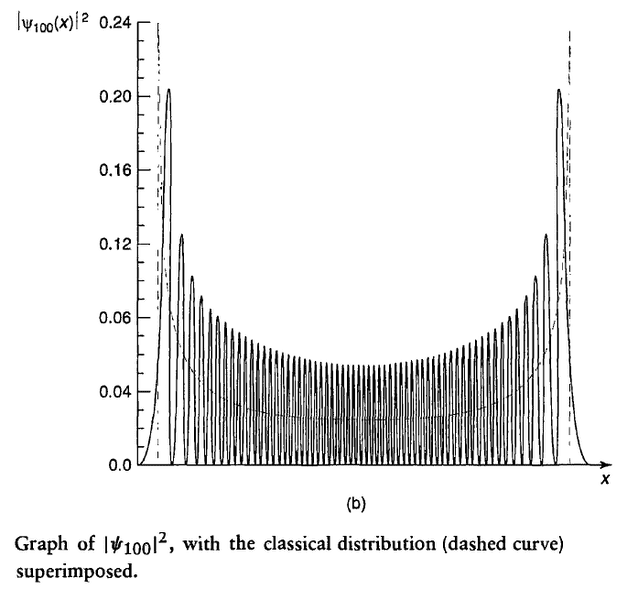
In Griffith's 2.3 The Harmonic Oscillator, he superimposes the quantum distribution and classical distribution and says
In the classical case we are talking about the distribution of positions over time for one oscillator, whereas in the quantum case we are talking about the distribution over an ensemble of identically prepared systems.

What I understand for quantum case is that ##|\Psi_{100} (x)|^2## gives the probability we will measure the particle at position ##x##. So if we were given a large set of the particles we will have a probability distribution of the measured ##x## and this distribution is what shown on the graph. However I don't quite understand what the distribution over time means in the classical case. I don't really see how the dependence of time fit in, since the graph is only x-dependence.
 

Attachments

  • 1.png
    1.png
    28.1 KB · Views: 1,015
Physics news on Phys.org
WeiShan Ng said:
However I don't quite understand what the distribution over time means in the classical case. I don't really see how the dependence of time fit in, since the graph is only x-dependence.
It is the distribution of x values that we will find if we sample the position of the one and only particle in our one and only classical oscillator repeatedly at many different times.

In the quantum mechanical case, we can't do repeated sampling on the same oscillator, so we get one sample from each of many oscillators instead of many samples from one oscillator. But either way, we end up with a large number of x values so that we can plot their distribution.
 
  • Like
Likes   Reactions: WeiShan Ng

Similar threads

  • · Replies 6 ·
Replies
6
Views
2K
  • · Replies 5 ·
Replies
5
Views
1K
  • · Replies 26 ·
Replies
26
Views
3K
  • · Replies 3 ·
Replies
3
Views
2K
  • · Replies 2 ·
Replies
2
Views
1K
  • · Replies 4 ·
Replies
4
Views
2K
  • · Replies 10 ·
Replies
10
Views
2K
  • · Replies 1 ·
Replies
1
Views
2K
  • · Replies 3 ·
Replies
3
Views
2K
  • · Replies 2 ·
Replies
2
Views
2K