WHT
- 22
- 4
Head's up, as this scientific finding is making the rounds. http://www.cnet.com/news/the-moon-is-shrinking-and-the-earth-is-shaping-it/
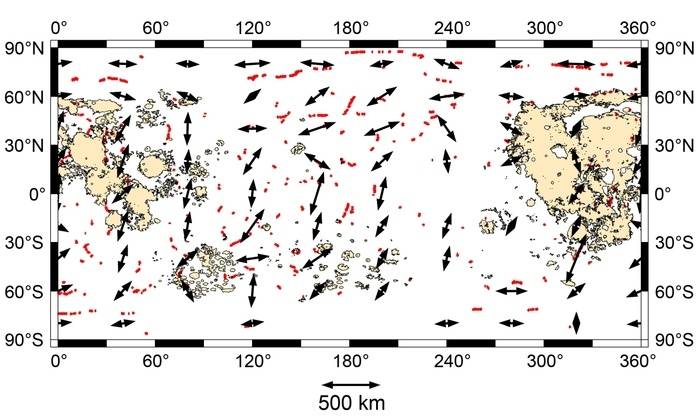
The claim is that the oriented gravitational pull shapes the landscape of the moon.
Except for the established effect of tides, it's odd that scientists do not ascribe much of the Earth's behavior to lunar forces. Yet this research claims that the Earth has a huge impact on the moon.
One topic we are working at The Azimuth Project forum is behavioral models for El Nino / Southern Oscillation. Whether this is coincidental or not, we are finding that the oscillation harmonics for ENSO and for the related Quasi-Biennial Oscillation (QBO) in the atmosphere follow precisely the folded periods of the Draconic and Synodic phases of the moon. We assert this correlation is not mere numerology because the physical model is so plausible.
A mass that can easily move due to gravitational effects is the one that has the least physical constraints. The ocean is one of these and the evidence is tidal action. Deeper within the ocean, the slight density difference of cool and warm water across the thermocline is even more compliant and so the lunar pull here results in the seemingly erratic sloshing oscillations of ENSO. And consider that the QBO takes place in the stratosphere, where the density of the atmosphere is so small that a lunar pull can bulge it very easily. This has ramifications for forcing the stratospheric winds in certain directions -- which is manifested by the lunar Draconic and Synodic periodicities we see in the QBO time series.
Something has to give here because the scientific establishment can't pick and choose as to what phenomena can demonstrate lunar forcing and which ones don't. There is other evidence that earthquake locality and timing is also associated with lunar dynamics, so the question is what do physics-minded people think about this.
Could this be a shift in thinking that rivals the adoption of plate tectonics theory? Forget predicting El Ninos as a meteorological topic -- if it turns out to be just geophysics and straightforward sloshing hydrodynamics, it will certainly shake up the climate science establishment.
The claim is that the oriented gravitational pull shapes the landscape of the moon.
Except for the established effect of tides, it's odd that scientists do not ascribe much of the Earth's behavior to lunar forces. Yet this research claims that the Earth has a huge impact on the moon.
One topic we are working at The Azimuth Project forum is behavioral models for El Nino / Southern Oscillation. Whether this is coincidental or not, we are finding that the oscillation harmonics for ENSO and for the related Quasi-Biennial Oscillation (QBO) in the atmosphere follow precisely the folded periods of the Draconic and Synodic phases of the moon. We assert this correlation is not mere numerology because the physical model is so plausible.
A mass that can easily move due to gravitational effects is the one that has the least physical constraints. The ocean is one of these and the evidence is tidal action. Deeper within the ocean, the slight density difference of cool and warm water across the thermocline is even more compliant and so the lunar pull here results in the seemingly erratic sloshing oscillations of ENSO. And consider that the QBO takes place in the stratosphere, where the density of the atmosphere is so small that a lunar pull can bulge it very easily. This has ramifications for forcing the stratospheric winds in certain directions -- which is manifested by the lunar Draconic and Synodic periodicities we see in the QBO time series.
Something has to give here because the scientific establishment can't pick and choose as to what phenomena can demonstrate lunar forcing and which ones don't. There is other evidence that earthquake locality and timing is also associated with lunar dynamics, so the question is what do physics-minded people think about this.
Could this be a shift in thinking that rivals the adoption of plate tectonics theory? Forget predicting El Ninos as a meteorological topic -- if it turns out to be just geophysics and straightforward sloshing hydrodynamics, it will certainly shake up the climate science establishment.