Do We Need Boundaries for Fraction Equations?

  • Thread starter Thread starter Callmelucky
  • Start date Start date
  • Tags Tags
    Algebra Fraction
Click For Summary
SUMMARY

In the discussion regarding boundaries for fraction equations, participants emphasized the necessity of excluding values that make the denominator zero. Specifically, for the equation \frac{x}{x-1}+\frac{x}{x+1}=\frac{9}{4}, it is crucial to state that x \neq 1 and x \neq -1 to avoid undefined expressions. The consensus is that authors should explicitly mention these restrictions to prevent confusion and ensure valid solutions. Additionally, any division by a variable introduces constraints that must be acknowledged throughout the problem-solving process.

PREREQUISITES
  • Understanding of rational expressions and their properties
  • Familiarity with the concept of undefined values in mathematics
  • Knowledge of the zero product property
  • Ability to manipulate algebraic equations involving fractions
NEXT STEPS
  • Study the implications of undefined values in rational equations
  • Learn about the zero product property and its applications in solving equations
  • Explore techniques for identifying and excluding invalid solutions in algebraic expressions
  • Practice solving complex fraction equations while keeping track of restrictions
USEFUL FOR

Students, educators, and anyone involved in algebraic problem-solving, particularly those working with rational expressions and seeking to understand the importance of defining boundaries in equations.

Callmelucky
Messages
144
Reaction score
30
Homework Statement
Do we always need to exclude solutions that would give 0 in the denominator of a fraction?
Relevant Equations
1/x
When working with fractions and when we have a fraction or equation with fractions like this one for example ##\frac{x}{x-1}+\frac{x}{x+1}=\frac{9}{4}## do we always need to set boundaries? Like, do we always need to write that x can't be a number that would give the denominator 0? In this particular case x can't be 1 and -1. Because that would equal 0 and we can't have 0 in the denominator.

I know it's kind of a stupid question and the answer is kind of obvious but I am not sure if that should be stated in the problem by the author or if I am supposed to do that.

Thank you.
 
Last edited:
Physics news on Phys.org
Callmelucky said:
Homework Statement:: Do we always need to exclude solutions that would give 0 in the denominator of a fraction?
Relevant Equations:: 1/x

When working with fractions and when we have a fraction or equation with fractions like this one for example ##\frac{x}{x-1}+\frac{x}{x+1}=\frac{9}{4}## do we always need to set boundaries? Like, do we always need to write that x can't be a number that would give the denominator 0? In this particular case x can't be 1 and -1. Because that would equal 0 and we can't have 0 in the denominator.

I know it's kind of a stupid question and the answer is kind of obvious but I am not sure if that should be stated in the problem by the author or if I am supposed to do that.

Thank you.
You should not call it a solution point. You should keep track of those invalid points and make sure that your final answer does not include them as valid.

ADDED: Sometimes intermediate steps are not valid for certain x-values. Although they don't work in the intermediate calculation, those x-values should be checked in the original problem. They might work.
 
Last edited:
  • Like
Likes   Reactions: WWGD, topsquark, Callmelucky and 1 other person
FactChecker said:
You should not call it a solution point. You should keep track of those invalid points and make sure that your final answer does not include them as valid.
Thank you.
 
Callmelucky said:
When working with fractions and when we have a fraction or equation with fractions like this one for example ##\frac{x}{x-1}+\frac{x}{x+1}=\frac{9}{4}## do we always need to set boundaries?
It's fairly clear in the equation above that x can be neither 1 nor -1.
If you multiply both sides of this equation by ##4(x - 1)(x + 1)## you get ##4x(x + 1) + 4x(x - 1) = 9##. At this point you should* state ##x \ne 1## and ##x \ne -1##, since there are no apparent restrictions on the possible solutions for x.
(* - by "should" I mean, if you don't do this, you are opening yourself up to trouble.)

Here's a different problem (admittedly very contrived) that shows why it's important to list restrictions:
##\frac{x^2 -1}{x - 1} + \frac 1 {x - 1} = \frac 1{x - 1}##

If we blithely multiply both sides by x - 1, we get ##x^2 - 1 + 1 = 1##, which simplifies to ##x^2 = 1##, with solutions ##x = \pm 1##. One of these is a solution to the original equation and the other is not.
 
  • Like
Likes   Reactions: PeroK and Callmelucky
I know, I was just confused because in some problems it's stated by the author that x can't be a number that would make a denominator 0. So I didn't know if I was supposed to write what x can't be or not.
 
I have another question, about something I haven't seen before.

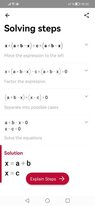
Here is the screenshot from photomath app(pic below).

It obviously makes sense, and the solutions do match with ones in my textbook. But I didn't expect that, I have only divided both sides with (a+b-x) and got x=c as the only solution.
Is there some kind of rule or something that would explain this.?

Thank you.
 

Attachments

  • WhatsApp Image 2022-12-20 at 09.29.12.jpeg
    WhatsApp Image 2022-12-20 at 09.29.12.jpeg
    14.5 KB · Views: 159
Callmelucky said:
But I didn't expect that, I have only divided both sides with (a+b-x) and got x=c as the only solution.
Is there some kind of rule or something that would explain this.?
You can only cancel ##a+b - x## if this expression is not zero. Whenever you cancel anything like this, you automatically have to write "or ##a + b - x = 0##.

This rule can be expressed as:
$$ac = bc \ \Rightarrow \ a = b \ \text{or} \ c = 0$$
 
  • Informative
Likes   Reactions: Callmelucky
PeroK said:
You can only cancel ##a+b - x## if this expression is not zero. Whenever you cancel anything like this, you automatically have to write "or ##a + b - x = 0##.

This rule can be expressed as:
$$ac = bc \ \Rightarrow \ a = b \ \text{or} \ c = 0$$
I see, thank you.
 
When the equation is set by the author at the beginning, does that automatically mean that there are no 0s in the denominator?
For example, I have an equation like this ##\frac{1}{a+b+x}=\frac{1}{a}+\frac{1}{b}+\frac{1}{x}## and I want to add stuff on the right side and in order to do that I need the smallest common denominator, which is abx, but if any of them is 0 I can't do that.

Thank you
 
  • #10
Callmelucky said:
When the equation is set by the author at the beginning, does that automatically mean that there are no 0s in the denominator?
For example, I have an equation like this ##\frac{1}{a+b+x}=\frac{1}{a}+\frac{1}{b}+\frac{1}{x}## and I want to add stuff on the right side and in order to do that I need the smallest common denominator, which is abx, but if any of them is 0 I can't do that.

Thank you
If any of these is zero, then one of your fractions is undefined. The original equation implies that none of the denominators is zero.
 
  • Like
Likes   Reactions: Callmelucky
  • #11
PeroK said:
If any of these is zero, then one of your fractions is undefined. The original equation implies that none of the denominators is zero.
Thank you.
There is one more thing, if I multiply both sides with (a+b+x)(abx) do I need to write that a+b+x##\neq##0 and a##\neq##0, b##\neq##0, x##\neq##0. Because on the left side a can be 0 so can b and x. In that case that would not apply to all a's and b's.
Thank you.
 
  • Like
Likes   Reactions: PeroK
  • #12
You should note those things to the best of your ability. It can be difficult to keep track of all the exceptions. It is always good to check your final answers in the original equations. That way, any division by zero will become apparent.
 
  • #13
Callmelucky said:
Thank you.
There is one more thing, if I multiply both sides with (a+b+x)(abx) do I need to write that a+b+x##\neq##0 and a##\neq##0, b##\neq##0, x##\neq##0. Because on the left side a can be 0 so can b and x. In that case that would not apply to all a's and b's.
Thank you.
Technically, that is implied by your original equation and could be stated explicitly at the beginning.

If at any stage you divide by a quantity, then you introduce an additional constraint that that quantity is non zero.
 
  • Like
Likes   Reactions: Callmelucky
  • #14
PeroK said:
Technically, that is implied by your original equation and could be stated explicitly at the beginning.

If at any stage you divide by a quantity, then you introduce an additional constraint that that quantity is non zero.
Thank you. But what if it happens that one of the denominators becomes 0 somewhere in the procedure? That fraction is invalid, but if it happens, does that mean that we just leave that fraction out of the equation and keep going with the procedure or something else?
 
  • #15
Callmelucky said:
Thank you. But what if it happens that one of the denominators becomes 0 somewhere in the procedure? That fraction is invalid, but if it happens, does that mean that we just leave that fraction out of the equation and keep going with the procedure or something else?
You'll need to provide an example of what you mean by that.
 
  • #16
PeroK said:
You'll need to provide an example of what you mean by that.
for example if equation ##\frac{1}{a+b+x}=\frac{1}{a}+\frac{1}{b}+\frac{1}{x}## is step in solving some other equation and it happens for a to be 0. The denominator on the left side will not be 0 and the rest of the stuff on the right side is valid. Is that then ##\frac{1}{b+x}=\frac{1}{b}+\frac{1}{x}##
It's not from the problem, it's just curiosity, I'm not even sure if that can happen.
 
  • #17
If you know ##a =0##, then you can replace ##a## by ##0##.
 
  • #18
PeroK said:
If you know ##a =0##, then you can replace ##a## by ##0##.
I know that but what happens with fraction 1/0, and with equation after plugging that in? My calculator says math error. Does that mean that the entire equation is invalid?

For example ##\frac{1}{b+x}=\frac{1}{0}+\frac{1}{2}##. My calculator gives error on ##\frac{1}{5}+\frac{1}{0}+\frac{1}{2}##
 
  • #19
Callmelucky said:
I know that but what happens with fraction 1/0, and with equation after plugging that in? My calculator says math error. Does that mean that the entire equation is invalid?
Yes. The entire equation is invalid.
 
  • Like
Likes   Reactions: Callmelucky
  • #20
Callmelucky said:
for example if equation ##\frac{1}{a+b+x}=\frac{1}{a}+\frac{1}{b}+\frac{1}{x}## is step in solving some other equation and it happens for a to be 0. The denominator on the left side will not be 0 and the rest of the stuff on the right side is valid. Is that then ##\frac{1}{b+x}=\frac{1}{b}+\frac{1}{x}##
It's not from the problem, it's just curiosity, I'm not even sure if that can happen.
This makes no sense. That first equation is not valid with ##a =0##.
 
  • #21
PeroK said:
Yes. The entire equation is invalid.
this is what I wanted to know. Thank you.
 
  • #22
Callmelucky said:
I have another question, about something I haven't seen before.

Here is the screenshot from photomath app(pic below).

It obviously makes sense, and the solutions do match with ones in my textbook. But I didn't expect that, I have only divided both sides with (a+b-x) and got x=c as the only solution.
Is there some kind of rule or something that would explain this.?

Thank you.
They used the zero product property.
 

Similar threads

  • · Replies 5 ·
Replies
5
Views
707
  • · Replies 3 ·
Replies
3
Views
2K
  • · Replies 5 ·
Replies
5
Views
2K
  • · Replies 4 ·
Replies
4
Views
2K
Replies
2
Views
2K
  • · Replies 39 ·
2
Replies
39
Views
4K
  • · Replies 25 ·
Replies
25
Views
1K
  • · Replies 7 ·
Replies
7
Views
4K
  • · Replies 14 ·
Replies
14
Views
3K
  • · Replies 8 ·
Replies
8
Views
2K