Does photocurrent depend on light frequency in the photoelectric effect?

Join the discussion
Registration is free. Ask a follow-up in this thread, or start your own.
5 replies · 3K views
pkc111
Messages
224
Reaction score
26
TL;DR
I am confused about information regarding the effect of light frequency on photocurrent in the Lenard's apparatus.
Pearson Physics 12 states:
"When the light sources have the same intensity but different frequencies, they produce the same maximum current"

However, Phet Simulation Photoelectric Effect seems to show that photocurrent changes with light frequency (eg see below for different photocurrents at 179 nm and 414 nm incident light wavelengths on sodium:

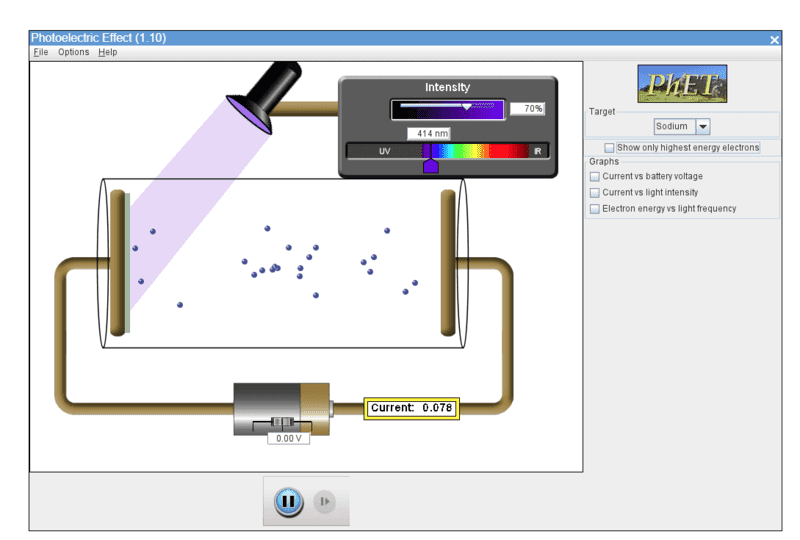
1654308153203.png

1654308178294.png
 
Reply
  • Informative
Likes   Reactions: Delta2
Physics news on Phys.org
Ironically in almost all treatments in physics books (even at the university level) in
$$\hbar \omega=E_{\text{kin}}+W_B$$
for the famous experiment by Millikan with the stopping voltage the constant ##W_B## is quoted wrongly as the binding energy of the electrons in the cathode, rather it's the binding energy of the anode [1]. To establish this, by the way, took Millikan years, while the measurement of Plancks constant ##h=2 \pi \hbar## was pretty right from the very beginning.

[1] J. Rudnick, D. Tannhauser, Concerning a widespread error in the description of the photoelectric
effect, Am. J. Phys. 44, 796 (1976).
https://doi.org/10.1119/1.10130
 
Reply
  • Informative
  • Like
Likes   Reactions: malawi_glenn and Delta2
vanhees71 said:
Ironically in almost all treatments in physics books (even at the university level) in
$$\hbar \omega=E_{\text{kin}}+W_B$$
for the famous experiment by Millikan with the stopping voltage the constant ##W_B## is quoted wrongly as the binding energy of the electrons in the cathode, rather it's the binding energy of the anode [1]. To establish this, by the way, took Millikan years, while the measurement of Plancks constant ##h=2 \pi \hbar## was pretty right from the very beginning.

[1] J. Rudnick, D. Tannhauser, Concerning a widespread error in the description of the photoelectric
effect, Am. J. Phys. 44, 796 (1976).
https://doi.org/10.1119/1.10130

Actually, even that is not as clear-cut.

The nature of what a "work function" is is more complicated than such a simple answer. For example, in many instances, it is treated as simply the image charge potential of an electron emitted very near the surface of the material, thus creating an image charge of itself. The work function then is the minimum energy for this electron to overcome the image potential of itself.

See, for example, Pg. 10 of this article, which is a common usage of work function in accelerator physics and photoinjectors:

https://indico.cern.ch/event/218284...ts/352241/490774/Part_1_-Electron_sources.pdf

It is why one can modify the work function via Schottky effect, resulting in a lower work function and thus, higher electron emission and higher QE.

Zz.
 
Reply
  • Like
  • Informative
Likes   Reactions: Son Goku, vanhees71 and berkeman