The Count
- 27
- 0
In a lecture from a course in QM, it was mentioned that Shroedinger's equation is deterministic in one and two dimensions. But in third dimension it gives unstable solutions, loosing it's determinism.
It was mentioned that "in space of D dimensions Gauss theorem leads to the conclusion that Coulomb field of point charge is proportional to 1/r(D-1) and thus the potential energy is proportional to 1/r(D-2). For D = 4 the potential energy is proportional to 1/r2. This potential when substituted in Shroedinger's equation leads to unstable solution. See Landau-Lifshitz Quantum Mechanics paragraph 35."Fall of a particle to the centre". Unstable solutions arising when D> 4."
I couldn't find any literature on this subject, and I have to say that from the book I could not derive such result.
Is it true for all 4 forces that loose their determinism in 3 dimensions, or just the coulomb (EM) force?
Is "particle falling to the center" a global example, that can represent all cases?
I was wondering if anybody can help on this.
For your help I will attach the specific pages of the book mentioned.
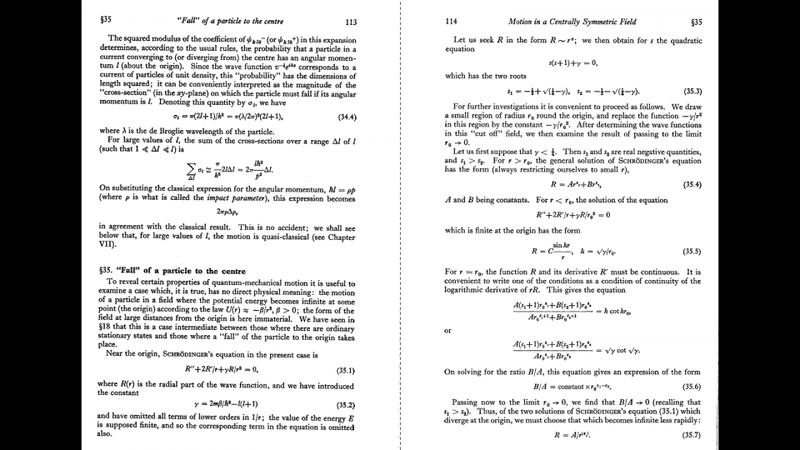
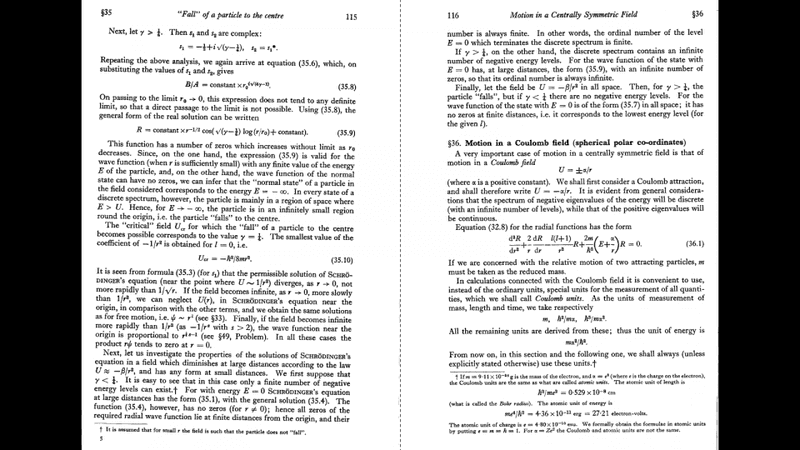
It was mentioned that "in space of D dimensions Gauss theorem leads to the conclusion that Coulomb field of point charge is proportional to 1/r(D-1) and thus the potential energy is proportional to 1/r(D-2). For D = 4 the potential energy is proportional to 1/r2. This potential when substituted in Shroedinger's equation leads to unstable solution. See Landau-Lifshitz Quantum Mechanics paragraph 35."Fall of a particle to the centre". Unstable solutions arising when D> 4."
I couldn't find any literature on this subject, and I have to say that from the book I could not derive such result.
Is it true for all 4 forces that loose their determinism in 3 dimensions, or just the coulomb (EM) force?
Is "particle falling to the center" a global example, that can represent all cases?
I was wondering if anybody can help on this.
For your help I will attach the specific pages of the book mentioned.
Attachments

Last edited: