Does the barycenter of the Earth-Moon system change?

  • Context: Undergrad 
  • Thread starter Thread starter Sven E
  • Start date Start date
  • Tags Tags
    Change Moon System
Click For Summary
SUMMARY

The barycenter of the Earth-Moon system is located approximately 1000 miles inside the Earth, primarily due to the Earth's mass being about 81 times greater than that of the Moon. While the barycenter does change position as the Earth orbits the Sun, the mass distribution of both the Earth and Moon is relatively homogeneous, with the Earth's deviation from a perfect sphere being only about 3% and the Moon's deviation around 10%. Changes in mass distribution, such as sea level rise, do not significantly affect the Earth-Moon distance due to the overall stability of the system's mass distribution.

PREREQUISITES
  • Understanding of barycenter concepts in celestial mechanics
  • Familiarity with gravitational studies and mass distribution
  • Basic knowledge of Earth and Moon physical characteristics
  • Awareness of orbital dynamics and their effects on celestial bodies
NEXT STEPS
  • Research gravitational studies related to Earth and Moon mass distribution
  • Explore the effects of sea level rise on gravitational forces
  • Learn about the calculation of barycenters in multi-body systems
  • Investigate the impact of orbital mechanics on celestial distances
USEFUL FOR

Astronomers, astrophysicists, students studying celestial mechanics, and anyone interested in the dynamics of the Earth-Moon system.

Sven E
Messages
2
Reaction score
0
Hi to all!

My question is:
Does the relative position of the barycenter of the Earth-Moon system change due to mass distribution changes in the system and would this affect the Earth-Moon distance?
For example: Could the sea level rise change the Earth-Moon distance?
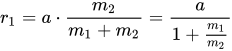
The only formula I found looks like this one:
057b0059e2415bfa714aa9f069ea3ac308e2e256

But this is obviously a formula which does not take mass distributions of the two objects into account.
Any suggestions for calculations regarding this question are highly appreciated! Thanks in advance! :smile:Sven
 
Astronomy news on Phys.org
It's already changing because it's moving around the sun. If you say "that doesn't count!", fine, but then this discussion will hinge around what "counts" and what doesn't.
 
Unsurprisingly, the Earth moon barycenter is located about 1000 miles inside the earth. Unsurprising, considering the Earth is about 81 times more massive than the moon. The precise mass distribution of the Earth and moon is not known with great precision. Gravitational studies to date suggest the Earth's mass distribution is very homogenous. the moon/s mass distribution is less well known although the data indicate it too is fairly homogeneous. The Earth is very close to being a perfect sphere, it deviates from spherical only by about 3%. The moon is much less spherical from earth. I think it deviates about 10% from spherical,. The huge gravity of Earth is part of the reason. The moon was largely molten when it first formed and its surface got tugged out of spheroidal by the earth. It also has a much thicker crust on the far side vs the near side thus giving it a lemon-like appearance. Still it is pretty round compared to most moons in the solar system.
 

Similar threads

  • · Replies 4 ·
Replies
4
Views
5K
  • · Replies 51 ·
2
Replies
51
Views
7K
  • · Replies 15 ·
Replies
15
Views
2K
  • · Replies 33 ·
2
Replies
33
Views
5K
Replies
8
Views
2K
  • · Replies 8 ·
Replies
8
Views
3K
  • · Replies 2 ·
Replies
2
Views
1K
  • · Replies 62 ·
3
Replies
62
Views
15K
  • · Replies 4 ·
Replies
4
Views
3K
  • · Replies 4 ·
Replies
4
Views
3K