Does the Electric Field Change When One Charge Moves Relative to Another?

Click For Summary
SUMMARY

The discussion centers on the behavior of electric fields when point charges move relative to one another, specifically addressing the fixed charge ##q_1## and the moving charge ##q_2##. It is established that while the electric field created by ##q_1## remains static from its own perspective, the net electric field changes as ##q_2## moves. The conversation highlights the axiom of classical electromagnetism that a point charge does not influence itself through its own electric field, leading to undefined forces according to Coulomb's Law. The discussion also touches on the limitations of classical electromagnetism in accurately describing charged point particles.

PREREQUISITES
  • Understanding of Coulomb's Law and electric fields
  • Familiarity with the concepts of static and dynamic electric fields
  • Basic knowledge of classical electromagnetism principles
  • Awareness of the Lorentz force and its implications
NEXT STEPS
  • Study the principles of electrodynamics and how they differ from electrostatics
  • Learn about the Landau-Lifshitz approximation and the Lorentz-Abraham-Dirac Equation
  • Explore the implications of self-interaction in charged particles
  • Investigate the concept of magnetic fields in relation to moving charges
USEFUL FOR

Physics students, electrical engineers, and anyone interested in advanced electromagnetism concepts and the behavior of electric fields in dynamic systems.

DrBanana
Messages
54
Reaction score
4
So consider you have a point charge ##q_1## which is somehow fixed in space so it won't move if a force is applied to it. Then at some distance away you have another point charge ##q_2##, where ##q_1## and ##q_2## are of comparable magnitude (so, one is not insignificant compared to the other). Now I think in high school at least the convention is, when you want to calculate the work done by the field on the charge ##q_2## as it moves from point A to point B you either set up a simple integral involving Coulomb's Law, or you use the potentials ##V_a## and ##V_b## of the points as if the q2 charge wasn't there. But my question is, why don't we calculate the net potential of point A or point B, taking both charges into account?

Another way to frame this is, when the ##q_2## charge moves from point A to point B, we assume the field created by ##q_1## doesn't change, but why? As ##q_2## moves, the net field does change, right? In that case, what do I do? I did some googling and learned that changing fields are addressed in electrodynamics, not statics, but I just want to be sure if the field changes here.

Edit: To make my issue a bit clearer: Consider we have one point charge stuck onto the end of a stick. The charge creates its own field. Now as we move the stick the charge also moves. My question is, does the field created by the charge do work on that charge?
 
Last edited:
Physics news on Phys.org
It's an axiom of classical electromagnetism that the electric field of a point charge does not influence the charge itself. According to Coulombs law the force would be undefined in both magnitude and direction.
 
PeroK said:
It's an axiom of classical electromagnetism that the electric field of a point charge does not influence the charge itself. According to Coulombs law the force would be undefined in both magnitude and direction.

Ok but why is it considered as an axiom? It's not that obvious that it's true.
 
DrBanana said:
Ok but why is it considered as an axiom? It's not that obvious that it's true.
There's no obligation on an axiom to be obvious. That said, if you have an isolated point charge, what would you expect it to do in response to its own electric field?
 
PeroK said:
There's no obligation on an axiom to be obvious. That said, if you have an isolated point charge, what would you expect it to do in response to its own electric field?
Ok just to clarify here, if we have a collection of 'fixed' charges ##q_1,\ q_2,\ ...\ q_n## and we move another point charge ##Q## around in the net electric field created by them, from the eyes of an observer the electric field obviously changes as ##Q## moves around, but from the 'perspective' of ##Q## it's moving around in a static field?
 
DrBanana said:
Ok just to clarify here, if we have a collection of 'fixed' charges ##q_1,\ q_2,\ ...\ q_n## and we move another point charge ##Q## around in the net electric field created by them, from the eyes of an observer the electric field obviously changes as ##Q## moves around, but from the 'perspective' of ##Q## it's moving around in a static field?
That's one way to put it.
 
Hi, I have a closely related question that fits right in, I think. It is about magnetic fields though.

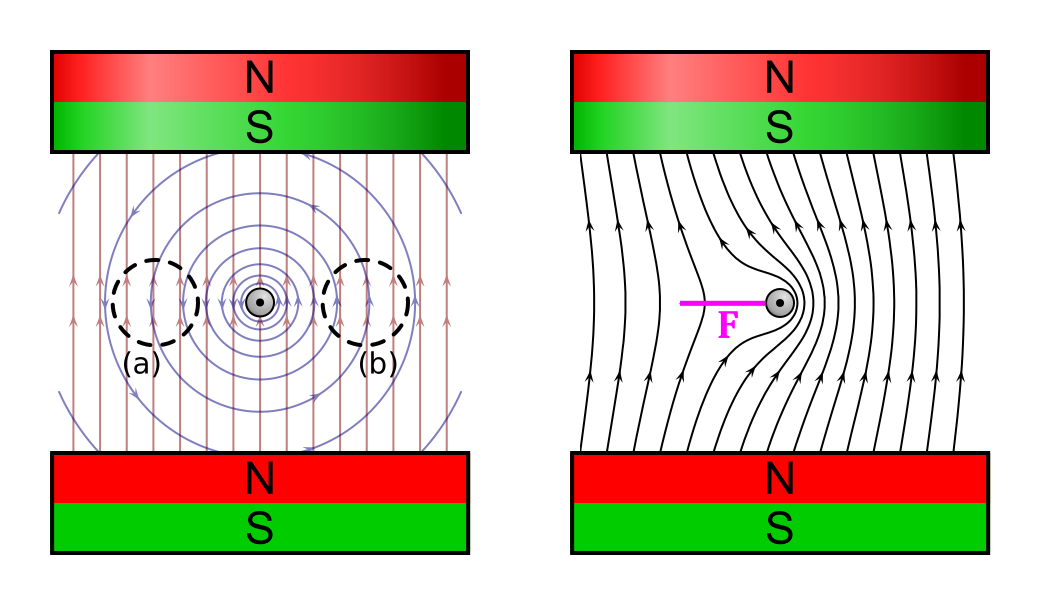
The superposition of a homogenous magnetic field and the field of a straight current-carrying wire perpendicular to it is called "catapult field":
wire-in-homogenous-field.svg

Now I've read numerous times that the Lorentz force vectors points in the direction of the weakest field. Is that only a mnemonic? As far as I understand it, the wire only "sees" the homogenous magnetic field of the magnets, doesn't it? Or is that different now, since the wire is not pointlike?
 
PeroK said:
It's an axiom of classical electromagnetism that the electric field of a point charge does not influence the charge itself. According to Coulombs law the force would be undefined in both magnitude and direction.
I would rather say that at this point classical electromagnetism breaks down. There is no self-consistent theory of charged point particles in classical electromagnetism known. The best description we have at the classical level and which to some extent also seems to be in accordance with phenomenology is the Landau-Lifshitz approximation of the Lorentz-Abraham-Dirac Equation.
 
  • Like
Likes   Reactions: DrBanana

Similar threads

  • · Replies 16 ·
Replies
16
Views
2K
  • · Replies 6 ·
Replies
6
Views
1K
  • · Replies 8 ·
Replies
8
Views
2K
  • · Replies 5 ·
Replies
5
Views
1K
  • · Replies 2 ·
Replies
2
Views
2K
  • · Replies 20 ·
Replies
20
Views
5K
  • · Replies 15 ·
Replies
15
Views
2K
  • · Replies 7 ·
Replies
7
Views
2K
  • · Replies 7 ·
Replies
7
Views
3K
  • · Replies 8 ·
Replies
8
Views
2K