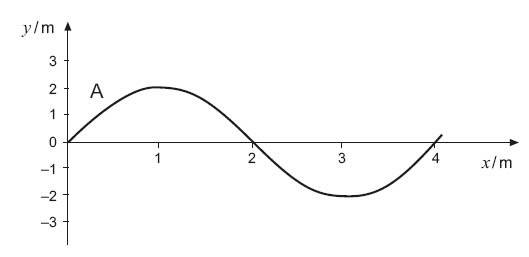
Does this graph is correct representing a sound wave?

Click For Summary
The discussion centers on the accuracy of a graph representing a sound wave in a medium. The original poster questions whether the graph, which resembles a sine wave, correctly depicts sound waves, which are compressive rather than electromagnetic. It is suggested that the equation y/m = A sin(kx/m) can be used to analyze the wave, focusing on finding the amplitude (A) and wave number (k) to match the graph's peaks and zeros. The conversation emphasizes the distinction between sound waves and electromagnetic waves. Overall, the inquiry seeks clarity on the representation of sound waves in graphical form.
SciencePF
Messages
55
Reaction score
0
I had today an exam.

I that exam this graph they said represent a sound wave. Is this graph correct representing a sound wave in a medium? My interrogation is about y/m as a function of x/m!
graph.jpg


Thanks in advance!
 
Physics news on Phys.org
No help! Is this a nonsense question?
 
well, i guess no, it's not right, as sound waves are compressive waves, not like electromagnetic that look like that(or more or less like that).
 
It looks like a sine wave to me. So y/m=Asin(kx/m). Find A and k to reproduce the peaks and zeros of the wave.
 
The book claims the answer is that all the magnitudes are the same because "the gravitational force on the penguin is the same". I'm having trouble understanding this. I thought the buoyant force was equal to the weight of the fluid displaced. Weight depends on mass which depends on density. Therefore, due to the differing densities the buoyant force will be different in each case? Is this incorrect?

Similar threads

  • · Replies 13 ·
Replies
13
Views
2K
  • · Replies 19 ·
Replies
19
Views
1K
  • · Replies 8 ·
Replies
8
Views
787
Replies
20
Views
5K
  • · Replies 4 ·
Replies
4
Views
1K
Replies
4
Views
2K
  • · Replies 8 ·
Replies
8
Views
2K
  • · Replies 17 ·
Replies
17
Views
2K
Replies
3
Views
829
Replies
1
Views
1K