Double Integrals 2: Solving X Limits

  • Context: MHB 
  • Thread starter Thread starter Petrus
  • Start date Start date
  • Tags Tags
    Integrals
Click For Summary

Discussion Overview

The discussion revolves around determining the x limits for a double integral involving the area bounded by the curves \(y=x^6\) and \(y=x^{1/5}\). Participants explore the intersection points of these curves as part of solving the integral.

Discussion Character

  • Mathematical reasoning
  • Homework-related

Main Points Raised

  • One participant requests tips on solving for the x limits of the area bounded by the curves \(y=x^6\) and \(y=x^{1/5}\).
  • Another participant suggests finding the intersection points of the curves by solving the equation \(x^6=x^{1/5}\), leading to the solutions \(x_1=1\) and \(x_2=0\).
  • A later reply confirms that these intersection points represent the x limits for the problem.
  • One participant shares their solution process for the double integral, detailing the steps taken to evaluate it after establishing the limits.

Areas of Agreement / Disagreement

Participants generally agree on the intersection points being \(x=0\) and \(x=1\) as the x limits for the integral. However, the discussion does not explore any alternative methods or solutions, leaving the approach somewhat singular.

Contextual Notes

The discussion does not address potential assumptions or limitations in the methods used to find the intersection points or evaluate the integral.

Who May Find This Useful

Students or individuals interested in double integrals, particularly those learning about setting limits of integration in relation to bounded areas defined by curves.
Petrus
Messages
702
Reaction score
0
Hello MHB,
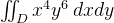
I would like to have tips how to solve the x limits for this problem
b867adbf43d51b76f0ac0beaa6f58a1.png
,
there
63f86405842dc75e05f46ff22f62e41.png
Regards,
 
Physics news on Phys.org
Petrus said:
Hello MHB,
I would like to have tips how to solve the x limits for this problem
b867adbf43d51b76f0ac0beaa6f58a1.png
,
there
63f86405842dc75e05f46ff22f62e41.png
Regards,

Your area D is bounded by the 2 curves $y=x^6$ and $y=x^{1/5}$.
Where do they intersect?
Or put differently, can you solve that set of 2 equations?
 
I like Serena said:
Your area D is bounded by the 2 curves $y=x^6$ and $y=x^{1/5}$.
Where do they intersect?
Or put differently, can you solve that set of 2 equations?
hmm $$x^6=x^{1/5} <=> x_1=1 x_2=0$$
 
Petrus said:
hmm $$x^6=x^{1/5} <=> x_1=1 x_2=0$$

Yep.
Those are the x limits in your problem.
 
I like Serena said:
Yep.
Those are the x limits in your problem.
Hello I like Serena,
I forgot to say thanks, I solved it!:)

For anyone who is interested how to solve it:
$$\int_0^1\int_{x^6}^{x^{\frac{1}{5}}} x^4y^6 \ dydx$$
We can always use Fubini's theorem and take out the constant and integrate the y so we got

$$\int_0^1 x^4 \left[\frac{y^7}{7}\right]_{x^6}^{x^{\frac{1}{5}}}$$
$$\int_0^1x^4\frac{x^{\frac{7}{5}}}{7}-x^4\frac{x^{42}}{7} dx$$
use the rule $$x^m*x^n=x^{n+m}$$ and we can simplify to ( we can take out a constant as well):

$$\frac{1}{7}\int_0^1x^{\frac{27}{5}}-x^{46} dx$$
$$\frac{1}{7} \left[ \frac{5x^{\frac{32}{5}}}{32} - \frac{x^{47}}{47} \right]_0^1 = \frac{29}{1504}$$

Regards,
 

Similar threads

  • · Replies 3 ·
Replies
3
Views
2K
  • · Replies 2 ·
Replies
2
Views
3K
  • · Replies 3 ·
Replies
3
Views
2K
  • · Replies 8 ·
Replies
8
Views
3K
  • · Replies 11 ·
Replies
11
Views
3K
  • · Replies 11 ·
Replies
11
Views
3K
  • · Replies 31 ·
2
Replies
31
Views
4K
  • · Replies 2 ·
Replies
2
Views
1K
  • · Replies 7 ·
Replies
7
Views
2K
  • · Replies 27 ·
Replies
27
Views
2K
