E&M: Field of a Wire with non-uniform current

Click For Summary
SUMMARY

The discussion centers on solving a magnetostatics problem related to the field of a wire with non-uniform current, specifically problem 2 from the MIT Physics II exam. Participants confirm that the curl of the magnetic field (B field) is zero outside the wire due to the absence of current density. The use of Ampere's Law in differential form is validated as an effective method for solving the problem, reinforcing the reliability of this approach. The conversation emphasizes the importance of verifying solutions through multiple methods to build confidence in the results.

PREREQUISITES
  • Understanding of magnetostatics principles
  • Familiarity with Ampere's Law in differential form
  • Knowledge of cylindrical coordinates
  • Ability to evaluate the curl of vector fields
NEXT STEPS
  • Study the application of Ampere's Law in various geometries
  • Learn how to compute the curl of vector fields in cylindrical coordinates
  • Explore the implications of current density on magnetic fields
  • Review additional magnetostatics problems from the MIT Physics II course
USEFUL FOR

Physics students, educators, and anyone interested in deepening their understanding of magnetostatics and the application of Ampere's Law in solving electromagnetic problems.

KDPhysics
Messages
73
Reaction score
24
Summary:: Not sure if my solution to a magnetostatics problem is correct

[Mentor Note -- thread moved from the technical forums, so no Homework Template is shown]

I was trying to solve problem 2 from: https://ocw.mit.edu/courses/physics/8-022-physics-ii-electricity-and-magnetism-fall-2006/exams/exam2.pdf

Here is my solution:
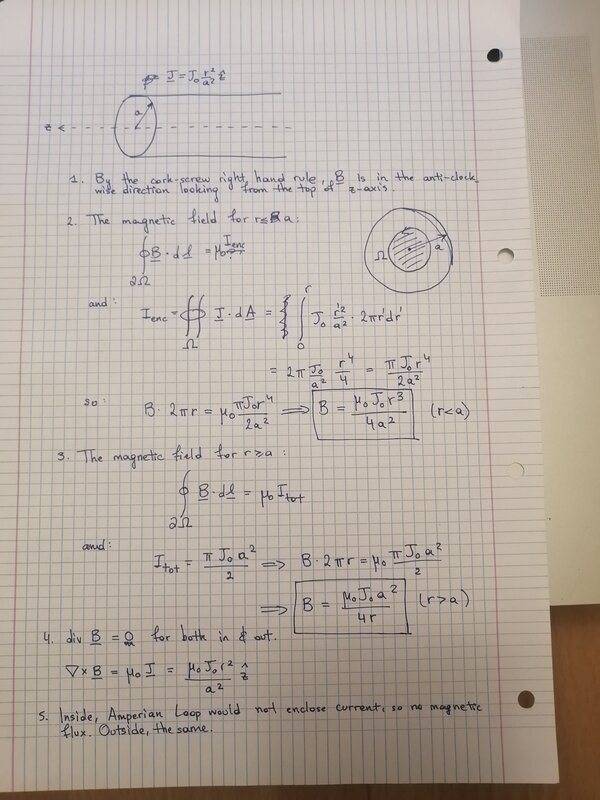
IMG_20200522_214706.jpg
 
Last edited by a moderator:
  • Like
Likes   Reactions: etotheipi
Physics news on Phys.org
Looks fine, except in part 4 you did not specify the field outside.
 
  • Like
Likes   Reactions: etotheipi and KDPhysics
do you mean the curl of the B field?
 
KDPhysics said:
do you mean the curl of the B field?
Yes, sorry, that's what I meant.
 
Since the current density is zero outside, is the curl also zero?
 
You have an expression for ##\vec B(\vec r)## outside the wire. Can't you just take its curl?
 
Isn't it faster to just use Ampere's Law in differential form?
 
I tried just evaluating the curl in cylindrical coordinates and found 0, as was expected.

Soo was my initial reasoning using Ampere's law correct? Or was it just a coincidence?
 
KDPhysics said:
Isn't it faster to just use Ampere's Law in differential form?
It is, but aren't you just curious whether you get the same answer if you did it the other way? Checking the answer by doing it in two different ways shows that it all hangs together and is not coincidence, not to mention reinforcing the belief in yourself that you can do this sort of thing on your own and do it correctly.
 
  • Like
Likes   Reactions: KDPhysics
  • #10
That is true... Well I guess I now trust Ampere's Law even more than before. Thanks
 
  • Like
Likes   Reactions: kuruman

Similar threads

Replies
7
Views
1K
Replies
4
Views
2K
  • · Replies 3 ·
Replies
3
Views
5K
Replies
5
Views
5K
  • · Replies 2 ·
Replies
2
Views
2K
  • · Replies 2 ·
Replies
2
Views
3K
  • · Replies 4 ·
Replies
4
Views
2K
Replies
2
Views
3K
  • · Replies 4 ·
Replies
4
Views
4K
Replies
3
Views
3K