E&M: Forces resulting from Charges at the Corners of a Cube

Click For Summary

Homework Help Overview

The discussion revolves around calculating the forces resulting from point charges located at the corners of a cube, specifically focusing on the forces acting on a charge at point A or K. The subject area is electrostatics, particularly the vector nature of forces between charged particles.

Discussion Character

  • Exploratory, Assumption checking, Mathematical reasoning

Approaches and Questions Raised

  • Participants discuss the distances of charges from point A and K, the vector nature of forces, and the symmetry of the problem. There are attempts to resolve forces into components and questions about the correctness of diagrams and calculations.

Discussion Status

Several participants have offered comments and guidance on resolving vector components and checking assumptions about charge positions. There is an ongoing exploration of different approaches to calculating forces, with some participants expressing confusion about specific calculations and setups.

Contextual Notes

Participants note discrepancies in charge positions as depicted in different diagrams, which may affect calculations. There is also mention of significant figures and units in the context of the problem, indicating a focus on proper scientific notation.

cherry
Messages
25
Reaction score
6
Homework Statement
Eight point charges, each of magnitude q =4.76e-06 C, are located on the corners of a cube of edge s=14.8 cm, as shown in the figure. What is the magnitude of the resultant force exerted by the other charges on the charge located at point A? Image: https://drive.google.com/file/d/1mOFCbEIpWz8IohRbg-ZmnU2rn6VfZ7dS/view?usp=sharing
Relevant Equations
F=k*(q^2/r^2)
My first attempt at solving:

I divided up the point charges based on the radius away from point A.
1 charge was s*sqrt(3) away, 3 charges were s*sqrt(2) away, and 3 charges were s away from point A.
q remained constant.

Therefore, my F_total was:
F_total = k * [(q^2 / s^2*sqrt(3))+3(q^2/s^2*sqrt(2))+3(q^2/s^2)]

When I solved this, I got the wrong answer, unfortunately.
Can someone lead me in the right direction?
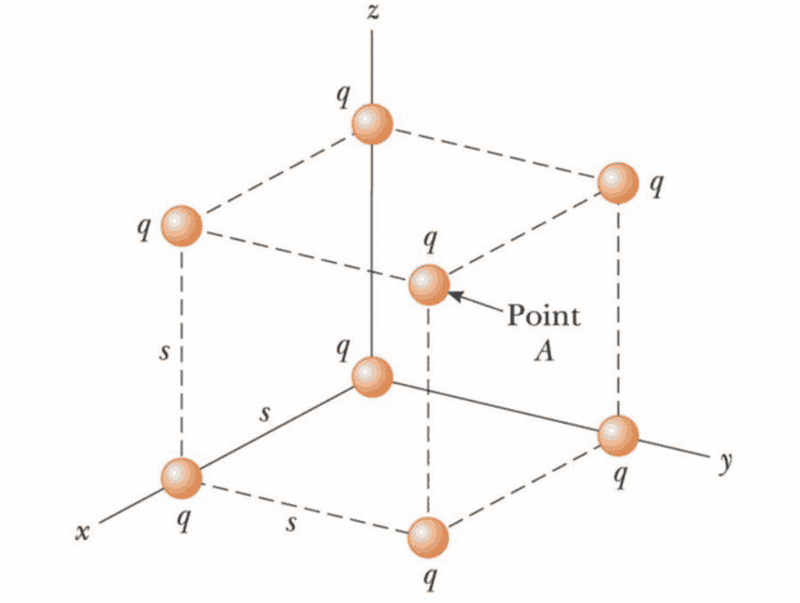
1705420620475.png
 
Physics news on Phys.org
Force is a vector. The magnitude of a sum of vectors is not the sum of the magnitudes.
 
  • Like
Likes   Reactions: PhDeezNutz
Apart from what was already said, I would notice that all components (x, y, and z) must be equal due to the symmetry of the problem. It is therefore sufficient to compute one of the components, which may be slightly faster.
 
  • Like
Likes   Reactions: MatinSAR, PhDeezNutz, Steve4Physics and 1 other person
Hi, I tried that and got 64.427 as my answer which was unfortunately wrong.
Screenshot 2024-01-16 at 11.13.19 AM.png


Unless I made a calculation error, in which case, could you let me know where the error is?
 
I get that three charges do not contribute to the force in the x-direction:
 
  • Like
Likes   Reactions: MatinSAR, Steve4Physics and berkeman
Hi @cherry. A few comments...

The Post #1 diagram shows point A at (s, s, s). But the Post #4 diagram shows it at (0, 0, s). So make sure you know which one is correct. And you seem to have renamed the charge on which the total force is required as 'K' to add to the confusion!

To perform the correct vector adiditions, you need to add the x components of all forces on A to get the x component of the total force on A; similary for y and z components. Then you combine these to get the total magnitude. So make sure you are correctly resolving each force into its x, y and z components.

Note that your answer of '64.427', even if it were correct, would lose you 2 marks: 1 mark for an inappropriate number of significant figures and 1 mark for missing units.

And if you can take-on @Orodruin's and @PeroK's replies, you can save yourself a lot of work.

Edit: typo's.
 
  • Like
Likes   Reactions: MatinSAR
Steve4Physics said:
Hi @cherry. A few comments...

The Post #1 diagram shows point A at (s, s, s). But the Post #4 diagram shows it at (0, 0, s). So make sure you know which one is correct. And you seem to have renamed the charge on which the total force is required as 'K' to add to the confusion!

To perform the correct vector adiditions, you need to add the x components of all forces on A to get the x component of the total force on A; similary for y and z components. Then you combine these to get the total magnitude. So make sure you are correctly resolving each force into its x, y and z components.

Note that your answer of '64.427', even if it were correct, would lose you 2 marks: 1 mark for an inappropriate number of significant figures and 1 mark for missing units.

And if you can take-on @Orodruin's and @PeroK's replies, you can save yourself a lot of work.

Edit: typo's.
Hi, I'm just a little confused as to how I would set up my equation.

Using Post #4 diagram:

Σx = -Ox-Cx-Ax-Dx

and Σx = Σy = Σz

and radius for Ox, Cx, Ax, Dx = s = 0.148 m

Is this right?
 
cherry said:
Hi, I'm just a little confused as to how I would set up my equation.

Using Post #4 diagram:

Σx = -Ox-Cx-Ax-Dx

and Σx = Σy = Σz

and radius for Ox, Cx, Ax, Dx = s = 0.148 m

Is this right?
I don't follow that. For any charge, there are only four charges for which the force has an x-component. One is a distance ##s## away; two are a distance ##\sqrt 2 s## away and one is a distance ##\sqrt 3 s## away.
 
cherry said:
Hi, I'm just a little confused as to how I would set up my equation.

Using Post #4 diagram:

Σx = -Ox-Cx-Ax-Dx

and Σx = Σy = Σz

and radius for Ox, Cx, Ax, Dx = s = 0.148 m

Is this right?
I don't understand what you are saying. It’s worth taking a few steps back.

So, we are using the Post #4 diagram (not the Post #1 diagram). Point K is (s, s, s) and we want the force on the charge at K (not the force on the charge at A).

Try this exercise.

Consider only 2 charges, the one at K (s, s, s) and the one at D (0, s, 0). Ignore the other charges.

Here are some questions for you.

In terms of k, q, s and any other values needed:
Q1. What is the distance between K and D?
Q2. What is the magnitude of the force acting on the charge at K due to the charge at D?
Q3. What is the x-component of this force?
Q4. What is the y-component of this force?
Q5. What is the z-component of this force?

If you can post your answers it will help us check your understanding.
 
  • #10
Steve4Physics said:
I don't understand what you are saying. It’s worth taking a few steps back.

So, we are using the Post #4 diagram (not the Post #1 diagram). Point K is (s, s, s) and we want the force on the charge at K (not the force on the charge at A).

Try this exercise.

Consider only 2 charges, the one at K (s, s, s) and the one at D (0, s, 0). Ignore the other charges.

Here are some questions for you.

In terms of k, q, s and any other values needed:
Q1. What is the distance between K and D?
Q2. What is the magnitude of the force acting on the charge at K due to the charge at D?
Q3. What is the x-component of this force?
Q4. What is the y-component of this force?
Q5. What is the z-component of this force?

If you can post your answers it will help us check your understanding.
I tried using trig this time, I hope this is correct.
Screenshot 2024-01-16 at 6.41.51 PM.png
 
  • #11
cherry said:
I tried using trig this time, I hope this is correct.
View attachment 338710
Looking good but some issues:

General: since you are using symbols for physical quantities, there is no need to put the units. You only need units when numerical values (for k, s and q) are entered. (Some poeple only put units on the final answer, but some people include units with all numerical values - it varies between establishments.)

3) and 5) Why have you used negative signs? The charges have the same sign so there is repulsion between them. If the charge at K is released, in what direction would it move (due to the force from charge D alone)?

Also, I’d be tempted to replace sin(45º) and (cos45º) by ##\frac 1{\sqrt 2}##.

4) Yes.
_______________

To get the total force on K (the long way) you would need to:

i) find the x, y and z components of every force on K (there are 7 such forces; you've just worked out the components for one of them);

ii) Add all the x components to give the total X; add all the y components to give the total Y; add all the z components to give the total Z;

iii) Add (vector addition)) X, Y and Z to get the resultant force on K.

But there are shorts cuts which have been suggested in earlier posts.
 
  • Like
Likes   Reactions: MatinSAR
  • #12
Steve4Physics said:
Looking good but some issues:

General: since you are using symbols for physical quantities, there is no need to put the units. You only need units when numerical values (for k, s and q) are entered. (Some poeple only put units on the final answer, but some people include units with all numerical values - it varies between establishments.)

3) and 5) Why have you used negative signs? The charges have the same sign so there is repulsion between them. If the charge at K is released, in what direction would it move (due to the force from charge D alone)?

Also, I’d be tempted to replace sin(45º) and (cos45º) by ##\frac 1{\sqrt 2}##.

4) Yes.
_______________

To get the total force on K (the long way) you would need to:

i) find the x, y and z components of every force on K (there are 7 such forces; you've just worked out the components for one of them);

ii) Add all the x components to give the total X; add all the y components to give the total Y; add all the z components to give the total Z;

iii) Add (vector addition)) X, Y and Z to get the resultant force on K.

But there are shorts cuts which have been suggested in earlier posts.
Hello again,

I'm still struggling to get the right answer. (used post #4 notation)
Screenshot 2024-01-16 at 8.07.21 PM.png


I think the part I messed up in was finding Fx, Fy, Fz of KO.
I calculated the angle using arccos(sqrt(2)s/sqrt(3)s). I then applied cos(theta) to all components of F of KO.
This is the part I am unsure about and am having trouble visualizing.
 
  • Like
Likes   Reactions: Steve4Physics
  • #13
cherry said:
Hello again,

I'm still struggling to get the right answer. (used post #4 notation)
View attachment 338713

I think the part I messed up in was finding Fx, Fy, Fz of KO.
I calculated the angle using arccos(sqrt(2)s/sqrt(3)s). I then applied cos(theta) to all components of F of KO.
This is the part I am unsure about and am having trouble visualizing.
The only problem is what you did with ##\theta##. The distance from O to K is ##\sqrt{s^2 + s^2 + s^2} = \sqrt 3 s##. So, the magnitude of this force must be ##F_{OK} = \frac{kq^2}{3s^2}##

Now, by symmetry, the force of charge O on charge K must have the same component in every direction. Hence: ##F_{OK}^2 = F_x^2 + F_y^2 + F_z^2 = 3F_x^2##.

And, finally, ##F_x = F_y = F_z = \frac 1 {\sqrt 3}F_{OK}##. I think that's all you're missing.

PS note that in general if you want the angle of a vector with an axis, then you can take the scalar (dot) product. In general, for the x-axis:
$$v_x = \vec v \cdot \vec i = |\vec v|\cos \theta_x$$$$\Rightarrow \ \cos \theta_x = \frac{v_x}{|\vec v|} = \frac{v_x}{\sqrt{v_x^2 + v_y^2 + v_z^2}}$$So, in your case, the ##\theta## you were trying to calculate satisfied ##\cos \theta = \frac 1 {\sqrt 3}##.
 
  • Like
Likes   Reactions: MatinSAR and Steve4Physics
  • #14
PeroK said:
The only problem is what you did with ##\theta##. The distance from O to K is ##\sqrt{s^2 + s^2 + s^2} = \sqrt 3 s##. So, the magnitude of this force must be ##F_{OK} = \frac{kq^2}{3s^2}##

Now, by symmetry, the force of charge O on charge K must have the same component in every direction. Hence: ##F_{OK}^2 = F_x^2 + F_y^2 + F_z^2 = 3F_x^2##.

And, finally, ##F_x = F_y = F_z = \frac 1 {\sqrt 3}F_{OK}##. I think that's all you're missing.

PS note that in general if you want the angle of a vector with an axis, then you can take the scalar (dot) product. In general, for the x-axis:
$$v_x = \vec v \cdot \vec i = |\vec v|\cos \theta_x$$$$\Rightarrow \ \cos \theta_x = \frac{v_x}{|\vec v|} = \frac{v_x}{\sqrt{v_x^2 + v_y^2 + v_z^2}}$$So, in your case, the ##\theta## you were trying to calculate satisfied ##\cos \theta = \frac 1 {\sqrt 3}##.
I got it - thank you so much!
 
  • Like
Likes   Reactions: Delta2, Steve4Physics and berkeman

Similar threads

  • · Replies 6 ·
Replies
6
Views
1K
  • · Replies 11 ·
Replies
11
Views
2K
Replies
9
Views
2K
Replies
23
Views
4K
Replies
3
Views
1K
  • · Replies 2 ·
Replies
2
Views
1K
  • · Replies 5 ·
Replies
5
Views
1K
  • · Replies 11 ·
Replies
11
Views
2K
Replies
1
Views
3K