Earthquake Cluster North Of Puerto Rico

  • Thread starter Thread starter lisab
  • Start date Start date
  • Tags Tags
    Earthquake
Click For Summary
SUMMARY

The recent cluster of earthquakes north of Puerto Rico, primarily ranging from magnitudes 2.0 to 3.5, is a typical aftershock sequence following the M6.4 mainshock. This activity has persisted for several months, with depths varying from 3 km to over 90 km, indicative of complex tectonic interactions in the region. The earthquakes are part of a swarm phenomenon, which is characterized by numerous small quakes following a significant mainshock. The tectonic setting involves the Caribbean Plate subducting under the North American Plate, contributing to the observed depth variations.

PREREQUISITES
  • Understanding of earthquake magnitude scales (e.g., Richter scale, moment magnitude)
  • Familiarity with tectonic plate boundaries and subduction zones
  • Knowledge of aftershock and foreshock phenomena
  • Basic comprehension of seismic depth measurements
NEXT STEPS
  • Research the USGS earthquake monitoring tools and data interpretation techniques
  • Study the tectonic dynamics of the Caribbean Plate and its interactions with surrounding plates
  • Learn about earthquake swarm phenomena and their geological implications
  • Explore the use of 3D seismic imaging to analyze fault structures
USEFUL FOR

Geologists, seismologists, and anyone interested in earthquake patterns and tectonic activity, particularly in the context of the Caribbean region.

lisab
Staff Emeritus
Science Advisor
Gold Member
Messages
2,033
Reaction score
612
I'm a total noob when it comes to geology, so sorry if this is a dumb question.

I live on the Ring of Fire so earthquakes are never far from my thoughts. I go to the USGS earthquake page often just to check out how our Earth is doing.

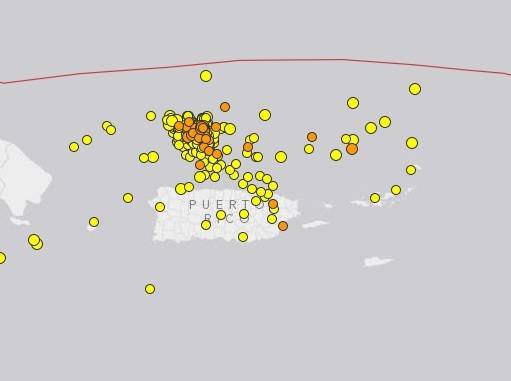
Lately I've notice a cluster of quakes just north of Puerto Rico. Here's a screen shot I took just now:
35hpkjd.jpg


A couple observations:

These are very small quakes - in the 2.0 to 3.5 range (one 6.4 is buried in there)
They vary in depth - from 3 km to over 90 km.
The screen shot just shows the last 7 days but it's been like this for months.

I don't see any similar thing happening elsewhere on the planet. Maybe Adak comes close, but nowhere near this spot.

So, what's going on north of Puerto Rico??
 
Earth sciences news on Phys.org
Hi Lisa

The M6.4 was the mainshock, I did record it on my gear here in Sydney, Australia. Not overly large amplitude considering how far it was away from me

What you are seeing is a pretty normal aftershock sequence from any reasonable sized and shallow event.
There were one or two M5 aftershocks in there as well
Seeing an aftershock sequence like this is always valuable in determining the extent of the movement on the fault plane. The pic is in 2D, but if you take the depths of events into account, you can produce a 3D diagram and see any dipping structure of the fault plane

Keep an eye out for future large events and you will see the mass of aftershocks that follow the mainshock.
On occassions you will also see several forshocks to the mainshock.

cheers
Dave
 
went into my records for another example for you :)

this one below is from Christchurch, New Zealand, following the M7.1 and several M 6 events of 2010 and 2011. The map as it states covers a 60 day period prior to and including 24 Feb 2011
but doesn't include the initial M7.1 of Sept 04, 2010 and many of its aftershocks, you can see the same clustering of the events

attachment.php?attachmentid=65798&stc=1&d=1390116986.jpg


cheers
Dave
 

Attachments

  • 110224 and 60days prior.jpg
    110224 and 60days prior.jpg
    74.4 KB · Views: 704
Last edited:
The USGS statistics are somewhat skewed because, "starting in January 2009, the USGS National Earthquake Information Center no longer locates earthquakes smaller than magnitude 4.5 outside the United States, unless we receive specific information that the earthquake was felt or caused damage." USGS records all earthquakes in the USGS, but filters those outside the US.

http://earthquake.usgs.gov/earthquakes/eqarchives/year/eqstats.php
http://earthquake.usgs.gov/earthquakes/map/doc_whicheqs.php

In the US, earthquakes of mag 3 or less are quite common, particularly in Hawaii, Alaska, parts of the Cascade range and California.

Indonesia, Japan, New Zealand, and basically the western Pacific 'Ring of Fire' and Sunda extension have frequent earthquakes. Puerto Rico has been particularly active for quite some time.
 
Last edited by a moderator:
davenn said:
Hi Lisa

The M6.4 was the mainshock, I did record it on my gear here in Sydney, Australia. Not overly large amplitude considering how far it was away from me

What you are seeing is a pretty normal aftershock sequence from any reasonable sized and shallow event.
There were one or two M5 aftershocks in there as well
Seeing an aftershock sequence like this is always valuable in determining the extent of the movement on the fault plane. The pic is in 2D, but if you take the depths of events into account, you can produce a 3D diagram and see any dipping structure of the fault plane

Keep an eye out for future large events and you will see the mass of aftershocks that follow the mainshock.
On occassions you will also see several forshocks to the mainshock.

cheers
Dave

Do you think the dozens (more like hundreds) of little quakes that have been happening there for several months were foreshocks to the 6.4 one? And is it typical for aftershocks and/or foreshocks to vary so much in depth, or does that depend on local conditions?
 
Hi Lisa
( will try typing this a second time, browser crashed and I lost a lots of text grrrr )

There are 4 common quake situations

1) A swarm - no significant mainshock
2) A swarm - with a significant mainshock
3) A shallow mainshock - with or without several foreshocks but lots of aftershocks
4) A deep mainshock - very rare foreshocks and few if any aftershocks

Ohhhh and another semi rare event where there are 2 major shocks within a hours or day's of each other
called doublet events. There have been a couple in the last ~ 5 years a pair of M8+ events in the Kuril Isl. north of Japan and a couple of years ago, west of Sumatera, Indonesia, M8.6 and a M8.2 ~ 3 hours apart.

The Puerto Rico activity appears to fall into the #2 category above, where there's an active swarm accentuated by the M6.4 mainshock then continuing with many more small events

Hawthorne, Nevada had a similar occurrence back in March and April of 2011. Some 400 small shocks over ~ 8 - 10 weeks ranging from M1 to M3.5. several weeks into the swarm there was a M 4.6 after which it resumed the smaller events till they finally died off and stopped.

Depth variations will largely be controlled by the type and location of fault that has moved
if its continental crustal fault, say like the Christchurch and Nevada events ( away from the main plate boundaries) then there not going to be a great variation in event depths - say ranging over ~ 20 km.
But a subduction fault quake will have a wide range of event depths that could easily range over 100 km or more.

Tectonics around Puerto Rico are quite complex, with Haiti, Dominican Repub. and Puerto Rico sitting between 2 subduction zones.. That area is primarily moving to the NNE and subducting under the North American Plate ( which includes a large section of the North Atlantic seafloor out to the Mid Atlantic Ridge)
http://www.intechopen.com/books/new-frontiers-in-tectonic-research-general-problems-sedimentary-basins-and-island-arcs/the-caribbean-plate-evolution-trying-to-resolve-a-very-complicated-tectonic-puzzle
http://web.ics.purdue.edu/~ecalais/projects/caribbean/dr2003/node3.html

cheers
Dave
 
  • Like
Likes   Reactions: 1 person
Lisa, have you ever checked the local earthquake network? I check this daily along with the USGS site.

http://www.pnsn.org/earthquakes/recent

They even have a blog for when we have the local slow slip events in the subduction zone. Fun to follow! What I think is interesting is that we haven't had anything above 4.5 since the Nisqually quake.

the PNSN also has a facebook page, and they are great for asking questions like this. You get responses from the local UW geologists, as well as the local nut cases. *giggle*
 
Ms Music said:
Lisa, have you ever checked the local earthquake network? I check this daily along with the USGS site.

http://www.pnsn.org/earthquakes/recent

They even have a blog for when we have the local slow slip events in the subduction zone. Fun to follow! What I think is interesting is that we haven't had anything above 4.5 since the Nisqually quake.

the PNSN also has a facebook page, and they are great for asking questions like this. You get responses from the local UW geologists, as well as the local nut cases. *giggle*

Nice - thanks for the link!
 

Similar threads

  • · Replies 2 ·
Replies
2
Views
2K
  • · Replies 46 ·
2
Replies
46
Views
9K
  • · Replies 3 ·
Replies
3
Views
6K
  • · Replies 4 ·
Replies
4
Views
4K
Replies
6
Views
4K
  • · Replies 1 ·
Replies
1
Views
4K
  • · Replies 7 ·
Replies
7
Views
4K
  • · Replies 8 ·
Replies
8
Views
5K