KDPhysics
- 73
- 24
- Homework Statement
- Explain this experiment: https://www.youtube.com/watch?v=r21ybCwXMjo
minute 4:45 - 5:40
- Relevant Equations
- Faraday's Law
Lenz's Law
My explanation:
A circular coil is connected to an AC supply at a frequency of 30-50 kHz (radio frequency). Therefore, an alternate current will be running through this “primary” coil, producing an alternating magnetic field. This magnetic field periodically decreases in strength, alternating direction with the same frequency at which the current alternates.
A second circular coil is brought near the primary coil. Therefore, the changing magnetic field will induce an emf in the secondary coil. By Lenz’s Law, nature abhors any change in magnetic flux. So, due to the decreasing/increasing field, the secondary coil will have an induced emf such that its own magnetic field opposes the change in flux. If the magnetic field of the primary coil is decreasing, the induced emf will be in the direction to produce its own magnetic field in the same direction, “strengthening it”.
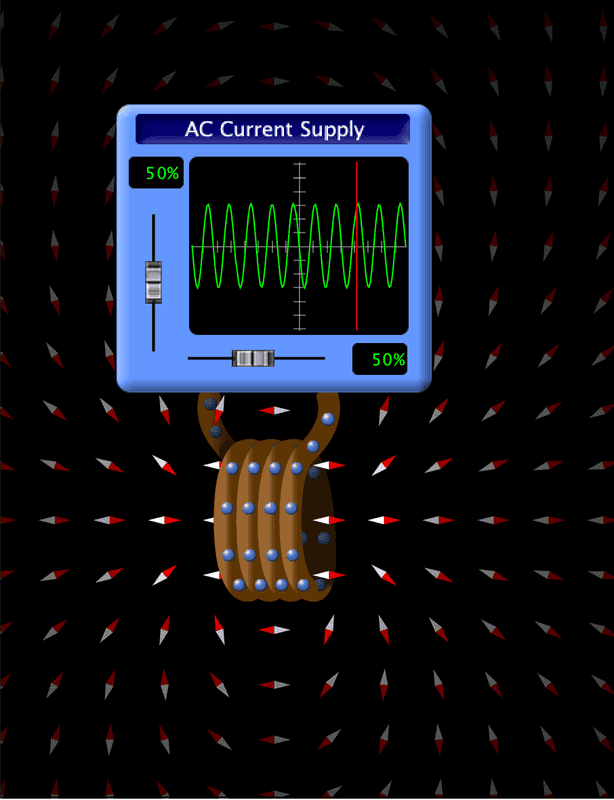
Therefore, alternate current will run through the secondary coil at a 30-50 kHz frequency. However, the light bulb physically can’t heat up and cool down at such a high frequency, and as a result all we see is a continuously lit up bulb. However, the induced current is still AC.
When the conductor is placed, eddy currents are formed within the sheet of metal. By Lenz’s law, the magnetic field produced by the eddy currents oppose the primary coil’s magnetic field. As a result, the change in flux through the secondary coil is very small, and so the induced emf will also be small.
Is this explanation correct?
Also, I still don't understand why the light bulb lights up at a certain distance, and when you put it closer to the primary coil it turns off. For example, see minute 5:11. Clearly, only at a couple centimeters away the coil is off, and then it is on again. But if the magnetic field is constantly changing, how is this possible?
A circular coil is connected to an AC supply at a frequency of 30-50 kHz (radio frequency). Therefore, an alternate current will be running through this “primary” coil, producing an alternating magnetic field. This magnetic field periodically decreases in strength, alternating direction with the same frequency at which the current alternates.
A second circular coil is brought near the primary coil. Therefore, the changing magnetic field will induce an emf in the secondary coil. By Lenz’s Law, nature abhors any change in magnetic flux. So, due to the decreasing/increasing field, the secondary coil will have an induced emf such that its own magnetic field opposes the change in flux. If the magnetic field of the primary coil is decreasing, the induced emf will be in the direction to produce its own magnetic field in the same direction, “strengthening it”.
Therefore, alternate current will run through the secondary coil at a 30-50 kHz frequency. However, the light bulb physically can’t heat up and cool down at such a high frequency, and as a result all we see is a continuously lit up bulb. However, the induced current is still AC.
When the conductor is placed, eddy currents are formed within the sheet of metal. By Lenz’s law, the magnetic field produced by the eddy currents oppose the primary coil’s magnetic field. As a result, the change in flux through the secondary coil is very small, and so the induced emf will also be small.
Is this explanation correct?
Also, I still don't understand why the light bulb lights up at a certain distance, and when you put it closer to the primary coil it turns off. For example, see minute 5:11. Clearly, only at a couple centimeters away the coil is off, and then it is on again. But if the magnetic field is constantly changing, how is this possible?
