Discussion Overview
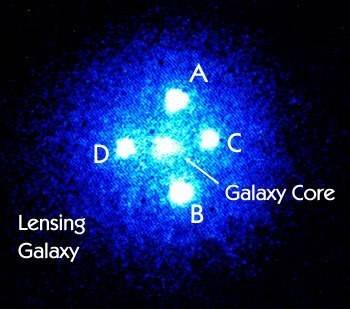
The discussion revolves around the phenomenon of gravitational lensing as exemplified by the Einstein cross (G2237+030) and the conditions under which it produces multiple images versus an Einstein ring. Participants explore the alignment of the quasar with the galactic nucleus and the implications for lensing effects.
Discussion Character
- Exploratory, Technical explanation, Conceptual clarification
Main Points Raised
- One participant notes that the Einstein cross shows four images of the quasar, suggesting good alignment with the galactic nucleus.
- Another participant proposes that an Einstein ring occurs only with perfect alignment, while a nearly perfect alignment results in two images.
- It is mentioned that if the lens is not a point but an extended ellipsoidal object, more than two images can be produced.
- A participant shares a link to a simulation tool that allows users to visualize different lensing scenarios, including Einstein rings and crosses.
- Another participant expresses gratitude for the information shared, indicating engagement with the discussion.
Areas of Agreement / Disagreement
Participants express varying views on the conditions necessary for the formation of an Einstein ring versus an Einstein cross, indicating that multiple competing views remain without a clear consensus.
Contextual Notes
Some assumptions about the nature of the lensing object and the alignment conditions are not fully explored, leaving room for further clarification and discussion.
Who May Find This Useful
Individuals interested in gravitational lensing, astrophysics, and the study of quasars may find this discussion relevant.