Einstein's Equivalence Principle.

Click For Summary
SUMMARY

The discussion centers on Einstein's Equivalence Principle, which posits that there is no local experiment that can distinguish between an elevator accelerating in outer space and one at rest in a uniform gravitational field. Key insights include the explanation of the equality of inertial mass and passive gravitational mass, which are fundamentally the same, and the concept that gravity can be understood as a geometric property of spacetime rather than a conventional force. This contrasts with Newtonian gravity, where the equivalence of these masses is an assumption rather than a derived conclusion. The discussion also highlights the limitations of Newtonian physics in explaining light's behavior in gravitational fields.

PREREQUISITES
  • Understanding of General Relativity (GR) principles
  • Familiarity with Newtonian gravity concepts
  • Knowledge of inertial and gravitational mass definitions
  • Basic grasp of spacetime geometry
NEXT STEPS
  • Study the implications of the Equivalence Principle in General Relativity
  • Explore the differences between Newtonian gravity and General Relativity
  • Investigate the role of the energy-momentum-stress tensor in GR
  • Learn about the historical development of Newton-Cartan theory
USEFUL FOR

Physicists, students of theoretical physics, and anyone interested in the foundational concepts of gravity and spacetime geometry.

FallenApple
Messages
564
Reaction score
61
So if someone is in an elevator moving up at g in outer space, vs someone in an elevator in a uniform gravitational field of g, there is no way telling whether one is in an elevator in outer space or resting on earth.

But what is the big insight about this? Isn't this true classically as well?

I saw this clip where Brain Greene poked a few holes into a water bottle and dropped it, showing that in mid air, the water stops leaking, so the water is in free fall along with the bottle. But this "experiment" could have easily have been done in Newton's time. Surely Newton must have known. So where is the philosophical difference?
Is it because Einstein deduced that light must bend in an accelerating elevator? So the principle was already there, he just applied it in a novel way?
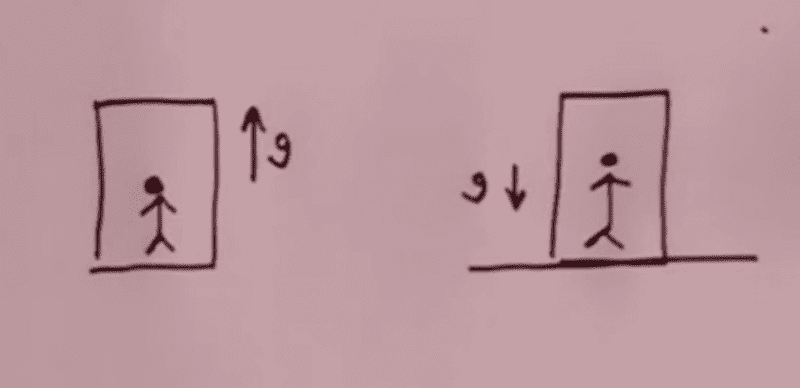
Equivalence_Principle.png
 
Last edited:
Physics news on Phys.org
FallenApple said:
But what is the big insight about this?
There may be others, but I see two big insights.

The first is that it explains the equality of inertial mass and passive gravitational mass. It was known that they were equal, but their equality seemed a strange coincidence. This insight explained that they are equal because they are the same thing.

The second is that it means that gravity can be geometrized. Instead of being considered a real force it can be turned into an inertial force due to the geometry of space and time.
FallenApple said:
Isn't this true classically as well?
...
Surely Newton must have known.
There is a theory of gravitation, called Newton Cartan theory, that is a reformulation of Newtonian gravity in terms of the geometry of space and time. It was developed in the 1920's or 1930's I think, which was well after Newton. He did not know nor did anyone else, it just wasn't an avenue that had been pursued.
 
  • Like
Likes   Reactions: FallenApple, vanhees71 and Battlemage!
FallenApple said:
there is no way telling whether one is in an elevator in outer space or resting on earth.

Locally, that is, in a small enough patch of spacetime, no, there isn't.

FallenApple said:
Isn't this true classically as well?

It's also true in Newtonian gravity for ordinary non-relativistic objects, yes. Whether it's also true in Newtonian gravity for, say, light is debatable.

Also, the way Newtonian gravity deals, theoretically, with this experimental fact is different from the way GR deals with it. In Newtonian gravity, in order to predict that the equivalence principle will be obeyed, you have to assume that inertial mass and gravitational mass are equal, i.e., that the ##m## that appears in ##F = ma## is the same as the ##m## that appears in ##F = GmM/r^2##. There is no way to get that from the axioms of Newtonian physics; it has to be put in as an additional assumption. But in GR, the equality of inertial and gravitational mass is not even a question, because there aren't two different "masses" in the theory to begin with: the motion of an object in a gravitational field is a matter of spacetime geometry and has to be the same for all objects.
 
  • Like
Likes   Reactions: FallenApple, vanhees71, Battlemage! and 1 other person
One could imagine a material whose inertial mass was ##m##, but whose gravitational mass was ##km##. Newtonian physics handles such a material just fine - ##F=GKMkm/r^2=mg##. It's just a mysterious empirical fact that ##k=K=1## for all materials. Relativity treats gravity as geometry. Two particles released with the same velocity in the same place must follow the same path because otherwise the path isn't determined by geometry. Therefore, as Peter says, the equivalence principle is completely integrated into GR, while Newtonian gravity simply notes it as a curious coincidence.
 
It's not a mystery but the definition of the units of inertial and gravitational mass. That one is proportional to the other has to be put as an observable fact in Newtonian mechanics.

In General Relativity, mass is no longer source of the gravitational field, but it's the energy-momentum-stress tensor of matter (i.e., all kinds of non-gravitational fields), which is universally coupled to the gravitational field in the sense of a gauge theory (see the recent Insight article by @haushofer about this formulation of GR). In this sense GR goes way beyond Newtonian gravity.
 
  • Like
Likes   Reactions: Dale
FallenApple said:
Isn't this true classically as well?
It is true empirically, so any valid model must predict it.
FallenApple said:
So where is the philosophical difference?
This animation explains the difference in the interpretation of the observation:

 
There is also the fact that the (strong) POE states that the two situations are indistinguishable for all physics. There is no such expectation in Newtonian physics.
 
vanhees71 said:
It's not a mystery but the definition of the units of inertial and gravitational mass. That one is proportional to the other has to be put as an observable fact in Newtonian mechanics.
Indeed - you can fix k to have any value you like by a unit choice for gravitational mass. However, Newton gives no particular reason why it must have the same value for every material. But "k must be equal for everything" falls out of the Newtonian limit of GR because test particles move on geodesics, which means their motion can't depend on what they're made of.
 
  • Like
Likes   Reactions: vanhees71
Dale said:
There may be others, but I see two big insights.

The first is that it explains the equality of inertial mass and passive gravitational mass. It was known that they were equal, but their equality seemed a strange coincidence. This insight explained that they are equal because they are the same thing.

The second is that it means that gravity can be geometrized. Instead of being considered a real force it can be turned into an inertial force due to the geometry of space and time.

Oh ok. So if the equality of inertial mass and passive gravitational mass is not just coincidence, then it hints at the equality of both elevator situations.

By inertial force, you mean fictitious?
 
  • #10
FallenApple said:
By inertial force, you mean fictitious?
Yes. I prefer the term "inertial", but "fictitious" is commonly used also.
 
  • #11
PeterDonis said:
Locally, that is, in a small enough patch of spacetime, no, there isn't.
It's also true in Newtonian gravity for ordinary non-relativistic objects, yes. Whether it's also true in Newtonian gravity for, say, light is debatable.

Also, the way Newtonian gravity deals, theoretically, with this experimental fact is different from the way GR deals with it. In Newtonian gravity, in order to predict that the equivalence principle will be obeyed, you have to assume that inertial mass and gravitational mass are equal, i.e., that the ##m## that appears in ##F = ma## is the same as the ##m## that appears in ##F = GmM/r^2##. There is no way to get that from the axioms of Newtonian physics; it has to be put in as an additional assumption. But in GR, the equality of inertial and gravitational mass is not even a question, because there aren't two different "masses" in the theory to begin with: the motion of an object in a gravitational field is a matter of spacetime geometry and has to be the same for all objects.

Hmm interesting. I'm curious why light would behave differently in elevator 1 vs elevator 2 in the Newtonian scheme. I mean, in the Newtonian scheme, there is no experiment that can measure the difference, therefore according to science, there is no difference. Unless, under the Newtonian scheme, they define the inertial frame as one in which light does not bend.
 
  • #12
[QUOTE="FallenApple, post: 5652767, member: 585259"I'm curious why light would behave differently in elevator 1 vs elevator 2 in the Newtonian scheme.[/quote]In Newtonian physics, massive objects in a gravitational field accelerate because they are being subjected to the force of gravity. However, light isn't a massive object, so there's no reason in the theory why light should be deflected by gravitational (or any other) forces at all and no reason to expect the behvior of light in the two elevators to be the same. We've already introduced the ad hoc assumption that gravitational mass is proportional inertial mass; but to explain the behavior of light in elevator #2 Newtonian physics needs another ad hoc assumption, namely that gravity acts on light as well.
 

Similar threads

  • · Replies 36 ·
2
Replies
36
Views
5K
  • · Replies 36 ·
2
Replies
36
Views
4K
  • · Replies 44 ·
2
Replies
44
Views
6K
  • · Replies 3 ·
Replies
3
Views
2K
  • · Replies 10 ·
Replies
10
Views
1K
  • · Replies 6 ·
Replies
6
Views
2K
  • · Replies 8 ·
Replies
8
Views
2K
  • · Replies 17 ·
Replies
17
Views
2K
  • · Replies 13 ·
Replies
13
Views
2K
  • · Replies 13 ·
Replies
13
Views
2K