Discussion Overview
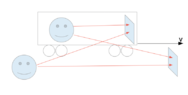
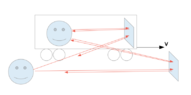
The discussion revolves around the behavior of light as it reflects off mirrors in different frames of reference, specifically in the context of Einstein's train thought experiment. Participants explore the implications of the second postulate of special relativity on the speed of light for observers inside and outside the train, raising questions about how the speed of light is perceived and whether it varies based on the motion of the mirrors.
Discussion Character
- Exploratory
- Debate/contested
- Technical explanation
- Conceptual clarification
Main Points Raised
- Some participants question whether there will be one or multiple speeds of reflected light for each observer, considering the implications of the second postulate of special relativity.
- Others assert that the speed of light in a vacuum is always c, regardless of the motion of the observer or the mirrors.
- There is a discussion about how the common-sense rules of speed addition do not apply to light, with some participants explaining the Lorentz transformation as the correct method for relating measurements between different frames.
- One participant raises concerns about how a moving mirror might affect the frequency and momentum of light, while another emphasizes that it does not change the speed of light in inertial frames.
- There are challenges to the understanding of how light behaves when emitted in different directions, with some participants questioning the implications of light being emitted at the same speed in all directions.
- Some participants express confusion about the relationship between the speed of light and the motion of the source, particularly in the context of astrophysical jets and their visibility.
Areas of Agreement / Disagreement
Participants express multiple competing views regarding the behavior of light and the implications of special relativity. There is no consensus on how to interpret the effects of moving mirrors or the nature of light's speed in different scenarios.
Contextual Notes
Participants highlight limitations in their understanding of the implications of special relativity, particularly regarding the addition of speeds and the behavior of light in various frames of reference. Some assumptions about classical physics are challenged but remain unresolved in the discussion.
Who May Find This Useful
This discussion may be useful for individuals interested in the foundations of special relativity, the behavior of light in different reference frames, and the conceptual challenges posed by thought experiments in physics.