Electric field and potential on a singular spin helix

Click For Summary
SUMMARY

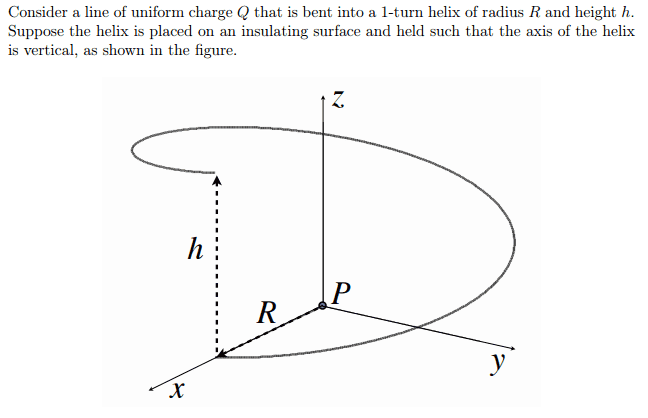
The discussion focuses on calculating the electric field and potential of a singular spin helix, characterized as a line of uniform charge with a radius R and height H. The user initially struggled with integrating the electric field from a segment but ultimately resolved the issue by applying the formula V = (k*delta Q)/r and integrating with r defined as sqrt(R^2 + h^2). The user clarified that delta Q equals Q/L, where L is the length of the helix, and concluded that h is equivalent to L after visualizing the setup.

PREREQUISITES
  • Understanding of electric fields and potentials
  • Familiarity with calculus, specifically integration techniques
  • Knowledge of uniform charge distributions
  • Basic concepts of electrostatics, including Coulomb's law
NEXT STEPS
  • Study the derivation of electric fields from continuous charge distributions
  • Learn about the application of the principle of superposition in electrostatics
  • Explore advanced integration techniques for calculating potentials
  • Investigate the properties of helical charge distributions in electromagnetism
USEFUL FOR

Physics students, electrical engineers, and researchers focusing on electrostatics and charge distribution analysis will benefit from this discussion.

Char-L
Messages
2
Reaction score
0
Hello dear physics masters on earth, I am very grateful to be priviliged to ask you a question regarding electric fields and potential of a single-cpin helix. It is portrayed as below.

It is a line of uniform charge, and 1-turn helix with radius R and height H. I have came to ugly answers, and I cannot verify whether I am right or wrong. I'm trying to calculate electric field and potential of a random point, assuming that the field is still applied on the point. I have tried to integrate electric field applied from a segment, which didn't turn out well. Any help would be gratefully appreciated. Thank you.
s.PNG
ss.PNG
 
Physics news on Phys.org
Why don't you show us what you already calculated?
 
  • Like
Likes   Reactions: Char-L
DrDu said:
Why don't you show us what you already calculated?
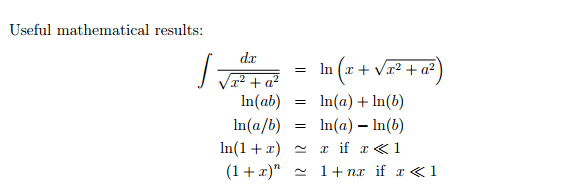
I actually found out. I had to set V = (k*delta Q)/r and integrate it, setting r as sqrt(R^2 + h^2), setting range between 0 and h.
Acknowledging delta Q = Q/L where L is the length, integration will give same result as given.
A tricky part for me was where h came from on the constant side. I found out that h is equal to L, after drawing that by myself on a water bottle...

Thanks for your concern anyways, and that's how I found the result out.
 

Similar threads

  • · Replies 21 ·
Replies
21
Views
4K
  • · Replies 2 ·
Replies
2
Views
1K
  • · Replies 3 ·
Replies
3
Views
2K
  • · Replies 6 ·
Replies
6
Views
1K
  • · Replies 20 ·
Replies
20
Views
2K
  • · Replies 11 ·
Replies
11
Views
2K
  • · Replies 11 ·
Replies
11
Views
4K
  • · Replies 5 ·
Replies
5
Views
3K
  • · Replies 30 ·
2
Replies
30
Views
4K
  • · Replies 8 ·
Replies
8
Views
2K