Electric field from a positive and negative plate pair

2 replies · 2K views · last reply
annamal
Messages
393
Reaction score
33
Homework Statement
Two large conducting plates carry equal and opposite charges, with a surface charge density as shown in image. The separation between the plates is d. What is the
electric field between the plates?
Relevant Equations
##\vec E = \frac{\sigma}{\epsilon_0}##
I am confused with the solution. It says ##\vec E = \frac{\sigma}{\epsilon_0}##. Shouldn't E = ##2*\vec E = 2*\frac{\sigma}{\epsilon_0}##? Electric field of the positive plate and electric field of the negative plate.
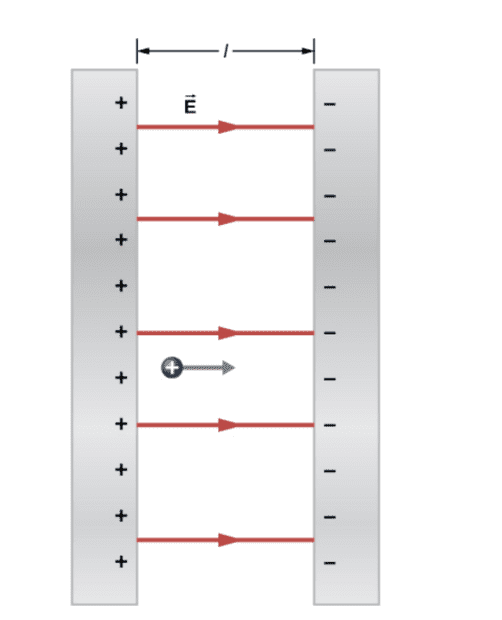
Diagram of two parallel charged plates separated by distance l: the left plate carries rows of plus signs, the right plate rows of minus signs, with horizontal red arrows labelled E pointing from left to right between them and a small positive charge drawn with an arrow moving rightward.
 
Last edited:
annamal said:
I am confused with the solution. It says ##\vec E = \frac{\sigma}{\epsilon_0}##. Shouldn't E = ##2*\vec E = 2*\frac{\sigma}{\epsilon_0}##?
It should not. Use a pillbox Gaussian surface with one flat face inside the conductor and the other flat face in the vacuum to see why and become unconfused.
 
Well if you mean that the total E-field should be double of that of the one plate, yes that is true but the field of one plate is ##E=\frac{\sigma}{2\epsilon_0}##. So the total field is $$2\frac{\sigma}{2\epsilon_0}=\frac{\sigma}{\epsilon_0}$$
 
  • Like
Likes   Reactions: Orodruin and annamal