Electric field lines next to conductor

Click For Summary
SUMMARY

The discussion centers on the behavior of electric field lines near a conductor (R2) placed next to a surface-charged rectangle (R1) using COMSOL's AC/DC module for simulation. Participants concluded that the electric field lines should terminate on the surface of the conductor, leading to induced charges on R2, with negative charge on the side facing R1 and positive charge on the opposite side. The simulation's lack of intensity representation led to a misunderstanding of the field's behavior, suggesting that the field does not flow around the conductor but rather is nearly homogeneous between the plates and diminishes outside the conductor.

PREREQUISITES
  • Understanding of electric field theory and surface charge density
  • Familiarity with COMSOL Multiphysics, specifically the AC/DC module
  • Knowledge of induced charges and their effects on electric fields
  • Basic principles of finite element analysis in electromagnetism
NEXT STEPS
  • Explore COMSOL Multiphysics documentation for advanced simulation techniques
  • Study electric field line behavior in conductors and dielectrics
  • Learn about charge distribution and its impact on electric fields
  • Investigate the principles of finite element analysis in electrostatics
USEFUL FOR

This discussion is beneficial for physics students, electrical engineers, and researchers interested in electrostatics and simulation techniques for electric fields in conductive materials.

mzh
Messages
61
Reaction score
0
Dear Physics Forums readers
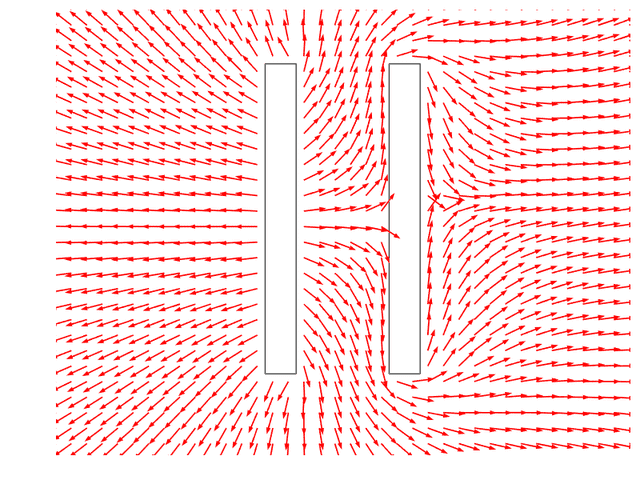
Let a two dimensional rectangle R1 carry a surface charge \sigma and be placed next to another rectangle R2 of the same shape made from metal (i.e. a conductor). What does the electric field look like close to the second rectangle?

My intuition would tell me, the field lines terminate on the close side of R2, causing accumulation of negative charge on the side close to R1 and positive charge on the far side which in turn emits a field. The net field could be seen as reaching through R2.

I tried to verify this using a finite element simulator and obtained the following image for the field (R1 left, R2 right):
field-metal.png


Now it seems to me as if the field goes around the metal. Is that correct? Or can the field only terminate *on* opposite charges?
 
Physics news on Phys.org
Or can the field only terminate *on* opposite charges?
It has to - a surface charge corresponds to electric field lines perpendicular to the surface.
In addition, the parallel component of the field has to vanish at the surface (the potential is constant).
 
It seems to me that the simulation is incorrect. The positive charge of the object on the left should induce a separation of charge in the object (conductor) on the right, so that its left surface acquires a negative charge and its right surface acquires a positive charge. The net charge of the conductor would of course remain zero. The electric field close to those surfaces would not be parallel to those surfaces.
 
It doesn't look right to me (But I've always had a blind spot when it comes to field lines)

The electric charges inside the conductor rearrange themselves slightly in such a way as to neutralise the field at the surface. The field is prevented from entering the conductor.

I would have expected the lines to terminate on the surface charge and start again from the other side as you did.

There's no intensity variation shown in the diagram, only directions - that may be the problem.
 
mzh - what kind of simulation software was it? Field patterns look awfully like fluid flow to me - with LHS rectangle acting as a source, and RHS rectangle simply as an obstacle. Fluid flow then has to be pretty slow to avoid vortices around RHS rectangle. And btw it would have been better to have labelled the rectangles in pic, specified sign of charge, and that charge distribution was either fixed or formed an equipotential on the source rect. But a nice idea to provide a pic that can be viewed without needing to log in first.
 
Thanks guys for the feedback.
@mfb: Ok. And can it also terminate on induced charges?
@{jtbell,AJ Bentley}: that's exactly what i was expecting. In the simulator, R2 is assigned a "metal" property. But I don't know if it can plot the actual charge distribution. Yeah, did not show the intensity of the field, but its of secondary importance to me currently.
@Q-reeus: I used COMSOL (AC/DC module). I don't think its going into PRL, so i left out the labels ;) Sign of charge should be clear from field direction on R1, no?
 
mzh said:
@Q-reeus: I used COMSOL (AC/DC module). I don't think its going into PRL, so i left out the labels ;) Sign of charge should be clear from field direction on R1, no?
Fair enough for last point, but it's always best to give a 'verbal' to such things anyway. So given this COMSOL is an AC/DC simulation, my guess is you have plotted a current flow - giving direction but not intensity, and with R2 an insulator. But that puzzles me because you say R2 was given a metal property.
 
Without intensity, E-field direction is pretty meaningless. That's why you get an apparently large 'flow' of field around the conductor. In reality that field is virtually non-existent. It's just a residual component.
 
mzh said:
@mfb: Ok. And can it also terminate on induced charges?
Right. Induced or not, a surface charge density implies a non-zero field strength (outside), which corresponds to ending field lines.
 
  • #10
AJ Bentley said:
Without intensity, E-field direction is pretty meaningless. That's why you get an apparently large 'flow' of field around the conductor. In reality that field is virtually non-existent. It's just a residual component.

Sure. I'll see what I get when considering the intensity.

To return to my main point of the thread (i'm not so much interested in how correct my simulation is done or not).

Given the above system (surface charge on R1, metallic R2). What will the field look like, say from textbook undergraduate physics?
 
  • #11
Between the plates: Nearly homogeneous (from left to right in the sketch)
To the right of the right plate: nearly homogeneous (away from the conductor)
Far away: Similar to a single charged object.
In between: Let the computer calculate it
 
  • #12
@mfb: thanks. i would think the same. something must be fishy with my simulation then.
 

Similar threads

  • · Replies 22 ·
Replies
22
Views
2K
  • · Replies 4 ·
Replies
4
Views
3K
  • · Replies 1 ·
Replies
1
Views
1K
  • · Replies 14 ·
Replies
14
Views
2K
  • · Replies 8 ·
Replies
8
Views
1K
  • · Replies 3 ·
Replies
3
Views
2K
  • · Replies 73 ·
3
Replies
73
Views
6K
  • · Replies 2 ·
Replies
2
Views
895
  • · Replies 25 ·
Replies
25
Views
2K
  • · Replies 7 ·
Replies
7
Views
3K