Electric field of a charged disc with a small circle cut out of it

Click For Summary

Homework Help Overview

The discussion revolves around understanding the electric field produced by a charged disc with a small circle cut out of it, specifically at a point on the z-axis. Participants express confusion regarding the configuration and terminology used in the problem, particularly the reference to a "thin spherical shell."

Discussion Character

  • Conceptual clarification, Assumption checking, Problem interpretation

Approaches and Questions Raised

  • Participants attempt to visualize the problem and question the relevance of certain terms and equations. Some suggest using superposition to approach the problem, while others express uncertainty about the implications of removing a section from the disc.

Discussion Status

There appears to be a productive exchange of ideas, with some participants beginning to understand the implications of the problem setup. Guidance has been offered regarding the use of superposition and the importance of clear communication in posts. However, there is no explicit consensus on the interpretation of the problem.

Contextual Notes

Some participants mention language barriers affecting their understanding of the problem. There is also a note about the need for complete problem statements to facilitate better assistance.

kirito
Messages
77
Reaction score
9
Homework Statement
A very small circular area with radius A is cut out from a thin charged disk with total radius R, where A≪R. The remaining disk, which is centered at the origin, has a uniform surface charge density σ. The goal is to calculate the electric field at a point on the z-axis, at a distance z from the center of the disk.
Relevant Equations
gauss
I am having a bit of a problem understanding what to visualise since in the first part we found the electric field resultant from the disc shell The goal is to calculate the electric field at a point on the z-axis, at a distance z from the center of the disk.
Screenshot 2024-10-12 at 2.23.13.png

now after they cut of the circle
Screenshot 2024-10-12 at 2.25.32.png


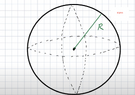
but I am failing to understand the question ,is not the shell hallow if they are removing a disc where are they removing it from
I tried to read the solution yet I don't understand the question ,if a visualisation can be provided I am thankful
 
Physics news on Phys.org
The "relevant" equation that you show is not relevant here. There is no shell. See here for the relevant equation. You want the electric field on the axis of symmetry at some distance from the center of the disk.

The disk with the hole at its center has the same field on the axis as a whole disk with charge density ##\sigma## plus the field from a second concentric disk of same size of the hole that has negative charge density ##-\sigma.##
 
  • Like
Likes   Reactions: PhDeezNutz and renormalize
kirito said:
if a visualisation can be provided I am thankful
I'm unclear how this problem involves a "shell". To my understanding, the configuration described looks like this:
1728691365234.png

except that in the problem, the hole in the second disk is much smaller in diameter than in this illustration.
(Illustration is from here.)
 
  • Like
Likes   Reactions: PhDeezNutz
renormalize said:
I'm unclear how this problem involves a "shell". To my understanding, the configuration described looks like this:
View attachment 352160
except that in the problem, the hole in the second disk is much smaller in diameter than in this illustration.
(Illustration is from here.)
first and for most thanks to everyone for the quick replies , I think as everyone stated imagining something like this would do the trick and solving using superposition instead of integration would be wiser ,
the thing is though I am learning the course in a language thats not my native one , but the term they used in part one of the question was a thin spherical shell

Screenshot 2024-10-12 at 3.20.12.png
and the solution for part 1 did indeed align with the term
then they demanded to use the result of section A
and used the spherical shell term so I could not imagine what the problem intitles
they even used a bit of a different approach for the same section and wrote in English electric field of a sphere and a disk and used them
 
Last edited:
I think I am starting to understand what they meant thanks to all of you
it seems like they did indeed consider a spherical shell but with a small hollow disk removed
and gave me a radius a<<R so I can use an approximation to solve the integral or use superposition
and assumed with such approximation the disk field should be similar to an infinite charged plane field
 
kirito said:
first and for most thanks to everyone for the quick replies , I think as everyone stated imagining something like this would do the trick and solving using superposition instead of integration would be wiser ,
the thing is though I am learning the course in a language thats not my native one , but the term they used in part one of the question was a thin spherical shell

View attachment 352162
and the solution for part 1 did indeed align with the term
then they demanded to use the result of section A
and used the spherical shell term so I could not imagine what the problem intitles
they even used a bit of a different approach for the same section and wrote in English electric field of a sphere and a disk and used them
For future reference: Please do not post only part of a problem. If there are other parts, we need to know what they are in order to put the question into perspective. You can still solve the shell problem by using the superposition of the field from a charge shell without a hole and a "hole" with negative surface charge density placed on the surface of the shell.
 
  • Like
  • Care
Likes   Reactions: renormalize and kirito
kuruman said:
The "relevant" equation that you show is not relevant here.
Nor is it an equation.

I agree with you, posting fragments of the problem, the equations and the attempt is not the path to success.
 
  • Like
  • Care
Likes   Reactions: kirito, renormalize and PhDeezNutz
Vanadium 50 said:
Nor is it an equation.

I agree with you, posting fragments of the problem, the equations and the attempt is not the path to success.
could you elaborate on what should one do to gain knowledge "path to success ", Any advice on what one should include in a post in general would help , I did read the guidelines, but I’m still getting used to the format of such sites.

I usually do not include the whole problem fearing that the post would be overly long with the attempts and the step by step thought process since I tried once and got feedback that even though including my thought process and whole solution or question can reveal what I do not understand yet it won't be helpful for the general public and would take too much time and effort to read and easy to forget what I am asking .

I seem to fail at understanding what is vital for a clear post and what can be omitted ,I will try to view posts with positive reviews and learn from them.

so if there are any attentional insight on how to fix the problems pointed out I am more than pleased to hear .
 
It's real simple. Look at the Forum Rules and follow them.
 
  • #10
kirito said:
Any advice on what one should include in a post in general would help , I did read the guidelines, but I’m still getting used to the format of such sites.

I usually do not include the whole problem fearing that the post would be overly long with the attempts and the step by step thought process since I tried once and got feedback that even though including my thought process and whole solution or question can reveal what I do not understand yet it won't be helpful for the general public and would take too much time and effort to read and easy to forget what I am asking .

I seem to fail at understanding what is vital for a clear post and what can be omitted ,I will try to view posts with positive reviews and learn from them.

so if there are any attentional insight on how to fix the problems pointed out I am more than pleased to hear .
For general technical questions, post them in the appropriate technical forum (start the thread by filling out the form at the top of that forum) and include links to your reading that you've been doing and ask questions about that reading. In some of the technical forums the thread title will include a "prefix" that you can set to B/I/A for Beginner/Intermediate/Advanced for the level that you would like the replies to be. I is undergraduate university level, and A is graduate school level and above.

For schoolwork-related problems, post in the Homework Help forums and fill out the Template that you are provided there when starting a new schoolwork thread. That includes the Problem Statement, the Relevant Equations, and your Attempt at the Solution. Always show your work on the problem so that we can then provide tutorial help.

The Homework Statement is where you list the problem word-for-word as it is given to you. You can also upload a PDF or JPEG image of the problem if that helps, but it's usually required that you type the problem in as well. The Relevant Equations section is to help you think about and list the equations and formulas and concepts that may be helpful in working the problem. You then show your work in the section below (the main body of the thread start).

To post math equations, it's best to use the LaTeX engine that PF provides. There is a helpful "LaTeX Guide" link below the Edit window to get you started. Note that you put double-$ delimiters at the start and end of each stand-alone line of LaTeX, and double-# delimiters at the start and end of in-line LaTeX that does not need to be on its own line.

Example of in-line LaTeX: ##v(t) = L \frac{di(t)}{dt}##

Example of stand-alone LaTeX:
$$v(t) = L \frac{di(t)}{dt}$$
Also, if you right-click on a LaTeX equation in a post, you get a pop-up menu to let you view the LaTeX source or view it in other formats.

LaTeX isn't supported in thread titles, so you can use simple text math in titles if you want.

Note also that PF uses a feature called "lazy LaTeX rendering" that speeds up page loads. When you first post your LaTeX in a thread, you will not see it rendered that first time. Just refresh your browser page to force it to be rendered, and then it should render whenever you come back to that page/thread in the future. If you edit your post that has LaTeX in it, when you save the edits you will note that the LaTeX has again not rendered. Just refresh your browser to force the LaTeX engine to re-render the equations.

If you have trouble using the Preview feature to check your LaTeX, you can use a website such as https://mathb.in/ or https://latexeditor.lagrida.com/ to preview your LaTeX before you post it.
 
  • Informative
Likes   Reactions: kirito

Similar threads

Replies
25
Views
2K
Replies
4
Views
3K
Replies
5
Views
683
Replies
2
Views
3K
  • · Replies 1 ·
Replies
1
Views
3K
  • · Replies 2 ·
Replies
2
Views
2K
Replies
9
Views
931
  • · Replies 2 ·
Replies
2
Views
2K
  • · Replies 6 ·
Replies
6
Views
2K
Replies
1
Views
2K