Electric filed of each plate of capacitor

Click For Summary

Homework Help Overview

The discussion revolves around understanding the electric field between the plates of a capacitor, specifically questioning the use of the infinite plate electric field equation versus the conductor plate equation. Participants are exploring the principles of electric fields generated by charged plates and the implications of charge distribution on the field strength.

Discussion Character

  • Conceptual clarification, Assumption checking, Exploratory

Approaches and Questions Raised

  • Participants discuss the rationale behind using the infinite plate equation for electric fields instead of the conductor plate equation. There are attempts to derive the electric field using superposition and Gauss' Law, along with considerations of charge distribution on the plates.

Discussion Status

The discussion is active, with participants providing insights and alternative approaches to understanding the electric field in capacitors. Some guidance has been offered regarding the application of Gauss' Law and the concept of superposition, but multiple interpretations and questions remain unresolved.

Contextual Notes

Participants are navigating through the complexities of electric field equations and their applications, questioning assumptions about charge distribution and the nature of the plates involved. There is an emphasis on the need for clarity regarding the differences between infinite and conductor plates in the context of electric fields.

baby_1
Messages
159
Reaction score
16
hello
here in this problem as you see we want to obtain the pressure between thew plate of capacitor
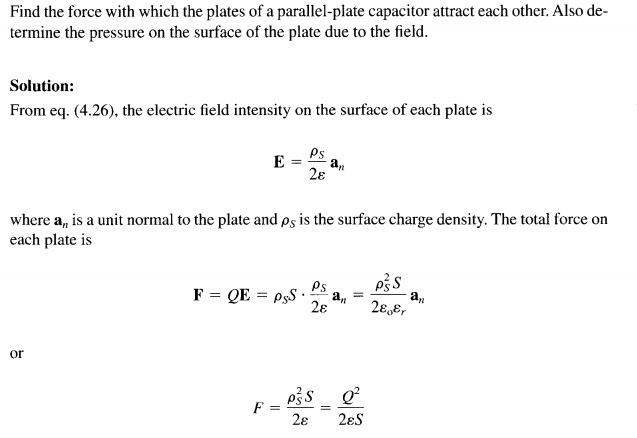
8697184500_1396513597.jpg

my question is about the capacitor each plate electric filed equation.
as we know the electric filed of an infinite plate is
gif.latex?E%3D%5Cfrac%7B%5Csigma%20%7D%7B2%5Cvarepsilon%20%7D.gif

but the equation of an conductor plate is
http://www.sciweavers.org/upload/Tex2Img_1396514351/render.png

as we know the each plate of capacitor is conductor.why in above problem the write use the infinite plate equation instead of conductor plate equation?

Thanks
 
Physics news on Phys.org
The magnitude of the electric field between the capacitor plates is E=ρs/ε. You can follow an other approach, based on potential energy.

Assume that the capacitor plates are at distance x from each other and the area of the plates is S. One plate is earthed, and you move charges from the grounded plate to the other one. Initially no charge is on the other plate, you do not need any work. I there is q charge on the plate, the electric field is q/(Sε) and you do dW=Exdq work to transfer dq charge. So the net work when the capacitor is charged to Q is
[tex]W=\int_0^Q{\frac{x}{Sε}qdq}=\frac{x}{2Sε}Q^2[/tex] That work is the potential energy of the capacitor. Its negative gradient is the force between the capacitor plates. [tex]F=-\frac{Q^2}{2Sε}[/tex]. The negative sign means that the force opposes the motion of the capacitor plate.

ehild
 
  • Like
Likes   Reactions: 1 person
Thanks ehild
but my question is something else.
yes, if we take the sum of two electric filed with surface electric filed equation
%7D%7B2%5Cvarepsilon%20%7D%28%5Cvec%7B-ax%7D%29%3D%5Cfrac%7B%5Csigma%20%7D%7B%5Cvarepsilon%20%7D.gif

but my question is why the writer use surface electric filed equation instead of conductor electric filed for each plate?
http://www.sciweavers.org/upload/Tex2Img_1396514351/render.png instead of
gif.gif


because as we know and prove the electric filed of conductor is
http://hyperphysics.phy-astr.gsu.edu/hbase/electric/gausur.html
 
The electric field inside the capacitor is Q/(εS). The surface charge density is Q/S on one plate and -Q/S on the other plate. But that electric field has been created by the charges on both plates, and the charges do not act on themselves. So you need to take the field of one plate and the force of that field on the charge of the other plate. I prefer the derivation with the energy.

ehild
 
Thanks ehlid
your explanation completely right.
now i change and say better my new question: the electric filed of capacitor and not force between two plate.
as i know we can use superposition to maintain the electric filed of between two conductor of capacitor.
so the electric filed of each conductor surface is
http://www.sciweavers.org/upload/Tex2Img_1396545115/render.png
that an is perpendicular unit vector .so we assume that positive charge on the top surface and negative charge on the bottom surface.
so we want to obtain the electric filed between two surface.
top surface:
http://www.sciweavers.org/upload/Tex2Img_1396545444/render.png
bottom surface:
http://www.sciweavers.org/upload/Tex2Img_1396545474/render.png

and superposition:
Et=E1+E2
http://www.sciweavers.org/upload/Tex2Img_1396545581/render.png
 
You saw the downward E , below the (+) top plate,
add to the downward E , above the (-) top plate.
They only add to each other in between the plates
... they cancel above the top plate and below the bottom plate.
That is one way to obtain this "between-the-plates" formula;
use Gauss' Law with clever geometric symmetry, not nasty integrations.
 
  • Like
Likes   Reactions: 1 person

Similar threads

  • · Replies 18 ·
Replies
18
Views
3K
Replies
11
Views
4K
  • · Replies 26 ·
Replies
26
Views
3K
  • · Replies 6 ·
Replies
6
Views
2K
Replies
4
Views
2K
  • · Replies 20 ·
Replies
20
Views
4K
  • · Replies 14 ·
Replies
14
Views
2K
Replies
3
Views
2K
  • · Replies 3 ·
Replies
3
Views
3K
  • · Replies 21 ·
Replies
21
Views
4K