math4everyone
- 15
- 0
Member advised to use the homework template for posts in the homework sections of PF.
I am stuck with this problem:
The right triangle shown with vertex P at the origin has base b, altitude a, and uniform density of surface charge σ. Determine the potential at the vertex P. First find the contribution of the vertical strip of width dx at x. Show that the potential at P can be written as $$\phi_P= (σb/4π \varepsilon_o)ln[(1+sinθ)/cosθ]$$
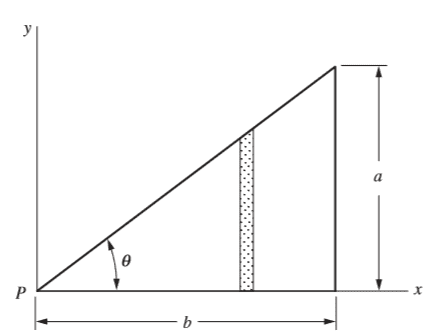
What I have done so far:
A tiny box of the strip has width dx and height $$rd\theta$$ so its contribution to P is
\begin{equation}
d\phi = \frac{(\sigma)(dx)(rd\theta)}{4 \pi \varepsilon_o r}=\frac{(\sigma)(dx)(d\theta)}{4 \pi \varepsilon_o }
\end{equation}
So the contribution of the entire strip would be
\begin{equation}
\frac{\sigma dx}{4 \pi \varepsilon_o}\int_0^{arctan(\frac{a}{b})} d\theta = \frac{\sigma dx}{4 \pi \varepsilon_o} arctan(\frac{a}{b})
\end{equation}
So the potential, $$\phi$$ would be:
\begin{equation}
\phi = \frac{\sigma}{4 \pi \varepsilon_o} arctan(\frac{a}{b}) \int_0^b dx = b\frac{\sigma}{4 \pi \varepsilon_o} arctan(\frac{a}{b})
\end{equation}
But this is clearly not the answer. What am I doing wrong?
The right triangle shown with vertex P at the origin has base b, altitude a, and uniform density of surface charge σ. Determine the potential at the vertex P. First find the contribution of the vertical strip of width dx at x. Show that the potential at P can be written as $$\phi_P= (σb/4π \varepsilon_o)ln[(1+sinθ)/cosθ]$$
What I have done so far:
A tiny box of the strip has width dx and height $$rd\theta$$ so its contribution to P is
\begin{equation}
d\phi = \frac{(\sigma)(dx)(rd\theta)}{4 \pi \varepsilon_o r}=\frac{(\sigma)(dx)(d\theta)}{4 \pi \varepsilon_o }
\end{equation}
So the contribution of the entire strip would be
\begin{equation}
\frac{\sigma dx}{4 \pi \varepsilon_o}\int_0^{arctan(\frac{a}{b})} d\theta = \frac{\sigma dx}{4 \pi \varepsilon_o} arctan(\frac{a}{b})
\end{equation}
So the potential, $$\phi$$ would be:
\begin{equation}
\phi = \frac{\sigma}{4 \pi \varepsilon_o} arctan(\frac{a}{b}) \int_0^b dx = b\frac{\sigma}{4 \pi \varepsilon_o} arctan(\frac{a}{b})
\end{equation}
But this is clearly not the answer. What am I doing wrong?
