Electric Potential Energy Question

Click For Summary
SUMMARY

The discussion centers on calculating the speed of two electrons that start at rest with a separation of 5.0 x 10⁻¹² m and accelerate away from each other due to electric potential energy. The key equation used is ΔEK + ΔEE = 0, where ΔEK represents the change in kinetic energy and ΔEE represents the change in electric energy. The correct approach involves recognizing that both electrons contribute to the kinetic energy, and the potential energy of the system is given by kq1q2/d. The final calculated speed of each electron when they are far apart is 1.0 x 10⁷ m/s.

PREREQUISITES
  • Understanding of electric potential energy and kinetic energy concepts
  • Familiarity with Coulomb's law and the formula for electric force
  • Knowledge of conservation of energy principles in physics
  • Basic algebra and calculus for manipulating equations
NEXT STEPS
  • Study the derivation of the potential energy formula for point charges, specifically kq1q2/d
  • Learn about the concept of reduced mass in two-particle systems
  • Explore the implications of conservation of momentum in multi-particle systems
  • Investigate the role of electric fields in particle acceleration
USEFUL FOR

Students studying electromagnetism, physics educators, and anyone interested in understanding the dynamics of charged particles and energy conservation principles.

MystiqThunder
Messages
7
Reaction score
0
1. Homework Statement
Two electrons start at rest with a separation of 5.0*10-12m. Once released, the electrons accelerate away from each other. Calculate the speed of each electron when they are a very large distance apart.

Homework Equations


ΔEK+ΔEE=0

The Attempt at a Solution


Okay so I know that:[/B]
  • The Electric force is in the same direction as the displacement, which means kinetic energy is increasing and electric energy is decreasing (ΔEK=-ΔEE)
  • As they move to a really far distance, the change in electric energy is equal to 0 - EE1 as anything divided by infinity is equal to zero
GIVENS:
mass of electron = 9.109*10-31 Kg
q = -1.60*10-19 C
k = 8.99*109
v1 = 0 m/s
r1 = 5.0*10-12 m

My process:
ΔEK+ΔEE=0
-ΔEE=ΔEK
-[kq1q2(1/r2-1/r1)]=½m(v2-v1)2
√[{-2(kq1q2(1/r2-1/r1)}/m]=v2
√[{-2(8.99*109)(-1.60*10-19)2(0-1/5.0*10-12)/(9.109*10-31)]=v2
1.0*107=v2

Is this correct?

Hopefully that shows it well, if not here is a picture (I write small, probably can't make out much):

EDIT: Looks like pic is a no show
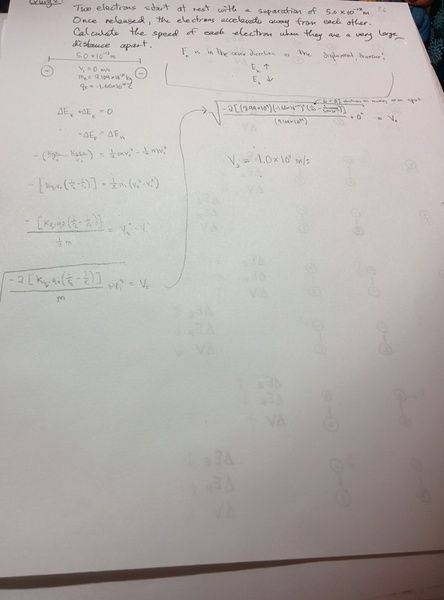
IMG_20141119_213002.jpg


Physics news on Phys.org
Looks to me as if you are moving only one charge to infinity. But the electrons are supposed to move away from each other.
 
BvU said:
Looks to me as if you are moving only one charge to infinity. But the electrons are supposed to move away from each other.
You are absolutely correct, as I discovered today walking into class. The conservation of energy comes from the kinetic energy of not just one but both electrons MOVING AWAY from each other, as you just said. Thanks a lot anyways :)
 
MystiqThunder said:
1. Homework Statement
Two electrons start at rest with a separation of 5.0*10-12m. Once released, the electrons accelerate away from each other. Calculate the speed of each electron when they are a very large distance apart.

Homework Equations


ΔEK+ΔEE=0

The Attempt at a Solution


Okay so I know that:[/B]
  • The Electric force is in the same direction as the displacement, which means kinetic energy is increasing and electric energy is decreasing (ΔEK=-ΔEE)
  • As they move to a really far distance, the change in electric energy is equal to 0 - EE1 as anything divided by infinity is equal to zero

My process:
ΔEK+ΔEE=0
-ΔEE=ΔEK
-[kq1q2(1/r2-1/r1)]=½m(v2-v1)2

The last equation is wrong. The potential energy of a system of two point charges is kq1q2/d, where d is the separation between them.
The electrons interact and there is no external force. So the centre of mass of the system stays in rest The kinetic energy of the system is the sum of the kinetic energies of both electrons, not the difference between them! Initially, d=5.0*10-12m
 
ehild said:
The last equation is wrong. The potential energy of a system of two point charges is kq1q2/d, where d is the separation between them.
The electrons interact and there is no external force. So the centre of mass of the system stays in rest The kinetic energy of the system is the sum of the kinetic energies of both electrons, not the difference between them! Initially, d=5.0*10-12m

If you look at how he is using it, this is not the problem, r1 and r2 correspond to the distance between the electrons at two different times. The problem, as BvU noted, is in the setup and treatment of the kinetic energy.

Mystiq: The expression for the kinetic energy difference is wrong not only because you forgot about one of the electrons. The difference should be proporional to v1^2 - v2^2, not (v1-v2)^2. In this case, one of the velocities was zero so it did not make a difference, but it is something you will generally need to consider.
 
Sorry. I see now that r1 and r2 were distances at two different times.
The two-electron system can be replaced by a single particle with reduced mass, μ=m/2 if the particles are identical. The velocity of that "imaginary" particle is equal to the relative velocity u=va-vb of the real particles, while the CoM of the system is stationary. As they are identical va=-vb=v and u=2v. The kinetic energy is then KE=1/2 μ u^2, and the change of the kinetic energy is ΔKE=1/2 μ(u22-u12).
As the particles were in rest initially, u1=0, so the change of the KE is ΔKE=1/2 μu22.
 
Last edited:

Similar threads

  • · Replies 13 ·
Replies
13
Views
2K
Replies
5
Views
2K
  • · Replies 3 ·
Replies
3
Views
2K
  • · Replies 22 ·
Replies
22
Views
4K
  • · Replies 23 ·
Replies
23
Views
2K
  • · Replies 3 ·
Replies
3
Views
2K
  • · Replies 11 ·
Replies
11
Views
2K
  • · Replies 34 ·
2
Replies
34
Views
3K
Replies
1
Views
2K
  • · Replies 5 ·
Replies
5
Views
1K