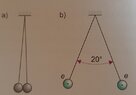
[Electrical force] 2 balls hanging from ceiling, angled

  • Thread starter Thread starter sea333
  • Start date Start date
  • Tags Tags
    Balls Force
Join the discussion
Ask a follow-up here, or get your own question answered by working scientists, mathematicians and engineers — people, not an autocomplete.
Real named experts · corrections over time · the nuance an AI answer skips
35 replies · 3K views
sea333
Messages
50
Reaction score
2
Homework Statement
2 metal balls hang from a ceiling on a thread(see picture a.) ). After the balls are charged with the same charge both thread diverge to an angle 20 degrees.(see picture b.) )
What charge is used to charge each ball.
weight of each ball = 0.02 kg
Relevant Equations
F = (1/(4*Pi*eps0))*(e*e)/r^2
20210727_191445.jpg

Capture.PNG
20210727_191509.jpg
 

Attachments

  • 20210727_191509.jpg
    20210727_191509.jpg
    22.9 KB · Views: 179
Physics news on Phys.org
kuruman said:
Your expression ##F_e=mg\tan(10^o)## is incorrect. The electric force is equal to the horizontal component of the tension, the weight is equal to the vertical component of the tension and ##T=\sqrt{(mg)^2+F_e^2}.##
ok but neither the Tension nor Fe are known, and we need Fe ?
 
kuruman said:
Write down two equations balancing forces in the horizontal and vertical directions separately and see where you can go from there.
horizontal: Fx - Fe = 0 -> Fe = Fx
vertical: Fg - Fy = 0 -> Fg = Fy
 
sea333 said:
horizontal: Fx - Fe = 0 -> Fe = Fx
vertical: Fg - Fy = 0 -> Fg = Fy
This is correct but doesn't get you very far. You need to bring in the given quantities. Please use symbols like m and q and so on, not numbers. The numbers will be substituted in the final expression for q once you have it.
 
kuruman said:
This is correct but doesn't get you very far. You need to bring in the given quantities. Please use symbols like m and q and so on, not numbers. The numbers will be substituted in the final expression for q once you have it.
Fe = Fx
Fg = Fy
Fx = (1/(4*PI*Eps0))*(q*q/r^2)
Fy = mg
 
kuruman said:
Right. But you have not brought in the information that the string makes a 10o angle with respect to the vertical. How would you go about doing that?
that is cosinus -> T = mg / Cos10
 
this
Fx - Fe = 0
Fx = (1/(4*PI*Eps0))*(q*q/r^2)
 
Fx/T = sin 10 -> Fx = Fe = T*sin10
 
T = mg / Cos10
Fx = Fe = T*sin10
 
Into the bottom equitation I can insert equation for T and get q which is the only unknown?
 
q*q/(4*PI*Eps0*r^2) = (m*g / Cos10) * Sin10

And then just move everything except q on the right side
 
This looks easy, but why was my attempt flawed with Tan10 ?
 
sea333 said:
This looks easy, but why was my attempt flawed with Tan10 ?
That was fine, but you have a wrong sign in your use of the cosine rule to find r. Easier would have been ##r=a\sin(10°)##.

Edit: see correction in post #27.
 
Last edited:
haruspex said:
That was fine, but you have a wrong sign in your use of the cosine rule to find r. Easier would have been ##r=a\sin(10°)##.
When I changed the sign now result looks correct.
I don't think you can get r in such a way because angle 10 degrees is not adjacent to r
 
kuruman said:
I explained that in post #2.
It looks like the Tan approach was correct
 
haruspex said:
Sorry, I meant ##r=2a\sin(10°)##.
I still don't see how this is correct as angle 10 is not adjacent to r
 
sea333 said:
I still don't see how this is correct as angle 10 is not adjacent to r
You have found that ##r=\sqrt{2a^2-2a^2\cos^2(20^o)}=\sqrt{2a^2(1-\cos(20^0))}##.
There is a trig identity that says
##\cos(2\theta)=\cos^2(\theta)-\sin^2(\theta)##
so that ##1-\cos(20^0)=1-\cos^2(10^o)+\sin^2(10^o)=2\sin^2(10^o)##. What do you get when you substitute in the expression for ##r##?

Another way to look at it is to break the isosceles triangle to two right triangles of base ##r/2## and hypotenuse ##a##. How is ##r/2## related to ##a##?
 
sqrt(4a^2sin^2(10)) = 2*a*sin10

How do you get from 1 - cos^2(10) - sin^2(10) to 2 sin^2(10) ?