Electrodynamics- combination of resistors

Join the discussion
Ask a follow-up here, or get your own question answered by working scientists, mathematicians and engineers — people, not an autocomplete.
Real named experts · corrections over time · the nuance an AI answer skips
11 replies · 2K views
othonmp
Messages
5
Reaction score
0

Homework Statement


What is the compensative system of this combination of resistors?
http://img545.imageshack.us/img545/6610/circuitoi.jpg
 
Last edited by a moderator:
Physics news on Phys.org
I'm not sure what you're referring to. Do you mean the total resistance?
 
othonmp said:

Homework Statement


What is the compensative system of this combination of resistors?
http://img545.imageshack.us/img545/6610/circuitoi.jpg

Can you define "compensative system"? I don't recognize the term.
 
Last edited by a moderator:
dinospamoni said:
I'm not sure what you're referring to. Do you mean the total resistance?

Yes,I mean the total resistance =]
sorry, English is not my first language
 
othonmp said:
Yes,I mean the total resistance =]
sorry, English is not my first language

Okay. What techniques have you learned about for reducing (simplifying) resistor networks? Can you spot any opportunities to apply them in the given circuit?
 
I'd go for

series: R_total = R_1+R_2+R_3+...

Parallel" 1/R_total = 1/R_1+1/R_2 +1/R_3 +...

Be careful about which one you use
 
gneill said:
Okay. What techniques have you learned about for reducing (simplifying) resistor networks? Can you spot any opportunities to apply them in the given circuit?

I know about combinations in parallel and in series, I could spot the parallel combination on the superior right corner (9Ω,8Ω,5Ω), they can be reduced to a resistance of aproximately 2.29Ω
there is a combination in series(8Ω,2Ω) that is equal a resistance of 10Ω
as well, there is a combination in parallel near B(2Ω,2Ω) that is equal 1Ω
but it just this, I don't know what I have to do with the first part, where there's are 5Ω resistances and a 9Ω resistance
 
Ok good so far. First, look for resistors in series and combine them into one resistor. Then see where that one is relative to the others
 
othonmp said:
I know about combinations in parallel and in series, I could spot the parallel combination on the superior right corner (9Ω,8Ω,5Ω), they can be reduced to a resistance of aproximately 2.29Ω
there is a combination in series(8Ω,2Ω) that is equal a resistance of 10Ω
as well, there is a combination in parallel near B(2Ω,2Ω) that is equal 1Ω
but it just this, I don't know what I have to do with the first part, where there's are 5Ω resistances and a 9Ω resistance

Yes, you should replace those parallel and serial resistances with their reduced values as you've stated, and continue to combine any more such opportunities that arise from those reductions.

Regarding the grouping in the top left corner near A, note the wire that bridges the combination. Since it's a perfect conductor, its resistance is zero. That ties together the points A and A'. What then must be the resistance between A and A'?
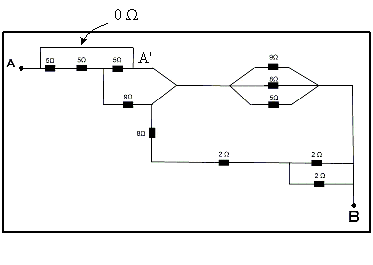
attachment.php?attachmentid=57440&stc=1&d=1365029445.gif
 

Attachments

  • Fig1.gif
    Fig1.gif
    2.7 KB · Views: 546
gneill said:
Yes, you should replace those parallel and serial resistances with their reduced values as you've stated, and continue to combine any more such opportunities that arise from those reductions.

Regarding the grouping in the top left corner near A, note the wire that bridges the combination. Since it's a perfect conductor, its resistance is zero. That ties together the points A and A'. What then must be the resistance between A and A'?

attachment.php?attachmentid=57440&stc=1&d=1365029445.gif

So this first part can be disregarded and I just have to combine in parallel 2,29Ω with 8Ω+2Ω+1Ω

then the result would be aproximately 1,9Ω, is that right?
 
gneill said:
Yes, that's the right procedure :smile:

Thank you =]