Elementary algebra of complex variables problem

Click For Summary
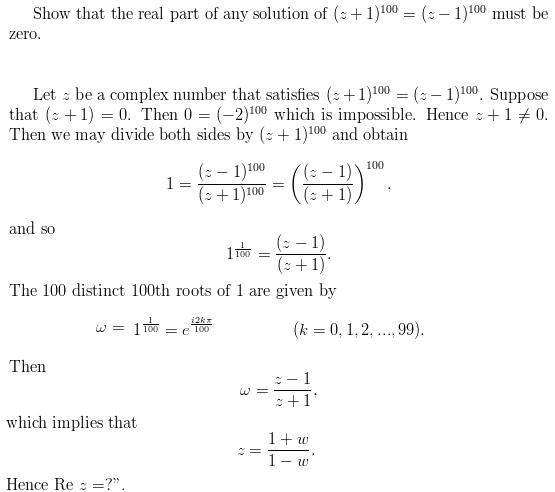
The discussion revolves around proving that the real part of z is zero in the context of complex variables. Participants explore the expression z = (1 + ω) / (1 - ω), where ω = e^{ikπ/50}, and debate how to demonstrate that z is purely imaginary. A key insight is that multiplying by (1 - ω*) results in a numerator that is purely imaginary and a denominator that is purely real, leading to the conclusion that Re(z) = 0. Despite initial confusion, one participant expresses relief upon understanding the proof, highlighting the collaborative nature of the problem-solving process. The conversation underscores the importance of careful manipulation of complex expressions in algebra.
jdinatale
Messages
153
Reaction score
0
I'm having difficulty deducing that Re z = 0.

w00r3b.jpg
 
Physics news on Phys.org
Try multiplying the top and bottom by (1-w*).
 
Last edited by a moderator:
You made a minor error in calculating the denominator when you canceled the ones.
 
Sorry for butting in, but although I can see where jdinatale went wrong in his last post, I still can't see how Re(z) can be proved to be zero.

Of course it's correct, but I can't quite see it.
 
oay said:
Sorry for butting in, but although I can see where jdinatale went wrong in his last post, I still can't see how Re(z) can be proved to be zero.

Of course it's correct, but I can't quite see it.

The calculation shows z is pure imaginary and that's still true after you make the correction. Doesn't that show Re(z)=0?
 
Dick said:
The calculation shows z is pure imaginary
How does it?

Sorry, I'm probably being very thick here and will live to regret it.

How does

z = (1 + \omega) / (1 - \omega)
where \omega = e^{ik\pi/50}

imply that z is purely imaginary?

Like I say, I know it's correct to say so, but I'm lost on how to prove it - even after trying using the conjugate method as offered above.

It'll probably be a face-palm moment when I find out...
 
oay said:
How does it?

Sorry, I'm probably being very thick here and will live to regret it.

How does

z = (1 + \omega) / (1 - \omega)
where \omega = e^{ik\pi/50}

imply that z is purely imaginary?

Like I say, I know it's correct to say so, but I'm lost on how to prove it - even after trying using the conjugate method as offered above.

It'll probably be a face-palm moment when I find out...

Look at what happens when jdinatale multiplies by (1+w*). The results has w-w* (which is pure imaginary) in the numerator and w+w* (which is pure real) in the denominator. What kind of a number is imaginary/real?
 
Dick said:
Look at what happens when jdinatale multiplies by (1+w*). The results has w-w* (which is pure imaginary) in the numerator and w+w* (which is pure real) in the denominator. What kind of a number is imaginary/real?
Ha-ha! I was right!

A complete face-palm...

Thanks for that. I blame my incompetence on my getting on a bit. :redface:
 

Similar threads

  • · Replies 14 ·
Replies
14
Views
2K
  • · Replies 5 ·
Replies
5
Views
2K
Replies
7
Views
2K
  • · Replies 9 ·
Replies
9
Views
2K
  • · Replies 2 ·
Replies
2
Views
3K
Replies
8
Views
3K
  • · Replies 17 ·
Replies
17
Views
3K
  • · Replies 6 ·
Replies
6
Views
2K
  • · Replies 3 ·
Replies
3
Views
2K