Eleven Inner Planets--What Will Earth's Ice Ages Be Like?

Click For Summary

Discussion Overview

The discussion revolves around the implications of Milankovitch cycles and hypothetical planetary configurations in an alternate universe, particularly focusing on how these factors might affect Earth's climate and nightscape. The conversation includes theoretical considerations of planetary formation and stability in relation to different stellar masses.

Discussion Character

  • Exploratory
  • Debate/contested
  • Conceptual clarification

Main Points Raised

  • One participant defines Milankovitch cycles and describes their components: eccentricity, obliquity, and precession, and their effects on Earth's climate.
  • Another participant argues that merging the systems of the inner planets and TRAPPIST-1 is problematic due to the differing masses and formation histories of the two systems.
  • Concerns are raised about the stability of a large moon orbiting Earth in a sun-like system, suggesting it would likely not be stable over billions of years.
  • Precision in the mass of the hypothetical moon is questioned, with a participant highlighting the improbability of such specific figures in astronomical contexts.
  • A participant mentions their calculation of the moon's mass based on Ganymede's mass, indicating a method for deriving such figures.
  • There is a suggestion that rounding numbers could simplify discussions and avoid confusion.

Areas of Agreement / Disagreement

Participants express disagreement regarding the feasibility of merging the two planetary systems and the implications of the hypothetical moon's mass. The discussion remains unresolved, with multiple competing views on the stability of the proposed configurations.

Contextual Notes

Participants note limitations in the information provided, particularly regarding the historical context of planetary formation and the stability of orbits over long timescales. There is also an acknowledgment of the challenges in simulating the proposed scenarios.

JohnWDailey
Messages
34
Reaction score
1
A Milankovitch cycle is defined in Universe Today as "a cyclical movement related to the Earth’s orbit around the Sun."

There are three elements to a Milankovitch cycle that affects the amount of solar heat and with it, the Earth's climate:

  • Eccentricity (Orbital Shape)--The elliptical shape of the Earth's orbit varies from 0.000055 to 0.0679 over a 100,000 year period. Eccentricity affects the lengths of a season.
  • Obliquity (Axial Tilt)--The Earth's axis shifts from 22.1 to 24.5 degrees over a 41,000 year period. Obliquity affects the amount of heat gathered on either hemisphere.
  • Precession (Axial Wobbling)--Currently, Polaris is the North Star, but it hadn't always been the case. In 3000 BCE, Thuban was the North Star. In 14,000 CE, Vega will be the North Star. Each wobble has a 26,000-year cycle. The tidal relationship between Earth and the moon plays a part in precession. Also, according to Universe Today...
"Precession as well as tilting are the reasons why regions near and at the poles experience very long nights and very long days at certain times of the year. For example, in Norway, the Sun never completely descends beneath the horizon between late May to late July."

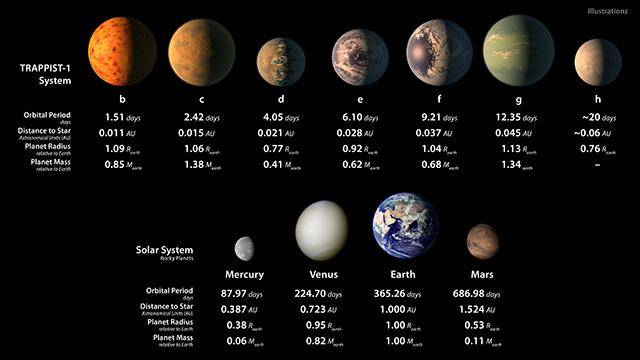
In an alternate universe, orbiting a yellow G-type main-sequence star are not four Inner Planets, but eleven.
4I1mj.jpg

Note that the farthest of TRAPPIST-1's planets, TRAPPIST-1h, is only 0.06 AUs (5,577,348.436046 miles) from the star. By comparison, the closest planet, Mercury, orbits the sun from a distance of 0.387 AUs (35.98 million miles). So it seems ideal to mesh the two systems without problem.

In this same universe, one natural satellite still orbits Earth, except that it is bigger--3,273 miles wide and a mass of 148,148,148,148,148,148,148.15 tons, as big as Ganymede--and orbits the planet from a distance of almost 475,000 miles.

How will the changes listed above affect Earth's nightscape and its Milankovitch cycles?
 
Physics news on Phys.org
JohnWDailey said:
So it seems ideal to mesh the two systems without problem.
Only if you completely ignore the history of the system. Our 4 planets formed at their distance (and as rocky planets) due to the overall mass of the solar system (=the overall mass of Sun). The TRAPPIST1-planets are closer due to the smaller overall mass of their system. It is not clear how to get both in the same system. A sun-like star would not get planets that close, a TRAPPIST-like star is unlikely to get rocky planets that far out.
JohnWDailey said:
a mass of 148,148,148,148,148,148,148.15 tons
That is oddly specific, and the mass at that precision will change on a daily basis based on asteroid impacts.
JohnWDailey said:
and orbits the planet from a distance of almost 475,000 miles.
That orbit is probably not stable over billions of years with a sun-like star, so we need a lighter star. Earth will be very cold.
JohnWDailey said:
How will the changes listed above affect Earth's nightscape and its Milankovitch cycles?
Impossible to tell with the information provided. And even with the missing information, it will require a lot of simulation work beyond the scope of a thread here.
 
The mass was what I got from Ganymede, which was dividing Earth's weight by 40.5, which is half that of our moon. It's said that Ganymede has twice the moon's mass.
 
Rounding up sometimes spare people the headache.
 

Similar threads

  • · Replies 3 ·
Replies
3
Views
624
  • · Replies 10 ·
Replies
10
Views
3K
  • · Replies 21 ·
Replies
21
Views
5K
  • · Replies 3 ·
Replies
3
Views
3K
  • · Replies 8 ·
Replies
8
Views
2K
  • · Replies 2 ·
Replies
2
Views
2K
  • · Replies 4 ·
Replies
4
Views
2K
  • · Replies 44 ·
2
Replies
44
Views
15K
  • · Replies 6 ·
Replies
6
Views
4K
Replies
2
Views
2K