EM fields and Current between 2 charged cylinders

Join the discussion
Ask a follow-up here, or get your own question answered by working scientists, mathematicians and engineers — people, not an autocomplete.
Real named experts · corrections over time · the nuance an AI answer skips
10 replies · 2K views
phantomvommand
Messages
287
Reaction score
39
Homework Statement
Please see attached photos.
Relevant Equations
Ampere's Law
The task is to find the magnetic field between the 2 long cylinders, which extend to infinity. Integration is involved to find the total current passing through the Amperian Loop shown below. What I do not understand is why only sides 1 and 3 contribute to that B ds part of Ampere's Law. Isn't there magnetic field flowing parallel to sides 2 and 4 as well, like how a current in a straight wire creates a circular magnetic field that runs parallel to all sides of a loop around it?

I see this as similar to a straight wire, as there is only an X-component of current. The Y-component cancels out. However, there is "thickness" to this current.
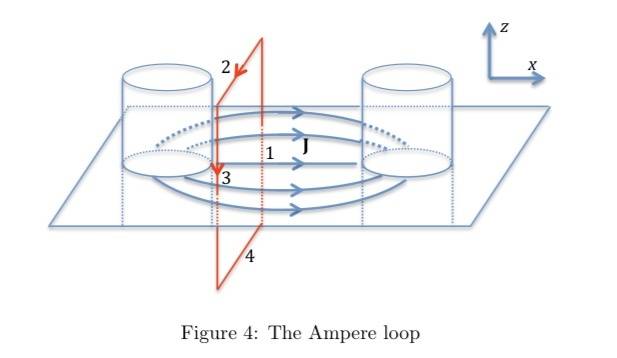
IMG_6730.jpg
 
Last edited by a moderator:
Physics news on Phys.org
The setup is not completely clear. Did you quote the complete problem statement exactly as it was given to you?

Do you have to find ##\mathbf B## for all points outside the two cylinders?
 
TSny said:
The setup is not completely clear. Did you quote the complete problem statement exactly as it was given to you?

Do you have to find ##\mathbf B## for all points outside the two cylinders?
Apologies for leaving this out:
The 2 cylinders in the image above are immersed in a conducting fluid. They are thus effectively joined by a wire (which the current runs through), so there is no B-field outside of that region.

If it is still unclear:
Attached below is the full problem. I am only asking about the last part (8). However, I think you would still have to read through the above parts to understand the context; apologies that my summary was unclear.

IMG_6732.jpg

Thanks for your help.
 
OK. Thanks for posting the entire problem statement.

Regarding your specific question about sides 2 and 4 of the Amperian path: First, consider any straight line parallel to the z-axis and lying outside the two cylinders. Let ##a## and ##b## be any two points on this line. Can you deduce anything about how the magnetic fields at these two points compare?
 
TSny said:
OK. Thanks for posting the entire problem statement.

Regarding your specific question about sides 2 and 4 of the Amperian path: First, consider any straight line parallel to the z-axis and lying outside the two cylinders. Let ##a## and ##b## be any two points on this line. Can you deduce anything about how the magnetic fields at these two points compare?
The magnetic field there would only be in the z direction? But shouldn’t we be considering points lying on lines parallel to the y-axes, which is where paths 2 and 4 run parallel to?
 
Since you know sides 2 and 4 of the loop are being ignored, I'm guessing that you have an official solution, If so, maybe it would help if you included it.

At what point(s)/region(s) are you finding the magnetic field? Or are you being asked for a general expression for ##\vec B (x,y,z)##? This is not clear from the question but if you have an official solution,it should be possible to tell.
 
phantomvommand said:
The magnetic field there would only be in the z direction?
No. The field will not be in the ##z##-direction. [EDIT: This is incorrect. ##\mathbf B## is in the positive or negative z-direction, except on the x-axis where B = 0.]

But if the cylinders are considered to be essentially infinitely long, you can say something about how the magnetic field varies as you move only in the ##z##-direction. That is, does ##\mathbf B## depend on ##z##? If so, how?

You should also be able to deduce from symmetry whether or not ##\mathbf B## has a non-zero ##z##- component.

But shouldn’t we be considering points lying on lines parallel to the y-axes, which is where paths 2 and 4 run parallel to?
If you figure out how ##\mathbf B## depends on ##z##, then consider a line parallel to the ##z##-axis that passes through some point ##a## of path 2 and, therefore, also passes through some point ##b## of path 4. How does ##\mathbf B## compare for points ##a## and ##b##? What does this tell you about how the line integral of ##\mathbf B## for path 2 compares to the line integral of ##\mathbf B## for path 4?
 
Last edited:
Steve4Physics said:
Since you know sides 2 and 4 of the loop are being ignored, I'm guessing that you have an official solution, If so, maybe it would help if you included it.

At what point(s)/region(s) are you finding the magnetic field? Or are you being asked for a general expression for ##\vec B (x,y,z)##? This is not clear from the question but if you have an official solution,it should be possible to tell.
161913C0-7752-4152-AF9E-71AB88E8A168.jpeg

It appears to me that there is only a Z-component of the B field, (See Eqn 30-31) but I am unclear why there is no Y-component along paths 2 and 4. The reason why ##J_x## = <that integral> is a result obtained from previous parts. I am mainly asking about the last line, when ##B \dot l ## was replaced with ##2B_zl## directly, ignoring a possible ##B_yl## along paths 2 and 4.
 
TSny said:
No. The field will not be in the ##z##-direction.

But if the cylinders are considered to be essentially infinitely long, you can say something about how the magnetic field varies as you move only in the ##z##-direction. That is, does ##\mathbf B## depend on ##z##? If so, how?

You should also be able to deduce from symmetry whether or not ##\mathbf B## has a non-zero ##z##- component.

If you figure out how ##\mathbf B## depends on ##z##, then consider a line parallel to the ##z##-axis that passes through some point ##a## of path 2 and, therefore, also passes through some point ##b## of path 4. How does ##\mathbf B## compare for points ##a## and ##b##? What does this tell you about how the line integral of ##\mathbf B## for path 2 compares to the line integral of ##\mathbf B## for path 4?
Please see my above reply to Steve4Physics, it could be helpful. Because of symmetry, the Magnetic field in the Z direction along path 1 = Magnetic field in the Z direction along path 3. Furthermore, along Path 1/3, ##B_z## is constant as the wires are infinitely long.

it seems to me that the magnetic field through paths 2 and 4 are also entirely in the z direction, so B dot dz = 0.
 
Yes, you are right. I was mistaken in how I was thinking about the z-component of ##\mathbf B##. I believe ##B_z## will be positive for positive values of ##y## and ##B_z## will be negative for negative values of ##y##.

But here's how I was thinking about how to show that the line integrals of B for sides 2 and 4 cancel. Since the cylinders are infinitely long, the B-field cannot depend on the coordinate ##z##. So, if you consider a point ##a## on side 2 and the corresponding point ##b## on side 4 that lies vertically below ##a##, then ##\mathbf B## at points ##a## and ##b## are the same. So, the line integrals along 2 and 4 will be equal in magnitude. But they will have opposite signs because the directions of integration are opposite for the two sides.

Of course, if ##\mathbf B## is parallel to the z-axis everywhere, then, as you say, the line integrals for 2 and 4 are each equal to zero. This would be the easy way to see that sides 2 and 4 don't contribute.
 
Last edited:
  • Like
Likes   Reactions: phantomvommand
phantomvommand said:
It appears to me that there is only a Z-component of the B field, (See Eqn 30-31) but I am unclear why there is no Y-component along paths 2 and 4.
You can use the Biot-Savart law to show that ##B_x = 0## and ##B_y = 0## at all points.

Consider an arbitrary point ##p## where you want to calculate ##\mathbf B##.

1621091272479.png


Consider the contribution to ##\mathbf B## at ##p## due to the current density at symmetrically placed points ##a## and ##b##, as shown. Use the Biot-Savart law to show that the net x and y components of ##\mathbf B## at point ##p## due to these two current densities is zero.
 
  • Like
Likes   Reactions: phantomvommand and Delta2