EM re-radiation from a metal object (antennas)

Click For Summary
SUMMARY

The discussion centers on the re-radiation of electromagnetic waves by passive monopole antennas, specifically when one antenna is active and the other is disconnected. It is established that a disconnected antenna primarily re-emits energy it absorbs, influenced by factors such as thermal dissipation and the antenna's radiation resistance. The conversation highlights the importance of mutual impedance and the inverse square law in determining the strength of the re-emitted wave compared to the original signal. Techniques such as using inductive-capacitive networks and detuning skirts are mentioned as methods to minimize unwanted re-radiation, particularly in the context of cell towers near broadcast stations.

PREREQUISITES
  • Understanding of monopole antenna theory and design
  • Familiarity with electromagnetic wave propagation principles
  • Knowledge of mutual impedance and its calculations
  • Experience with inductive-capacitive networks for antenna tuning
NEXT STEPS
  • Research the principles of Yagi-Uda antenna design and its application in increasing directivity
  • Explore the effects of antenna spacing on mutual impedance and signal strength
  • Learn about the use of detuning skirts in minimizing re-radiation from antennas
  • Study the impact of thermal dissipation on antenna performance and signal integrity
USEFUL FOR

Engineers, antenna designers, and telecommunications professionals seeking to optimize antenna performance and minimize interference in RF applications.

Johan L
Messages
4
Reaction score
3
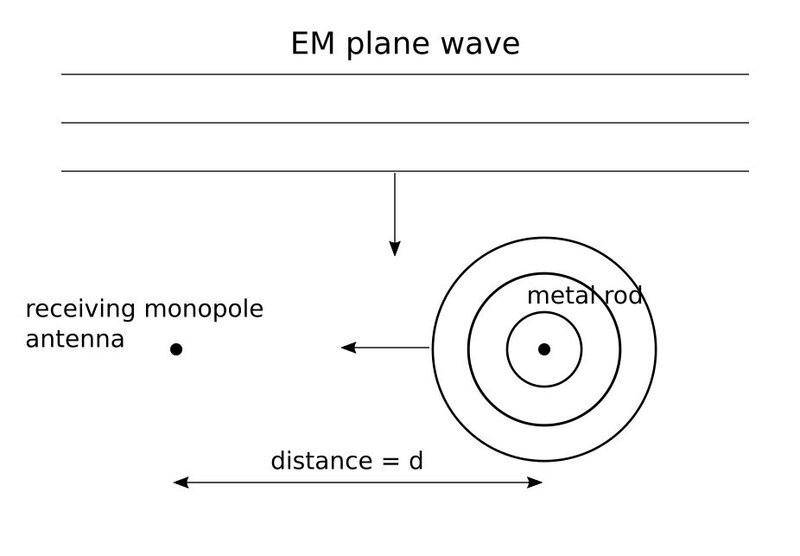
Consider the following situation. Two identical monopole antennas are placed in a field with distance d. One of them is used to receive signals and the other is disconnected and can therefor be considered to be just a metal rod (my guess). A plane wave of a single frequency is coming from a distant source. Since no energy is extracted in the form of a signal from the passive antenna I guess it will re-radiate most of the energy received by it (minus thermal dissipation). Questions:

Is it first of all true that a disconnected antenna re-emits most of the energy that otherwise would have been absorbed and converted into a signal?

How strong will the contribution of the re-emitted wave be compared to the original for the receiving antenna? Is it just a a matter of the inverse square law and the aperture of the receiving antenna?

Can you prevent the passive antenna from re-emitting totally (and over all frequencies) by terminating it somehow?
Capture.JPG
 
  • Love
Likes   Reactions: Delta2
Science news on Phys.org
I think the best you can hope for is to minimize the current in the metal pole by de-tuning it with an inductive-capacitive network. This reradiation issue is a problem with cell towers located near am broadcast stations and there are companies that manufacture "detuning skirts" to minimize reradiation form the am broadcast station.
 
  • Like
  • Informative
Likes   Reactions: hutchphd, Delta2, Johan L and 1 other person
The passive antenna develops the same EMF at its terminals as the active one, so the current is determined by its radiation resistance and load resistance in series. If the passive antenna is disconnected it has no current, so it will not influence the received power of the active one. If it is short circuited it will carry a large current and will re-radiate all the "incident" power. The phase of the radiation depends on the ratio of reactance to resistance for the passive antenna; this is the basis of the Yagi antenna, where an inductive antenna acts as a reflector and a capacitive antenna acts as a director.

To ascertain the effect on the active antenna, the usual way is to look up curves for the mutual impedance and apply a formula for coupled cciruits. Altenatively, the path loss formula can be used if the spacing is greater than about lambda/6. If it is closer than this, the attenuation between the two will be nominally 3dB. It is necessary to take into account the phase of the two signals during addition.
 
  • Like
  • Informative
Likes   Reactions: Delta2, Johan L and berkeman
Yagi TV antennas have numerous horizontal dipoles. usually only one of these is connected to the receiver. The others are called parasitic elements. These extra passive elements increase the active dipoles directivity by 20 to 30 dB.
 
  • Like
Likes   Reactions: Delta2
I think the 20 to 30 dB figure is a little high. More usually abouit 15 dB. To obtain 30dB directivity increase would require about 1000 dipoles.
 
  • Like
Likes   Reactions: Delta2
tech99 said:
If the passive antenna is disconnected it has no current, so it will not influence the received power of the active one. If it is short circuited it will carry a large current and will re-radiate all the "incident" power.
Thanks for the explanation. But this makes me a bit confused. Doesn't an electromagnetic wave always induce current to flow back and forth in a thin solid linear conductor (assuming it is directed along the E-field)? With a resonance maximum when the conductor is λ/2 long?

Can't a solid linear conductor of length L that is disconnected from the ground be considered to be a "short circuited" dipole with two conductors of length L/2? So if a wave impinges on a thin metal rod, in my mind it will then (according to the second sentence in the quote above) re-radiate all incident power if the wavelength is twice that of the rod. Or am I missing something?
 
Last edited:
  • Love
Likes   Reactions: Delta2
Johan L said:
Thanks for the explanation. But this makes me a bit confused. Doesn't an electromagnetic wave always induce current to flow back and forth in a thin solid linear conductor (assuming it is directed along the E-field)? With a resonance maximum when the conductor is λ/2 long?

Can't a solid linear conductor of length L that is disconnected from the ground be considered to be a "short circuited" dipole with two conductors of length L/2? So if a wave impinges on a thin metal rod, in my mind it will then (according to the second sentence in the quote above) re-radiate all incident power if the wavelength is twice that of the rod. Or am I missing something?
Your heading mentions monopoles, so my explanation refers to monopoles which I assume to be a quarter of wavelength long. Such an antenna utilises the ground as one terminal. If the monopole is half a wavelength long then it can be resonate without the ground plane, so to disable it would require breaking it at the mid point.
 
Johan L said:
Can't a solid linear conductor of length L that is disconnected from the ground be considered to be a "short circuited" dipole with two conductors of length L/2?
That's a very interesting way of seeing it but in my opinion it is not the same thing as a short circuited dipole. In my opinion the two ends of the conductor form a capacitor (that has as in between space all the surrounding space) that has some small capacitance so the circuit is "closed" via this small capacitor and the current in the circuit (which consists of the rod plus this capacitor) is minimized because of this small capacitance.
 
  • Like
Likes   Reactions: alan123hk and Johan L
  • #10
tech99 said:
Your heading mentions monopoles, so my explanation refers to monopoles which I assume to be a quarter of wavelength long. Such an antenna utilises the ground as one terminal. If the monopole is half a wavelength long then it can be resonate without the ground plane, so to disable it would require breaking it at the mid point.
Ok. should have been clearer about that. Then we agree.

Delta2 said:
That's a very interesting way of seeing it but in my opinion it is not the same thing as a short circuited dipole. ...
Not sure I follow your analogy with a capacitor. Are you thinking of the circuit equivalent of a dipole antenna? Do you not consider the two arrangements below to be "equivalent"? That the same current will flow inside the antenna element(s), even when the frequency is not perfectly tuned? If one re-emits all the energy that it absorbs, will not the other (minus thermal losses)?

How much that is absorbed on the other hand (how much current that is generated), should depend on the frequency right? The antennas should be "invisible", and the surrounding EM plane wave field should not be much effected by them, for frequencies far away from the resonance, no?

Capture3.JPG
 
Last edited:
  • #11
Johan L said:
Do you not consider the two arrangements below to be "equivalent"?

If you consider the left antenna or the right antenna in the figure below independently for reflection and scattering of electromagnetic wave from space, and they have the same size and shape (including length, diameter, and the gap between the lower end and the ground, etc.), then I can't see any reason why they are not equivalent.

But If the distance between the lower end of the right antenna and the ground is much greater than that of the left antenna, or if you consider that the feeding point of the left antenna is at the bottom and the feeding point of the right antenna is in the middle, etc., then of course they cannot be equivalent.

So whether the two are equivalent depends on the specific situation and how we consider it. :smile:
1622251218206.png
 
Last edited:
  • Like
Likes   Reactions: Johan L and Delta2
  • #12
The two are not the same. The RH version is isolated from ground, so its lowest resonance is when it is half a wavelength long. The LH version is connected to ground, so its lowest resonance is when it is a quarter wavelength long ie half the frequency. When the switch is open they are the same.
 
  • #13
tech99 said:
The two are not the same. The RH version is isolated from ground, so its lowest resonance is when it is half a wavelength long. The LH version is connected to ground, so its lowest resonance is when it is a quarter wavelength long ie half the frequency. When the switch is open they are the same.
What you say is correct. However, it doesn't just apply at Resonance, although the currents at resonance can be much higher. Any piece of metal will have currents induced in it by an incident EM wave and, even if the 'parasitic' dipole is open circuit at the middle (therefore well away from resonance), it will / can affect the net induced emf in a nearby receiving antenna. If you really need to eliminate such effects (such as in the stays of a tall MF mast antenna) the parasitic structure would be divided up into much shorter lengths with insulators. (Something to spot when driving past some MF local radio masts)

Many dipole antennae are mounted, stood - off from a mast part way up and the (sometimes very wide) mast is a significant element in the antenna pattern. In that case, the 'reflector' is very long and well away from resonance. Choosing the right spacing can give some useful control of the horizontal pattern.
 
  • Like
Likes   Reactions: Johan L
  • #14
tech99 said:
The two are not the same. The RH version is isolated from ground, so its lowest resonance is when it is half a wavelength long. The LH version is connected to ground, so its lowest resonance is when it is a quarter wavelength long ie half the frequency. When the switch is open they are the same.
I made the switch open so that it would depict the situation when they are the same.
 
  • Like
Likes   Reactions: Delta2
  • #15
Johan L said:
I made the switch open so that it would depict the situation when they are the same.
The presence of the ground (explicit on the left) effectively places an Image of the antenna underground because of the part of the wave front that hits the ground and reflects upwards (at an angle) towards the antenna itself (one way of thinking of it). It gives a Vertical Pattern that's different from that of an isolated antenna, out in empty space (or a few wavelengths up).
 

Similar threads

  • · Replies 1 ·
Replies
1
Views
1K
  • · Replies 4 ·
Replies
4
Views
3K
  • · Replies 69 ·
3
Replies
69
Views
8K
  • · Replies 4 ·
Replies
4
Views
2K
  • · Replies 4 ·
Replies
4
Views
2K
  • · Replies 9 ·
Replies
9
Views
2K
  • · Replies 9 ·
Replies
9
Views
2K
  • · Replies 8 ·
Replies
8
Views
2K
  • · Replies 3 ·
Replies
3
Views
2K
  • · Replies 9 ·
Replies
9
Views
9K