Energy in different inertial frames

Click For Summary

Discussion Overview

The discussion revolves around the concept of energy in different inertial frames, particularly focusing on the kinetic energy of colliding objects (the Earth and an asteroid) and the implications of neglecting momentum conservation. Participants explore the relationship between energy and momentum, the nature of inertial frames, and the outcomes of collisions from varying perspectives.

Discussion Character

  • Debate/contested
  • Conceptual clarification
  • Technical explanation

Main Points Raised

  • One participant describes a scenario involving the Sun, Earth, and an asteroid, questioning the conversion of kinetic energy to thermal energy during a collision.
  • Another participant asserts that ignoring momentum leads to incorrect conclusions about energy changes in different frames.
  • There is a discussion about the conservation of energy versus the conservation of kinetic energy, with some participants noting that kinetic energy can be converted to thermal energy.
  • Questions arise regarding the definition of an inertial frame if momentum conservation is not considered.
  • A participant mentions that an asteroid colliding with the Earth results in a totally inelastic collision, leading to a loss of kinetic energy, and emphasizes the importance of momentum conservation to determine the final velocities post-collision.
  • Some participants express confusion about obtaining correct results without considering momentum, highlighting the interconnectedness of energy and momentum.

Areas of Agreement / Disagreement

Participants generally disagree on the implications of neglecting momentum conservation, with some asserting that it is essential for accurate analysis, while others question the relationship between energy and momentum. The discussion remains unresolved regarding the correct interpretation of energy changes in different frames.

Contextual Notes

Participants express uncertainty about the definitions and implications of inertial frames when momentum conservation is disregarded. There are also unresolved questions about the nature of energy conservation in the context of collisions.

Oliver321
Messages
59
Reaction score
5
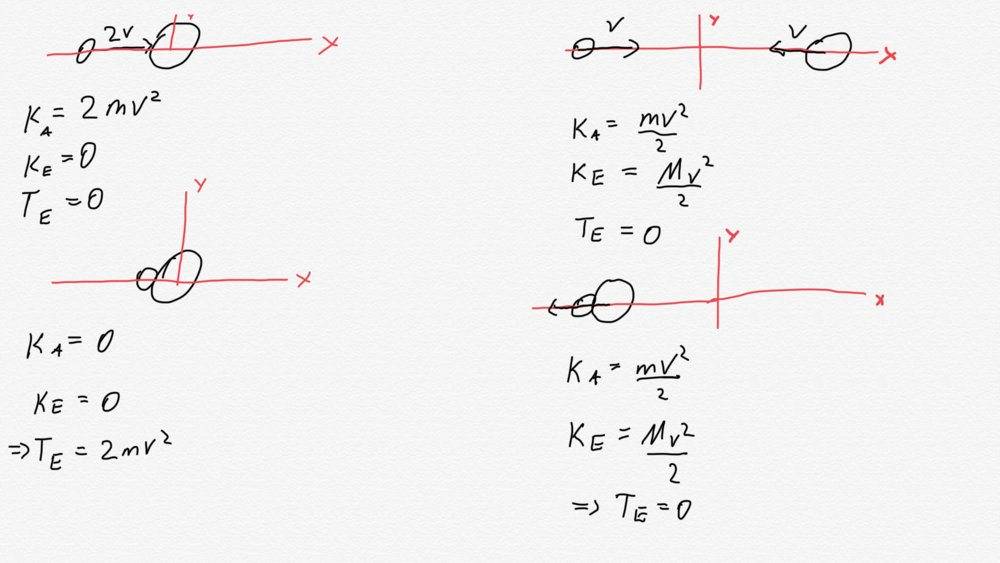
Lets neglect conservation of momentum and assume that all frames of reference are inertial. Now imagine three objects: the sun, the Earth and an asteroid. In the inertial frame of the sun, Earth and asteroid are flying towards each other ( velocitys v and -v).
Now imagine you are standing at the surface of the earth: you see the asteroid flying towards you with 2v. So after some time the asteroid hits the Earth and all of its kinetic energy (K=2mv^2) gets converted into thermal energy (let’s assume the Earth stands still after the impact which implies that also the asteroid stands still). The temperature of the Earth rises.
Now look at this scenario from perspective of the sun:
Earth hast velocity -v and the asteroid has velocity v (so a velocity difference of 2v). They both hit each other. In the first moment the asteroid gets slowed down to zero (converting its kinetic energy in thermal energy) and in the exact same moment the asteroid gets accelerated to the velocity of the Earth (which costs energy). But that would implie that really no kinetic energy gets converted into thermal energy, because the kinetic energy of the Earth and the asteroid are the same before and after the impact. Only the velocity of the asteroid points in the other direction. Nevertheless kinetic energy could not be negative so the direction plays no role.

Where is my mistake?

Thank you for your help!
CBD0CF5D-3EE8-4B0A-B074-B3CA696CB6A9.jpeg
 
Physics news on Phys.org
If momentum is conserved, then the change in kinetic energy is the same in all frames.

Ignoring momentum is your mistake.
 
PeroK said:
If momentum is conserved, then the change in kinetic energy is the same in all frames.

Ignoring momentum is your mistake.

But shouldn’t it be, that energy for its own is conserved? Is there something that connects energy and momentum deeply? I thought both conservation laws arise from different properties of our universe (noether theorem).
 
Oliver321 said:
But shouldn’t it be, that energy for its own is conserved? Is there something that connects energy and momentum deeply? I thought both conservation laws arise from different properties of our universe (noether theorem).
Energy is conserved but not kinetic energy alone. Kinetic energy may be converted to thermal energy for example.

Special relativity unifies energy and momentum in a beautiful way.
 
  • Like
Likes   Reactions: vanhees71 and Oliver321
Oliver321 said:
Lets neglect conservation of momentum and assume that all frames of reference are inertial.
How do you define "inertial frame of reference", if conservation of momentum doesn't apply?
 
  • Like
Likes   Reactions: Oliver321
PeroK said:
Energy is conserved but not kinetic energy alone. Kinetic energy may be converted to thermal energy for example.

Special relativity unifies energy and momentum in a beautiful way.

So I don’t get a right result if I don’t consider momentum?

A.T. said:
How do you define "inertial frame of reference", if conservation of momentum doesn't apply?

That’s a good question. That’s probably not possible. Nevertheless it is a bit confusing for me, that I can not get the right awnser without respecting conservation of momentum.
 
Oliver321 said:
So I don’t get a right result if I don’t consider momentum?
That’s a good question. That’s probably not possible. Nevertheless it is a bit confusing for me, that I can not get the right awnser without respecting conservation of momentum.

If an asteroid hits the Earth then that is a totally inelastic collision. Kinetic energy is lost. Using conservation of momentum tells you how much kinetic energy is lost.

If you do not consider momentum then you do not know the final velocity of the Earth after the collision.
 
  • Like
Likes   Reactions: vanhees71
Oliver321 said:
Nevertheless it is a bit confusing for me, that I can not get the right awnser without respecting conservation of momentum.
First you have to ask a question that is not self-contradictory.
 

Similar threads

  • · Replies 2 ·
Replies
2
Views
1K
  • · Replies 41 ·
2
Replies
41
Views
4K
  • · Replies 64 ·
3
Replies
64
Views
4K
  • · Replies 9 ·
Replies
9
Views
2K
  • · Replies 6 ·
Replies
6
Views
2K
  • · Replies 7 ·
Replies
7
Views
2K
  • · Replies 2 ·
Replies
2
Views
1K
  • · Replies 5 ·
Replies
5
Views
2K
  • · Replies 5 ·
Replies
5
Views
3K
  • · Replies 1 ·
Replies
1
Views
1K