Engine in-cylinder pressure validation

  • Context: Automotive 
  • Thread starter Thread starter Fadzli
  • Start date Start date
  • Tags Tags
    Engine Pressure
Click For Summary

Discussion Overview

The discussion revolves around the validation of engine in-cylinder pressure through simulation and experimental methods, specifically focusing on a 2-stroke engine. Participants explore discrepancies between simulated and experimental pressure data, considering various parameters that may influence the results.

Discussion Character

  • Exploratory
  • Technical explanation
  • Debate/contested
  • Mathematical reasoning

Main Points Raised

  • One participant notes significant differences between simulation and experimental data despite following engine specifications closely.
  • Another participant questions whether the experimental tests were conducted on a cold engine and suggests considering valve event timing and charge momentum.
  • Concerns are raised about the accuracy of the crank rotation to piston displacement calculation, particularly due to potential encoder reading issues.
  • Participants discuss the importance of accounting for adiabatic compression heating in simulations, indicating that the compression process is not isothermal.
  • One participant mentions that their simulation only covers the closed cycle from intake valve closing to exhaust valve opening, incorporating detailed chemical and combustion modeling.
  • Another participant expresses skepticism about the simulation results, highlighting a lack of expected pressure spikes due to combustion.
  • Literature references are provided to support claims about expected in-cylinder pressure ranges during specific crank angles.
  • Participants agree on the need to verify the encoder's accuracy in recording crank angle data.

Areas of Agreement / Disagreement

Participants express differing views on the accuracy of the experimental results versus the simulation outcomes. While some lean towards the experimental data being accurate, others question the simulation's fidelity due to its featureless nature. The discussion remains unresolved with multiple competing views on the validity of the results.

Contextual Notes

Limitations include potential inaccuracies in encoder readings affecting crank angle data, assumptions about heat transfer, and the complexity of modeling combustion processes. The discussion does not resolve these limitations.

Who May Find This Useful

Readers interested in engine simulation, experimental validation methods, and the dynamics of 2-stroke engines may find this discussion relevant.

Fadzli
Messages
7
Reaction score
0
Hi all,
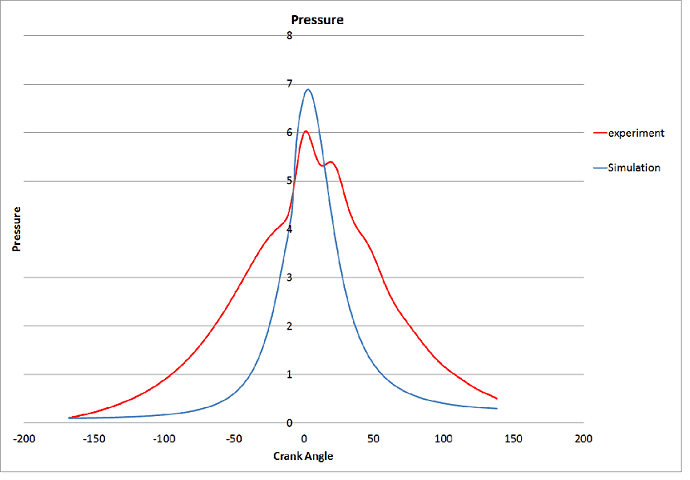
I’m currently investigating the engine in-cylinder pressure by simulation and experimental method. All inputs parameters in the simulation were exactly follow the engine technical specification (engine geometry, compression ratio, fuel injection parameters, initial pressure and temperature etc.) When both data were plotted, they are significantly different (please refer to the attached picture). Based on my literature study, most of the pressure vs crank angle graph are almost similar to my simulation result. So any idea why this is happen? Or at least what else parameters need to consider in order to validate these two results?
pressure.png
 
Engineering news on Phys.org
Are you doing your test by hand cranking a cold engine?
 
Your experimental plot does not seem to take valve event timing and charge momentum into consideration. Cylinder pressure will not start to rise significantly until the intake valve closes and cylinder pressure does drop off quicker than piston speed on the power stroke which is why exhaust valve timing opens the valve before bottom dead center.
 
Are you modeling a 2 stroke or 4 stroke engine?

What I am seeing is the opposite of the above valuation with the test indicating a sooner initiation of pressure rise than your simulation indicates.

Assuming your crank rotation to piston displacement calculation is correct, this would indicate an additional source of pressure rise during the compression stroke. Are you accounting for adiabatic compression heating in your simulation calculations? This is not an isothermal compression process.

Also, to repeat my original question, what is the method and engine conditions under which you are getting your compression test data. The basis of this question is that on a hot engine the compression pressure rise will be enhanced by heat transfer to the enclosed gas from surrounding preheated engine components.
 
Thanks JBA and Jac5522,
This is a modelling for 2 stroke engine and I already take into consideration of heat transfer inside cylinder. But my initial discussion with the engine contractor, we found that most probably the crank rotation to piston displacement calculation was not correct which is due to encoder reading. The encoder was installed not directly connected with engine shaft, but only with belting which is assumed power lost will be there. I hope this assumption is true and I will try to fix this first.
But anyway, thanks again for the advice.
 
As Jac and JBA indicated, your simulation prediction doesn't seem to take into account intake/exhaust events or fuel mixture ignition. How are you taking these confounding factors into account?

Your captured data looks similar to an expected result from a 2-stroke diesel engine, see below image:

http://www.marinediesels.info/Theory/actual_diesel_cycle.htm
out_of_phase_card.gif
 
Thanks Mech_Engineer,
My simulation was not predict for the whole engine cycle but only from intake valve closing (IVC) to exhaust valve opening (EVO) which mean only in close-cycle. But the software is capable to simulate detailed chemical reaction process (in CHEMKIN format), fuel spray modeling, combustion modeling and also turbulence modeling. So I believe that by taking all those consideration, the results should be accurate enough. Instead of simulation result, I think experimental result was more doubtful. Correct me if I'm wrong.
Thanks
 
What leads you to think the experimental result is wrong?
 
I'm not saying it's totally wrong, but based on my literature, all the references paper/journal reported that for crank angle between -150 degree to -50 degree, the in-cylinder pressure would be not more than 1 MPa. And also, by referring to my previous answer, most probably there is problem with the encoder which record all the crank angle data in my experiment. So maybe I need to verify this first.
 
  • #10
I'm more inclined to believe your experimental data is accurate, since the simulation result seems surprisingly featureless, especially the lack of a pressure spike due to combustion. The experiment seems to agree fairly well in general shape with the plot from Mech_engineer, on the other hand. What kind of 2 stroke is it - is it a small 2 stroke? Large 2 stroke diesel? Turbocharged? Tuned exhaust?
 
  • #11
It is a small 2 stroke with 85mm x 87mm (bore x stroke) without turbocharged or tuned exhaust
 
  • #12
Do you have any examples in literature which show a similar simulated pressure curve to your result?
 
Last edited:
  • #13
Here are 2 examples of articles with quite similar engine condition for comparison. Both showing low in-cylinder pressure (less than 1 MPa) in the earlier or later combustion process.
pressure1.jpg
pressure2.jpg
 
  • #14
You should confirm that the encoder was reading your angular position correctly, but overall the "shape" of the curve seems reasonable. I agree that the pressure rise so early in the cylinder's travel seems suspicious, but if the encoder checks out maybe something else is happening...
 
  • #15
Yes, agreed. Now working to check the encoder. Thanks
 

Similar threads

  • · Replies 14 ·
Replies
14
Views
2K
  • · Replies 45 ·
2
Replies
45
Views
6K
  • · Replies 5 ·
Replies
5
Views
2K
  • · Replies 3 ·
Replies
3
Views
3K
  • · Replies 2 ·
Replies
2
Views
3K
  • · Replies 3 ·
Replies
3
Views
2K
Replies
5
Views
4K
  • · Replies 4 ·
Replies
4
Views
2K
  • · Replies 9 ·
Replies
9
Views
5K
  • · Replies 6 ·
Replies
6
Views
3K