maxhersch
- 20
- 0
This is a somewhat vague question that stems from the entries in a directional cosine matrix and I believe the answer will either be much simpler or much more complicated than I expect.
So consider the transformation of an arbitrary vector, v, in ℝ2 from one frame f = {x1 , x2} to a primed frame
f' = {x'1 , x'2} which is related to the non-primed frame by a rotation of angle γ.
The transformation matrix will look like this:
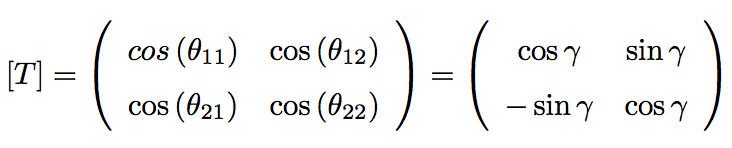
So this matrix can be derived from some simple trigonometric identities, specifically
$$ cos( \frac {\pi}{2} + \gamma) = -sin(\gamma) $$ and $$ cos(\frac {\pi}{2} - \gamma) = sin(\gamma) $$
So my question is perhaps more related to these identities than the matrix. Nonetheless, why are the entries in the 2nd column of the transformation matrix equivalent to the derivative of the entries in the 1st column? Is there some intuitive explanation, perhaps related to the trig identities? Regardless of how simple or complex the reasoning may be, I would appreciate some insight just for the sake of my curiosity. Thanks.
So consider the transformation of an arbitrary vector, v, in ℝ2 from one frame f = {x1 , x2} to a primed frame
f' = {x'1 , x'2} which is related to the non-primed frame by a rotation of angle γ.
The transformation matrix will look like this:
So this matrix can be derived from some simple trigonometric identities, specifically
$$ cos( \frac {\pi}{2} + \gamma) = -sin(\gamma) $$ and $$ cos(\frac {\pi}{2} - \gamma) = sin(\gamma) $$
So my question is perhaps more related to these identities than the matrix. Nonetheless, why are the entries in the 2nd column of the transformation matrix equivalent to the derivative of the entries in the 1st column? Is there some intuitive explanation, perhaps related to the trig identities? Regardless of how simple or complex the reasoning may be, I would appreciate some insight just for the sake of my curiosity. Thanks.